
All the animals are old and have become useless to their masters. But together they form a band. A synergistic effect of the group defeats the gang of robbers. Bremen Town Musicians found a safe haven without ever reaching their initial goal.
10 Lessons from Bremen Town Musicians
Bremen Town Musicians by Jakob and Wilhelm Grimm is a fairy tale with numerous precious lessons to learn.
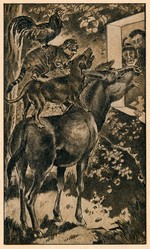
Town Musicians of Bremen, written by the Grimm Brothers is a story about four animals who are facing certain death. They became too old. Instead of waiting for their sad death, they decide to go to Bremen, a town of opportunities. They want to become town musicians. On their way, they have to spend the night in the woods where they find a hut with the robbers. The animals scare the gang out of the hut and choose places to sleep.
A few hours later one of the robbers returns to the hut which should be still loaded with their loot. When he tries to light the fire in the heath, the cat attacks, who rests in the ashes, attacks him. The robber withdraws but at the door, the dog bites him and in the yard, the donkey kicks him. Before he escapes, the cock scares him with his crow as well.
This lively story bears a surprising number of positive messages and lessons to learn. I intend to present them to convince you to read it to your kids so they learn a few things about life and society. With more of such stories, our world would be at least a bit better place. Here are ten important lessons from The Bremen Town Musicians.
1 Power of Cooperation
2 Importance of Persistence
When you face troubles it's very easy to give up. Each of the animals is facing the same harsh truth. They are just too old for the expectations of the society. Yet they find a new purpose. They can still play and sing! They can still be of some use although their initial skills are vanishing. They persist and persistance is one of the main keys to success.
3 Stay Optimistic
The power of positive thinking is not just a phrase. It really works and animals in the fairy tale about Town Musicians of Bremen are the perfect example of such an approach. When one door closes, the other door opens. Maybe even more than one door. Or at least a window!
4 Focus on the Future
The animals learn that their past usefulness doesn't translate into the present. When they lose their powers the masters simply decide to get rid of them. The donkey is only good for the glue factory. The dog is about to be shot and the cat is to be drowned. The cock suddenly becomes a part of tomorrow's menu.
But they can overcome the feeling of injustice and focus on the future. None of them has ever been in Bremen yet they believe they might find a better life. They believe in second chances and they eventually got one.
5 Be Compassionate
The power of the Bremen Town Musicians lies in their ability to work together. This would not be possible without understanding each other's situation. By knowing what other members of the band feel, they befriend each other even without ever seeing each other before. They create a strong entity that can defeat the gang of robbers.
Compassion is not exactly at the top of the values in the modern world but it should be. If we try to single out just one characteristic by which the animals and humans in the story are better it's compassion. Compassion makes us human.
6 Differences Can Allways Add Value
Each individual is unique but the real strength of humans is in the ability to build societies. Smaller or larger groups of people were able to survive in prehistory with a very limited set of tools, having weak and vulnerable bodies yet knowing how to use the positive traits of every member of the group.
Town Musicians of Bremen are the same. They form a strange pyramid to scare the robbers out of the hut and then each of them participates with its unique abilities to prevent them from coming back. Instead of hating each other for being different, they can use their difference to create something new and special - a group with more human traits that any human in the story is able to show.
7 Age Can Be Used as an Advantage
Old age brings numerous problems. The donkey is losing power. The dog is too slow for hunting. The cat's teeth are just not sharp enough anymore. The cock seems useful just for the soup. Yet they still have numerous skills and experiences. Their society just doesn't want to give them another chance.
So they take their destinies into their own hands (or paws or whatever). If you can't do your job from yesterday you still can do something useful. You can still tell stories, sing songs, or play in the band of Bremen Town Musicians.
8 Respect Others
This story is about respect as well. Just because you are old you should not be pushed out of society. No matter your age, your gender, or your look you are still a being with valuable characteristics. The masters of animals don't respect them anymore because they can't give them what they did before.
Fortunately, animals respect each other and form a winning combination for a better life. Most important of all, each one of them respects itself.
9 Use Threats As a Motivational Factor
Bremen Town Musicians is a short fairy tale where we still have the opportunity to get an impression of each of the members. Every one of them is content with its position in society. When this position becomes endangered, they don't give up.
Instead, they are willing to explore the unknown. They join forces and part to Bremen.
10 Every Change Should be Perceived as an Opportunity
This lesson is related to the previous one. It's more about the attitude. The world is constantly changing and we are changing with it. Our adaptability to changes is one of our major powers. Yet nobody likes changes. Especially when we become older.
Every single change in our routines can be seen as an unnecessary obstacle. Why buy a smartphone if the old mobile still works perfectly well? And why bother with mobiles if we managed to survive without them for so many millenniums and created so many splendid things?
On the other hand in every society, a certain number of individuals devoted their lives to changes. They were inventors, revolutionaries, leaders. They were not always successful. In fact, most of them were not successful. Yet they tried. And eventually, it was them who led us to the point we are now.
Like it or not. The title characters in Town Musicians of Bremen were facing changes and they were not pleasant ones. Their lives were ending. But they saw the opportunity for a change. To try something new, explore the opportunities, and make new friendships.
This is another lesson we should not forget.
What's your favorite lesson from Bremen Town Musicians?
DerdriuMarrinerJan 16, 2024
It's helpful to know of Jack Zipes as particularly, uniquely useful because of his translating the 1812, first, original edition.
Also, it's most informative regarding threat as a motivational factor. Threat initially somewhat seemed rather drastic because of my interpreting it as something used by one musician wannabe against the other three and vice versa.
Now I understand that threat serves as something in all places, throughout all times, to unify, to unite peoples whose biogeography, culture, family and friends suffers from impairment if not annihilation.
What greater threat than that final massacre of death ;-{ ?
TolovajJan 13, 2024
TolovajJan 13, 2024
TolovajJan 13, 2024
TolovajJan 13, 2024
TolovajJan 13, 2024
TolovajJan 13, 2024
TolovajJan 13, 2024
DerdriuMarrinerJan 13, 2024
As I mentioned previously, I wonder about rewards instead of threats.
But what kind of threats would be used in a tight-knit group?
DerdriuMarrinerJan 13, 2024
Might there be any symbolism concerning cats, dogs, donkeys and roosters that necessitate these particular sentients being selected for this fairy tale?
DerdriuMarrinerJan 13, 2024
Adaptability, age, compassion, cooperation, diversity, optimism, persistence, prescience and respect singly and together assure us, as in your introductory paragraph, of our world as a "bit better place."
The one attribute that I perhaps can consider restating is threats as motivational factor.
What would you think of rephrasing into reward as motivational factor?
DerdriuMarrinerJan 12, 2024
That text describes the cat as an unspecified "town musician"; the dog as an aspiring drummer; the donkey as an aspiring lute player; and the rooster as an aspiring singer/vocalist.
And yet no images have their four wannabe musicians with musical instruments apart the two split images by Oskar Herrfurth. The latter introduces us to a cat with a wind instrument such as a clarinet or flute, the dog with a brass instrument such as the horn and the donkey with a brass instrument such as a trumpet.
The first image by Frederik Richardson makes a sentient pyramid -- without instruments -- of the rooster atop the cat atop the dog atop the donkey. It makes me think of a modern retelling by Ilse Plume, who offers the wannabe musicians as organizing a singing, barking, braying, vocalizing group!
Wouldn't the D.L. Ashliman version be an accurate, close, exact translation of the original Grimm Brothers tale?
DerdriuMarrinerJan 12, 2024
My one regret remains no accompanying in-text illustrations.
The in-text images of your wizzley show the rooster as dark-tailed, dark wing-tipped golden, with or without a white body, according to Frederik Richardson and red according to Oskar Herrfurth.
The singer/vocalist rooster reminds me of a russet rooster that companionably, safely stayed on the front porch with my feline sentients and with their orphaned-opossum companion.
What color would you imagine the vocalizing rooster to be?
DerdriuMarrinerJan 12, 2024
In-text images in your wizzley display the dog as brown according to Paula Ebner and Oskar Herrfurth and golden according to Frederik Richardson.
The D.L. Ashliman version gives no description of the drummer dog and in fact has no illustrations.
Perhaps I imagine the aspiring drummer as a black Labrador retriever like Clinker or a golden retriever like Shiloh.
What color might you opt for?
A golden canine sentient and a golden feline sentient would be so photogenic!
DerdriuMarrinerJan 12, 2024
Your wizzley displays in-text images of the cat black according to Paula Ebner, gray according to Oskar Herrfurth and white according to Frederik Richardson.
Perhaps I imagine the feline sentient as black or black-patched white or brindled or ginger.
What color might you imagine?
DerdriuMarrinerJan 11, 2024
The D.L. Ashliman and the Rackham-illustrated Bremen Town versions call the dog, the donkey and the rooster each "he" even as they call the cat by no gendered adjective.
The Grimly-illustrated Tales from the Brothers Grimm version describes the cat with the adjective "his" even as the Ilse Plume The Bremen-Town Musicians and the Anna Milbourne/Heather Amery/Gilliam Doherty The musicians of Bremen retellings designate the cat as "she."
Is there an indication anywhere as to what the Grimm Brothers judged the feline gender to be?
DerdriuMarrinerJan 11, 2024
The Arthur Rackham-illustrated Peter Glassman-afterworded Grimm's Fairy Tales, -- like the D.L. Ashliman-compiled, translated, classified Grimm Brothers' Children's and Household Tales and the Gris Grimly-illustrated Tales from the Brothers Grimm -- respectively conclude that "And he who last told the story has hardly finished speaking yet"; "And he who last told the story has hardly finished speaking yet"; and "And the mouth of him who last told this story is still warm."
That phrase does not occur in the modern retellings The Bremen-Town Musicians by Ilse Plume and The musicians of Bremen by Anna Milbourne, Heather Amery and Gillian Doherty.
What is the meaning and the reason for that statement? Might "hardly finished speaking" and a mouth "still warm" be there to add authenticity to the fairy tale?
DerdriuMarrinerJan 11, 2024
There's a Grimm Brothers version in the fantasy section of the library here.
This week I will look at the online versions mentioned below and at the public-library version here.
TolovajJan 10, 2024
TolovajJan 10, 2024
DerdriuMarrinerJan 10, 2024
The library system here has fairy-tale versions by Jessica Gunderson, Margaret Hillert, Sue Kassirer, Anna Milbourne, Doris Orgel, Ilse Plume, Judy Sierra and Shaun Tan.
Might you be familiar with these versions?
DerdriuMarrinerJan 10, 2024
In particular, I like your descriptions that "A few hours later one of the robbers returns to the hut which should be still loaded with their loot. When he tries to light the fire in the heath, the cat attacks, who rests in the ashes, attacks him. The robber withdraws but at the door, the dog bites him and in the yard, the donkey kicks him. Before he escapes, the cock scares him with his crow as well."
Might the Bremen Town Musicians ever have been performed as a play or produced as a film?