 I'll admit that is the question which always makes me recoil deep inside. I will keep calm, because no argument is ever won by screaming with incandescent rage, but I'm sick to the stomach.
Maybe it's that I've made too much of a snap judgement, but all I hear is this: 'the value of a human life should be messaged not in justice, rights and all that twaddle, but in dollars.'
I do not share that opinion; and fortunately I also have the facts on my side. It can be cheap to kill someone, nobody is disputing that. If the individual is sentenced, then immediately taken outside and strung from the nearest tree, then it's very cheap indeed. At least in monetary cost.
The price in the loss of morality and justice was quite astronomical.
Worse case scenario would place a minor in life imprisonment, wherein he or she stays until they are in extreme old age. During this time, that individual would be sharing a cell, eating food brought and prepared in bulk. They would also be working, bringing in a wage which goes directly back into the prison system. (There's an argument that this is slavery through the back door, but few people really care about that one.)
On the other hand, the individual on Death Row is incurring many, many more costs. These include:
- Extra lawyers, judges, juries and the whole apparatus of the court-room. After all, these sentences usually go to appeal, time and time again, as a stay of execution is sought.
- Cost of hiring and attendant expenses for bringing in the right lawyers. In American law, there are strict requirements governing the experience and qualifications of lawyers in capital cases. The requisite attorney might not be locally available.
- The cost of retaining all court-room staff during lengthy appellate pauses. This usually occurs while everyone is waiting for the legally sanctioned lawyer to become free.
- Scientific and laboratory results. Those representing inmates on Death Row are far more likely to order DNA testing than, for example, blood sample tests. If the result is uncertain, then this can be repeated. Such professional input is very expensive.
- Paperwork and administrative costs. All of this evidence needs to be typed up, clarified and securely stored.
- Extra prison staff. People on Death Row are held in individual cells, with guards hand delivering everything from food to toilet paper. That requires a lot more staff than guarding people serving life imprisonment.
- Execution apparatus. Even once the inmate gets there, then the mode of killing them has to be paid for. These are huge costs, particularly now that countries like Britain have banned the export of drugs to be used in lethal injections. Those with the electric chair aren't faring much better. They have to pay a wage to electricians for a start; while everyone needs to pay doctor's fees, and coroner fees, and lawyer fees, and clerical fees (in both senses of the word), and security fees (there are going to be protesters outside) etc etc etc.
The US State of New Jersey stopped executing people in 1963, because each death sentence cost the tax-payer around $4.2 million ($6,129,405.55 in today's money). A former Californian judge Donald McCartin, who never stinted on sentencing people to death, ultimately called it, 'a waste of time and money'. He noted that it was ten times more expensive to impose the Death Penalty, than to go for life imprisonment.
In short, it costs an estimated $90,000 per inmate to house them on Death Row.



 Like many children, I was fascinated by the kind of gruesome and unwholesome things that my mother would rather I didn't know about at all. This included dinosaurs, ghosts, murders, zombies, vampires, judicial punishment, werewolves, slavery and Big Foot.


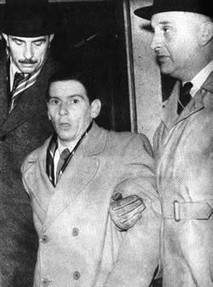 Through my early reading of serial killers and all that was dark and dangerous, I encountered the story of Timothy Evans.




 St Tydecho's Churches in West Waleson 09/03/2014
 Goodies for an Outlander Premiere Partyon 03/06/2015
 Holocaust Memorial Day Interview with Rainer Höss, Grandson of Rudolf Architect of Auschwitzon 01/24/2015
 Romantic Valentine Gifts for an Outlander Fanon 01/16/2015


Comments
They would even get a pay cheque and commendations for it.
I think you know my answer to the Aristotle question. :)
What you have said, Jo, about execution being a cover for a serial killer is so blindingly obvious that no one has ever said it. It is terrifying that serial killers could be promoted by the state. Aristotle believed that the state should encourage virtue. Does employing an executioner encourage virtue?
Executioners don't choose to do it. Not any more. We're well past the days of public hangmen. What happens (in the US) is that prison wardens are asked to inject the condemned. Prison wardens are not trained medical staff, but doctors can't do it. They took an oath to 'first do no harm'.
I always thought it a little suspect that people would want to do that anyway. It would be the perfect cover for a serial killer.
Killing anyone cannot be easy, but I think killing in war is different. My grandfather was also in the war. He was a pilot so he didn't actually know how many people he killed. But it still bothered him because he was killing people who, like him were fighting for there country. However like soldiers executioners make the world safer. Maybe that is why they choose to do it
The expression "crime of passion" implies that he felt a strong passion (love, anger, jealousy) caused him to commit the crime. Ferguson's victim meant NOTHING to him. Some experts believe that a person can be fully aware of what they are doing even if he doesn't remember it later. Either way, he chose to drink and his young victim paid for HIS decision with her life. He should pay with his. No, it won't bring his victim back, but maybe it can give her family some peace.
Me too! Me too!
Thanks for this information, Jo. It confrms my own feelings that I would never want to kill anyone, however horrid or guilty they were.
Tara - We're all good. Though it does seem slightly obscene for us to be picking over that poor girl's murder like this. Mind you, it matters within the context of the debate, so let's go there.
To me, cold-blooded means sober, in full control of your faculties, able to make a considered judgement within the knowledge of what's right and wrong, then doing it anyway. Premeditating a murder generally fits into this category.
It's all opposed to 'crimes of passion' (heat of the moment); impaired judgement; not knowing, nor able to know, the difference between right and wrong; diminished responsibility; an accident; or/and under the influence of drugs, alcohol or a dominant personality.
I'm not claiming that Jeffrey Ferguson was innocent, nor that his actions should go unpunished, but the man killed was not the same man who committed that murder. One had a brain pickled by alcohol and the other hadn't.
What if, in killing 50 Jeffrey Fergusons and Charles Mansons, you also kill a Timothy Evans? Then it's the law and the system that killed the innocent person. There's way too much room for error in capital punishment for my liking.
Frank - I've read many accounts of people going into therapy after acting as the executioner. In most cases, there is a 'dummy' fitted into the method, so that a team of executioners don't know for certain which of them was the killer. It's still traumatic though.
Do we wonder about the impact of the execution on the executioner? I know that this is not the same situation, but my grandfather, who killed a German soldier in the war [in combat] never got over the trauma of killing someone and used to have nightmares about the event. This was a killing in the hot blood of battle, but what is the impact of cold blooded, premeditated killing in an execution? Do you have to harden your heart and desensitize yourself just to cope with what you have done? Must you desensitize yourself before you execute? How do you cope with having killed someone?
I'm sorry too, I must have missed your message in my inbox.
Jeffrey ferguson kidnapped, raped and murdered a 17 year old girl (the article I read said 17). I'm sure she screamed and begged for her life as she was being tortured. Drunk or not the murderer knew the girl was suffering he knew her family would suffer. But his pleasure was more important than all of this. I call that cold-blooded. We can't just pardon everyone who claims to have found Jesus.
The number of people killed by convicted killers may not be high. Incarceration is good but it leaves room for error. The murders that I mentioned are proof of this. The law is to protect the innocent from the guilty. I think the law has a responsibility to protect the innocent over the guilty even if this means killing 50 jeffrey fergusons or Charles mansons to protect 1 innocent person.
Sorry Tara, I've been away for a week, hence the silence this end. I should have mentioned that I was going, but I didn't anticipate being away for so long!
Missouri's just killed a clean living, religious man. Ok, Jeffrey Ferguson was an alcoholic at the time he horribly murdered a 13 year old girl, but that's hardly cold-blooded. He was off his face.
You raise a good point with the murder of prison guards. But I maintain that you're over-stating the situation somewhat. If every Death Row prisoner habitually killed his or her guards, then there would be no-one left working in those wings. Plus what about those serving life imprisonment in states without the death penalty, who never do murder others? Like, for example, Charles Manson.
With the death penalty, there is a guaranteed kill taking place. Without it, we're still talking in potentialities always. It's a terrible thing what happened with that family and Randy Greenaway, but that's still an exception rather than the rule. I hope that lessons about security systems were learned, so that there's no chance for it to repeat in the same way.