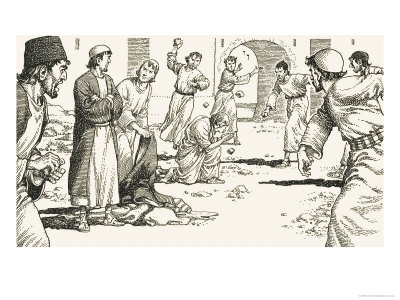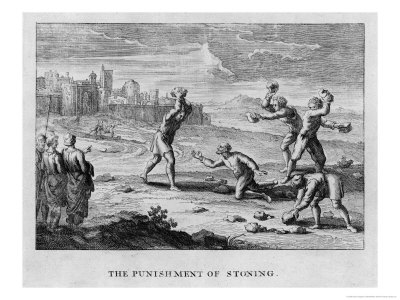
Applications of the Death Penalty: Stoning

by JoHarrington

Examining the religiously motivated and gruesome use of stoning as a method of execution. Not an article for the faint-hearted.

Stoning to death appears in the holy texts of Judaism, Christianity and, controversially, Islam.

This makes it one of the most enduring methods of enacting capital punishment. Each time it's used, it's religiously sanctioned. God made them do it. Allah made them do it. Yahweh made them do it.

Anti-stoning proponents therefore have to reach into the Bible, Koran and Torah to find arguments against its use. The most effective activists are those able to say, 'Do not do this in the name of MY deity.'

As the rest can be dismissed as heathens.

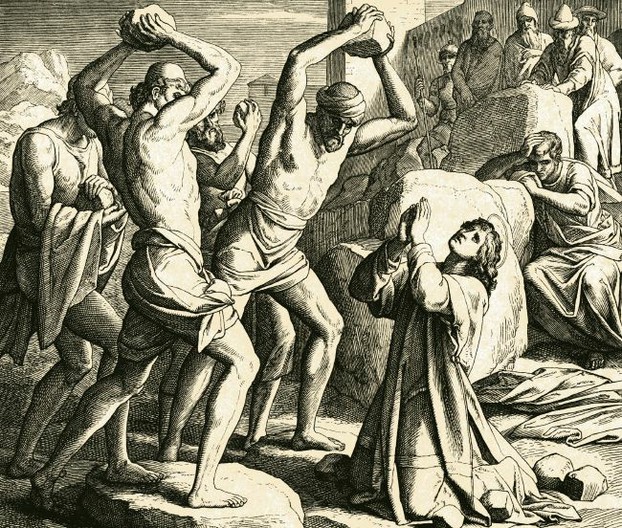
The Stoning of St Stephen

After nearly being eradicated from the world, stoning is in the midst of a resurgence. As late as 2009, it was introduced onto the statute books of Indonesia, where previously it had not been.

It is currently in use, as a method of pursuing the death penalty, in Afghanistan, Indonesia, Iraq, Iran, Nigeria, Saudi Arabia, Sudan and Somalia. It has also illegally been used by mobs or individuals in Mexico, Kurdistan, Pakistan, the United Arab Emirates and the USA.

Stoning of Stephen by Rembrandt

The History and Use of Stoning

Its use in capital punishment is as old as recorded history. There are very specific rules attached to its application.

There are two ways in which the condemned may be stoned to death.

The first is to be surrounded or to stand up against a wall. The victim is then pummeled with stones until they die.

The second, and most common mode, is for the person to be partially buried. A hole is dug especially in the ground for this purpose. This renders it much more difficult for the individual to raise their hands to ward away the stones.

Tradition states that anyone who is able to escape the pit will be allowed to live.  It's been observed that this is very difficult for men, who are buried up to their waists. It's practically impossible for women, who are interred to their necks.

Moreover, this custom is not always observed. On August 10th 1994, in Arak, Iran, a badly injured lady managed to free herself from the stoning pit. Both of her eyes had been knocked out, but she simply fled in any direction. Guards raced after her and shot her in the back.

Historically, condemned people were tightly wrapped in a shroud, secured into place with binds, before being slotted into the pit. Those individuals would have found it utterly impossible to escape. This method has been seen in Iran as recently as 1994. (If you wish to actually watch this happen, there's a video here. The stoning of two women occurs about 6 minutes in.)

Also in Iran, the penal law governs the size of the stones. Article 104 states: 'Stones used in stoning should neither be so big as to kill the adulterous at the first or second blow, nor as small as a pebble.'

Authors Mark Jones and Peter Johnstone, in their History of Criminal Justice, discussed the religious origins of stoning as a mode of capital punishment.

'After the establishment of the Davidic monarchy (circa 1000 BC(E))... difficult cases... were taken to the priests and judges at Jerusalem... once (they) ascertained guilt, sentencing and execution followed immediately. They usually inflicted death penalties by stoning, with the community casting stones at the convict until death occurred.' (pg 26)

Religious scholars would add that this was not a new phenomenon. According to both the Bible and the Torah, stoning had already been well established by the time of Moses. The verses of Leviticus outline a long list of crimes for which transgressors could be stoned to death.

Buy History of Criminal Justice 5th Edition

Chapter 2 provides the evidence for stoning during Biblical times.
History of Criminal Justice, Fifth Edition
 

Sekila (Stoning) in Judaism

This is the religion where it all began.

The oral tradition of Judaism, as written into the Mishnah in around 220 CE, makes it clear that stoning was losing popularity long before 70 CE.

Even when Sekila had been carried out, in previous centuries, it had been lessened in impact. The condemned was drugged into insensibility, then pushed off a two storey building first. If they weren't dead, only then were large rocks smashed onto their bodies. They were more likely to be crushed to death than stoned in the traditional manner.

The tractate Makkot, which focuses upon Judaic law, called all capital punishment 'destructive'. Chapter 1.10 states, 'Had we been in the Sanhedrin none would ever have been put to death', and historically this appears to have been the case in practice too.

While stoning remained on Jewish statute books, as the primary mode of execution, it was not actually applied in sentencing. By the 12th century, religious scholar Moses ben-Maimon was able to write with a clear conscience, "It is better and more satisfactory to acquit a thousand guilty persons than to put a single innocent one to death."

Crimes Punishable by Stoning in the Mishnah

This was rarely carried out in practice.
  • Intercourse between a man and his mother.
  • Intercourse between a man and his father's wife (not necessarily his mother).
  • Intercourse between a man and his daughter in law.
  • Intercourse with another man's wife from the first stage of marriage.
  • Intercourse between two men.
  • Bestiality.
  • Cursing the name of God in God's name.
  • Idol Worship.
  • Giving one's progeny to Molech. (child sacrifice)
  • Necromantic Sorcery.
  • Pythonic Sorcery.
  • Attempting to convince another to worship idols.
  • Instigating a community to worship idols.
  • Witchcraft.
  • Violating the Sabbath.
  • Cursing one's own parent.
  • A stubborn and rebellious son.

Buy Books and DVDs about Stoning

Find out why, from antiquity to the modern day, stoning has been such a popular form of capital punishment.
Cruel and Usual Punishment: The Terrifying Global Implications of Islamic Law

Cruel and Usual Punishment is a wake up call to the Western world. Nonie Darwish presents an insider's look at Sharia and examines how radical Muslim laws are destroying the Wes...

View on Amazon

Perfect Martyr: The Stoning of Stephen and the Construction of Christian Identity

Recent studies have examined martyrdom as a means of constructing Christian identity, but until now none has focused on Stephen, the first Christian martyr. For the author of Lu...

View on Amazon

ABC News Nightline Stoning a Woman to Death

A woman bears a child out of wedlock. And according to local law, she is sentenced to death by stoning. Are we talking about modern times? Yes. Amina Lawal is a 32-year-old Nige...

View on Amazon

Stoning in Christianity - Jesus Christ on the Mount of Olives

"He that is without sin among you, let him first cast a stone at her." King James Bible, John 8:7

Stoning is undoubtedly sanctioned by Biblical lore. The Old Testament covers the same ground as the Jewish Torah, so all of the offenses listed there also apply in Christianity.

However, Christian nations have been reluctant to follow through by adding this method of the death penalty onto their statute books. The reason lies in a curious entrapment story recounted in the Gospel of St John.

Chapter 8 tells how Jesus Christ was teaching in a temple, on the Mount of Olives, when he was visited by a group of Jewish Pharisees and scribes. In Mosaic Law, only they had the legal right to condemn a person to death, but nevertheless they asked Christ for his opinion.

The rabbis had brought with them a woman found guilty of adultery. Everyone present knew that the religious, and lawful, penalty for this was death by stoning. However, as already established in the section on Judaism, this had fallen out of favor with the populace.

There was a dilemma here. As a devout man, Christ should have been demanding that the Old Testament Laws be obeyed. This was precisely what he had been preaching. We know from the Gospel of St Matthew that Christ had been accusing the Pharisees of not upholding Mosaic Law.  "Think not that I am come to destroy the law, or the prophets: I am not come to destroy, but to fulfil." Matthew 5:17

But Christ was not a Pharisee himself. If he sentenced the woman to death, as the law dictated, then he immediately broke a second tenet of Mosaic Law. He didn't have the right to say it himself. Moreover, the stoning would not only go against public sympathy, but would condemn himself. It would give the Pharisees a legal reason to either execute Christ or hand him over to the Roman authorities.

Christ then pulled off a nifty turn of phrase. He neither saved her nor ordered the woman's stoning. He said, 'Let he who is without sin cast the first stone.'  In the silence, no-one did a thing. One by one the Pharisees stepped back, unwilling to place themselves in such a politically sensitive position either.

Finally the woman stood alone in front of Christ. As there was no longer anyone to accuse her of the crime, then it was case dismissed. She walked free.

However it seemed that the Pharisees did not appreciate this sleight of hand. They had arrived with rocks ready for a stoning (however cosmetic that may have originally been).  In the mounting tension, they appeared ready to start stoning Christ himself. He quickly hid in the side passageways of the temple, then secretly slipped away.

Jesus Christ did not condemn stoning. Indeed, his teachings in Matthew 5 appear to make it clear that he was attempting to reverse public opinion on the issue. As Jews became squeamish about the death penalty, Christ urged a return to the laws which demanded it.

But it appears that stoning has not been embraced as a method of judicial execution for the same reason as crucifixion.  It was nearly used to kill Christ and that, in the Christian mind, renders it practically sanctified. Anyone dying in this way could automatically be linked with the Messiah himself and that would never do for criminals.

However, not every Christian has interpreted it in that way.

Murray Seidman: A Gay Man Stoned to Death by a Christian in Philadelphia, USA

John Joe Thomas's defense was that the Book of Leviticus, in the Bible, was clear on how to deal with homosexuals.

A Christian Stoning in Modern Day America

Murray Seidman was executed in a Biblical fashion, because he was alleged to be gay.

On January 12th 2011, police were called to an apartment building in Lansdowne, Pennsylvania, USA.

They found 28 year old John Joe Thomas sobbing in the hallway, telling them wildly, "I'm not going down there again, there is too much blood!"

Indeed there was. It was splattered all over the walls and furniture; and it belonged to the 70 year old man lying face down on the floor. Murray Seidman had been stoned to death in his own living room.

During questioning, John made a startling confession. He had deliberately executed the old man, according to the tenets of the Book of Leviticus. John alleged that he had consulted his Bible and prayed, after Murray had made sexual advances to him.

'If a man also lie with mankind, as he lieth with a woman, both of them have committed an abomination: they shall surely be put to death; their blood shall be upon them,' read Leviticus 20:13. It was in direct contradiction to 18:22/29, which merely recommended exile for the same.

Maybe John didn't think that he could force Murray to leave the community, so he took the former option.

John went outside and picked up a sizable rock, which was then placed into a sock. This was used to batter Murray ten times, until the old man lay dead. John is currently in prison awaiting trial for homicide.

This isn't the only example of illicit stoning in the Americas, though there's no evidence that the other three were religiously motivated. They are included here solely because they took place in Christian countries.

  • In 1979, in Indiana, USA, three schoolboys stoned to death an Amish baby. The boys had been throwing rocks at a family riding past in a horse and trap, when an errant missile hit the infant. The boys received suspended jail sentences of between 3-5 years and were each fined between $2,000 to $5,000.
  • In 2009, in Juárez, Mexico, Solangie Medina was stoned to death by three men, when she intercepted them trying to steal her car. Her murderers were each sentenced to 39 years in prison.
  • In 2010, in Tancítaro, Mexico, Mayor Gustavo Santoro and an unnamed assistant were discovered stoned to death in their office. I've been unable to find out more on this story.

Books about Christianity and Homosexuality

Buy these Biblical studies to determine whether John Joe Thomas was religiously justified in stoning Murray Seidman to death.

Should Christianity be used to justify stoning, when the Bible advocates it for certain transgressions?

   Login
No, because...
Usewisdom on 08/23/2012

We are in the "Age of Grace" under the convanent of forgiveness of sin through Christ's sacrifice on the cross. "The Age of the Law" is before Christ and this is when stoning was instituted for the death penalty for sin. Western Civilization is established upon "The age of Grace" eradicating a lot of barbaric customs.

nickupton on 05/04/2012

I read in Charlie and the Chocolate Factory that being sucked up a chocolate tube was an apt punishment for certain transgressions. I would be inclined to pay more attention to this book than the Bible.

WiseFool on 04/13/2012

It's a millennia old text written by men with very archaic and barbaric views. I realise this argument will have me dismissed as a heathen, but there we are.

The Stoning of Soraya M DVDs and Books

This film is a dramatization of a true story, as told in the book of the same name, about the stoning of an Iranian woman.

Rajm (Stoning) in Islam

There is a problem with the Muslim justification for Rajm. It's not mentioned in the Koran.

Stoning is undeniably a Judeo-Christian form of capital punishment, which is what makes its appearance in the Muslim world all the more startling.

Where it does turn up in early Islamic thought, it's with reference to the Bible rather than the Koran.

Then, in the 7th century CE, a series of works began to be created entitled hadith. Finally stoning received a mention, but only in three of the hadith and open to fierce debate amongst Islamic scholars. These works were meant to complement and interpret the Koran, but never, ever replace it.  If any tenet proved contradictory, then that given in the Koran took precedence.

So when those three hadith advocated stoning for adultery and other sexual transgressions, then it was largely ignored. After all, the Koran had already covered that ground and laid out the due punishment. The penalty should be a prescribed number of lashes, depending upon the status and circumstances of the individuals involved.

Thus it was so for the next thirteen centuries, until the very end of the 20th. Over the past decade, the most publicized cases of legal stoning have come from Islamic nations.

This is mirrored in the fact that only those countries suddenly have lapidation (as stoning is Anglicized) or Rajm (in Arabic) on the statute books, as a method for carrying out the death penalty. But this is a very recent phenomena.

The 1986 execution of Soraya Manutchehri, in Iran, was viewed very much as an anomaly, as Rajm had only been added to the Islamic penal code three years previously. Even then, sentences which were handed out tended to become transmuted into hangings with just one or two confirmed exceptions.

Nothing else much really happened until the beginning of the 21st century. Then it all kicked off.

  • In 2000, Nigeria added stoning to its statute books for adultery and homosexuality.
  • In 2002, Iran placed a moratorium on stoning, transferring all death penalties to hanging instead.
  • In 2006, Iranian judges broke the moratorium to sentence two men to stoning for adultery, though it is uncertain whether this was carried out. In a separate case, a woman was also condemned to lapidation. She is still alive at the time of writing in 2012.
  • In 2007, an extra-judicial stoning was carried out in Iraq. A man was also stoned in Iran for adultery.
  • In 2008, a female was stoned in Somalia under a charge of adultery.
  • In 2009, Indonesia introduced stoning for adultery onto its statute books, but only for those who were already married. Iran stoned a man to death for murder, but also declared its intention to remove lapidation as a means of enacting the death penalty. Meanwhile a man was stoned in Somalia for adultery.
  • In 2010, a couple were stoned by the Taliban in Afghanistan, again under a charge of adultery. A man was executed by the same method in Somalia, but this time for rape.
  • In 2012, Iran finally declared lapidation to be illegal and banned its use in sentencing.

Throughout this time, there were unverified reports of individuals being stoned in Saudi Arabia and Sudan. Nigerian judges have sentenced hundreds of people to death by lapidation, but none of them have actually been executed.

Hadith apparently overtook the Koran as the Islamic holy books of choice for some law-makers.

Books about Shari'ah Law (Islamic Law)

Buy these studies to understand the teachings of the Koran and Hadith, as interpreted into the modern legal system.

The Taliban Stone an Adulterous Couple to Death in Afghanistan

In August 2010, the death penalty was carried out upon Siddqa and Khyyram, a couple who had attempted to elope together.

Siddqa had already been promised to another man. The arranged marriage had not yet taken place, but the betrothal had netted $9,000 for her father. She did not want to be engaged to her future husband, because she was already in love with another man.

Unfortunately, Khyyam was already married with two children. The couple could never be together in any conventional way. So they eloped to Pakistan and set up a home there, far away from family and friends.

Homesickness must have overtaken common sense and regard for the law, because Siddqa and Khyyam really did want to come home. Messages flew back and forth. Eventually they received the assurances that they needed.

If they returned to Dashte Archi, their district in Kunduz, Afghanistan, then they would be allowed to exist as man and wife. The Taliban elders promised it and their words were backed up by the Mullahs.

It was a trap. In a two am raid on their home, Siddqa and Khyyam were seized and taken out onto waste ground for sentencing. They were both found guilty of adultery and stoned where they stood.

Remarkably, Siddqa didn't die after two minutes of barrage, during which she tried desperately to crawl out of her hole. At one point, a large rock collided with her head and her burka became drenched with blood. She collapsed back into the pit, obviously unconscious. Siddqa was finally dispatched with two bullets to the head.

Then it was Khyyam's turn. He wasn't buried, but blindfolded with his own tunic. His arms were pinioned behind his back.

As his sentence was read out, he crouched down into a fetal shape in a futile defense of his own major organs. The first rock sent him sprawling.

For long minutes, he could be heard sobbing, face down on the floor, as stones bounce bloodily off his body. Then he's silent and still.

Zabiullah Mujahid, speaking on behalf of the Taliban, told the Times of Pakistan, “Anyone who knows about Islam knows that stoning is in the Koran, and that it is Islamic law. There are people who call it inhuman – but in doing so they insult the Prophet. They want to bring foreign thinking to this country.”

Books about the Taliban in Afghanistan

Learn more about this strict Islamic group, which adopted stoning in Afghanistan, paving the way for other Muslim countries to follow.
Taliban: Militant Islam, Oil and Fundamentalism in Central Asia, Second Edition

Correspondent Ahmed Rashid brings the shadowy world of the Taliban—the world’s most extreme and radical Islamic organization—into sharp focus in this enormously insightful book....

View on Amazon

Afghanistan: A Cultural and Political History (Princeton Studies in Muslim Politics)

Afghanistan traces the historic struggles and the changing nature of political authority in this volatile region of the world, from the Mughal Empire in the sixteenth century to...

View on Amazon

My Forbidden Face: Growing Up Under the Taliban: A Young Woman's Story

Born into a middle-class Afghan family in Kabul in 1980, Latifa had a conventional childhood. Then, Taliban soldiers seized power in Kabul. And from that moment, Latifa, just si...

View on Amazon

A Controversial Stoning in Somalia

On October 27th, 2008, over a thousand people gathered in a Kismayo football stadium to watch an offender being stoned to death.

Thirteen year old Aisha was walking to her grandmother's house, when she was ambushed by three men. They took it in turns to rape her.

Many capital punishment sentences begin with the fury and outrage of an aggrieved family member. This one was no exception.

As soon as Aisha crawled home after her ordeal, her father was on the telephone. Ibrahim Duhulow demanded justice from the police department. They suggested that he bring his daughter in.

The Duhulow family are devout Muslims, who were new to the port city of Kismayo. They had arrived from the Hagardeer refugee camp in Kenya, just three months previously. This made things difficult, not least because it meant that Ibrahim had totally misjudged what would keep his daughter safe.

The al-Shabab officers listened carefully to the story, then they promptly arrested Aisha. They had not heard a rape report. They had heard a confession. Aisha Ibrahim Duhulow had admitted to intercourse with three men outside of marriage; and that was an offense punishable by stoning.

Early in the morning of October 27th 2008, vehicles with loudspeakers drove slowly around the city. Their announcement stated simply that there would be a stoning in the Kismayo football stadium at 4pm. Over 1000 people answered the call to witness it.

At the appointed time, Aisha was dragged out into their midst. There was a hole dug in the center of the pitch and she knew what was going to happen to her.

Sheik Hayakalah, on behalf of the authorities, had spoken on the local radio station. He told listeners, "The evidence came from her side and she officially confirmed her guilt, while she told us that she is happy with the punishment under Islamic law."

Those watching her being hauled onto the pitch had a different story to tell. Some said that she'd become mentally unstable after being separated from her family, in the aftermath of her triple rape. Others knew nothing about that. They could just see a clearly terrified child begging for her life.

"I'm not going, I'm not going." Aisha cried, referring to the pit dug for her. "Don't kill me! Don't kill me!"
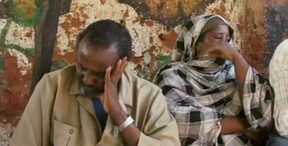
Her parents and brothers were amongst the spectators, helpless to do anything about it. But there were other protesters too.

Everyone there was Muslim, but this did not look like Allah's will. There was a surge of people rushing onto the pitch to save her. But the militia were ready.

Shots were fired into the crowd and there were injuries. An eight-year-old boy was killed. (Sheik Hayakalah later publicly apologized for that and stated that the gunman had been punished.) Order was restored and the execution went on as planned.

Aisha screamed and tried to escape, as four men forced her into the pit. She struggled as she was buried up to her neck. For someone supposedly 'happy with the punishment', she was making a pitiful fuss.

Then fifty men surrounded her armed with hefty stones brought in especially for the death penalty. They pelted her with them, as she fought to free herself.

Finally it was over. A pause. Nurses rushed on to dig the teenager up and check for signs of life. She was still alive!  She was buried again and more stones came. Three times this occurred, until Aisha was eventually declared dead.

Even then, there was apparently a final round of stoning, just in case.

Her family fled Somalia shortly afterwards. Along with a veritable stream of people terrified that this could have happened to their daughter, their child, they made their way back to the refugee camps of Kenya and there they remain.

Was it right for Aisha Ibrahim Duhulow to be stoned to death?

(Please comment at the end of this page with your thoughts.)

Books about Human Rights Abuses in Somalia

Harsh War, Harsh Peace: Abuses by al-Shabaab, the Transitional Federal Government, and AMISOM in ...

This 62-page report finds that al-Shabaab forces have brought greater stability to many areas in southern Somalia, but at a high cost for the local population - especially women...

View on Amazon

Humanitarianism Under Fire: The US and UN Intervention in Somalia

The international humanitarian intervention in Somalia was one of the most challenging operations ever conducted by US and UN military forces. Until Somalia, the UN had never ru...

View on Amazon

Somalia - The Untold Story: The War Through the Eyes of Somali Women

Somalia came to the world's attention in 1992 when television and newspapers began to report on the terrifyingly violent war and the famine that resulted. Half a million Somalis...

View on Amazon

Do you support the use of stoning in executions?

  Display results
Thank you for voting!

More Articles About the Death Penalty

Examining the murky history and gruesome use of death by needle as a method of execution. Not an article for the faint-hearted.
I consider judicial execution to be a 'cruel and unusual punishment', which is contrary to international human rights laws.
Examining the murky history and gruesome use of electrocution as a method of execution. Not an article for the faint-hearted.
Examining the murky history and gruesome use of the firing squad or gunman as a method of execution. Not an article for the faint-hearted.
Examining the murky history and gruesome use of beheading as a method of execution. Not an article for the faint-hearted.
Examining the murky history and gruesome use of hanging as a method of execution. Not an article for the faint-hearted.

Stoning in the News

Independent OnlineMen jailed for stoning sangoma to deathIndependent OnlineDurban - The mother of the sangoma who was stoned to death in Welbedacht by a mob which wron...
Muslims Stoning Christians in Michigan? Not quite… (Updated) - PatheosPatheos (blog)The following is a detailed look at a conflict which took place last year at the Ar...
Independent OnlineSeven held after stoning in KZNIndependent OnlineDurban - Seven men have been arrested after allegedly assaulting and stoning to death two suspected ...
Soldier may face disciplinary action for stoning Karzai portraitStars and StripesKABUL — A U.S. soldier could face disciplinary action for throwing stones at a portrai...

You might also like

Answering Pro Death Penalty Arguments

I consider judicial execution to be a 'cruel and unusual punishment', which i...

One For Ten: Innocent People Freed from Death Row

Documentary film-makers are set to launch an anti-death penalty campaign. The...

Death Row: Waiting to be Killed

Have you ever really imagined what it would be like? You or a loved one give...

JoHarrington, on 04/06/2012
 
Thank you! Would you like to post a comment now?
10

Comments


   Login
JoHarrington on 08/24/2012

Thank you very much for clarifying the Christian position on this. In fact, Genesis is Old Testament, so presumably that should be the position of all Abrahamic religions?

I would love to think that world leaders were reading this article, though I shouldn't think that they'd do so without a bit of help. Please feel free to link it into the e-mails that you send, to protest stoning, to each of the relevant prime ministers and presidents. :D

And thank you very much for your comment.

Usewisdom on 08/23/2012

In the book of Genesis Cain stoned Abel his brother and when God asked Cain where his brother was Cain answered, "Am I my brother's keeper?". God condemned Cain for life for this act. Stoning someone is like a pack of wolves smelling the blood of their victim and going insane for more blood. It is a scary thing to witness the darkness of the human soul. This article is very informative and cuts to the core of how barbaric people can become. The little girl stoned to death because she was raped broke my heart, all of the deaths of these people were barbaric and cruel to the extreme. Thanks for shining a light onto a dark subject, here's hoping more leaders of countries will view this article and change these barbaric laws.

JoHarrington on 05/04/2012

I think that all human beings have a dark side. In most people it's buried beneath many layers of kindness and compassion. In others it's closer to the surface. But we all have it.

Dehumanize the subject, then take away all consequence. Add on a justification of being right or even holy in your action. In those circumstances, I think that way too many of us would see our dark sides come right to the fore.

What makes them act like barbarians? Because they can. Because they're afraid. Because they think they're right. Because someone told them to do so. And I'm not just talking about stoning here, but anything on the spectrum from petty cruelties in everyday life through to genocide on a mass scale.

Most of us demonstrate it daily, not in our actions, but in our inaction. Turning a blind eye to the horrors in this world.

Thank you for your kind words about my research and article. <3 I'd be crap in a documentary. I'm not at all eloquent, when it comes to verbalizing things.

I'm familiar with the Life of Brian scene. I debated including it, but thought that it might not be appropriate. Brilliant film and yes, more well-observed than might be immediately apparent.

nickupton on 05/04/2012

I have seen some diabolical stuff but some of these images and videos are simply awful. I couldn't help but stare at the people doing the stoning. I wonder what makes them behave like utter barbarians?

Most certainly I vote a resounding "NO" to stoning.

Well researched??? I should say so. Have you thought about making a documentary about the subject?

Whilst reading this I couldn't help thinking about the stoning scene In Monty Python's Life of Brian. I don't want to try and be humorous here, it is not the place for it; what shocked me, though, was the realization of how accurate it was in a silly way - only men with beards to be present, rules on the size of rocks to be used and a crowd ready to inflict pain and death on someone for the most ridiculous of reasons. It really does show us what an idiotic thing stoning someone to death is.

JoHarrington on 04/13/2012

Thank you for reading it, WiseFool. When researching and writing these things, I try to keep a cool detachment, otherwise the whole thing would be over-emotional ranting. On this one, I had to pause. It really did upset me. Sometimes with all the iron will that you can muster, you have to back away, in order to come back and do your job later.

There is a worldwide backlash against this. Iran has just taken it out of the Islamic Penal Code, which is a great move. Unfortunately, a see-saw effect took place, with it suddenly becoming prevalent in Iraq.

I agree that it's an horrific form of execution. Thank you for commenting. <3

WiseFool on 04/13/2012

Powerful stuff, Jo. Thanks for writing. There is no question that stoning is a completely barbaric activity that has no place in our world. The fact that, in some countries, it is used so frequently as a 'punishment' for rape victims is utterly horrendous. I simply cannot understand why more isn't done to prevent it from happening. We’re prepared to go to war for oil, but we’re not prepared to step in and prevent these horrific practices?…It beggars belief.

JoHarrington on 04/07/2012

You flatter me, Mladen, thank you.

The argument as to why this is a better form of death penalty for those throwing the stones is one of responsibility. Not one stone kills the victim. It's the amalgamation of them all. So one stone is merely one injury and that, I think, is key to why people are able to throw them.

That said, I agree with your opinion ten-fold.

Mladen on 04/07/2012

You know my opinon about death penalty, well multiply it with one million and you have my comment here. I am not sure I would be able to find words to describe feelings I have toward this disgusting punishment. Looking someone helpless into the eyes and hit him with the stones and even celebrating after that... No comment, really!

On the other hand, your article is great and noble gesture. I don't have to mark it is well written and informative, right? Every article of yours is.

JoHarrington on 04/07/2012

Thank you very much, Sheri. Did I get the Judaic part right?

It took longer to research the fine detail of this article than any that I've ever written before. I knew all about the modern applications and how each case is justified in religious terms, but I wanted to get those religious terms absolutely right.

I don't think I've ever been so deeply immersed in the depths of Judaism, Christianity and Islam in my life!

It's always good to get clarification and confirmation from someone who knows what she's talking about. Thank you. :)

Sheri_Oz on 04/07/2012

What a well-researched article here! Of course, I can only comment on the accuracy of the Jewish part - in fact, in Jewish Law it is very difficult to get a guilty conviction for adultery as three witnesses must have observed the couple in the act itself. Of course, that would also make it difficult to prove rape or incest, but in the case of rape and incest (as opposed to adultery) circumstantial evidence is sufficient. The latter is true for Sharia Moslem Law as well (I interviewed a Sharia judge here in Israel on that issue once).


Disclosure: This page generates income for authors based on affiliate relationships with our partners, including Amazon, Google and others.
Loading ...
Error!