French Dijon Mustard : Ingredients, Flavoured Varieties & Manufacture
French Dijon mustard can be classified as gourmet food. Here you can find Dijon mustard standard and flavoured varieties, and learn about the ingredients and manufacture.
"Roll up, roll up!"
"Buy your French Dijon mustard here"
cries the stall-holder.
But why French Dijon?
And which is the best?
In my view the best French producers are:
Maille, Edmond Fallot, Amora and Grey Poupon.
Below you will find information about Dijon mustard as well as examples of most varieties of this mustard to buy.
The best producers of French Dijon Mustard
Mustard Wiki
Contents
Dijon Mustard Production
Dijon mustard is produced all over the world to varying recipes. However the original, and most likely the best, is produced in France. Being named as it is, one would expect it to come exclusively from Dijon, France.
This, however, is not the case, as it is not protected by the EU (European Union) with either a PDO (Protected Designation of Origin) or a PGI (Protected Geographic Indication). Dijon mustard is not as pungent as English mustard.
Dijon mustard must be carefully stored as, once opened, the fragrance may be lost, due to oxidation with air, which alters the taste and degrades it to an unappetizing brownish colour. Mustard has around 450mg of sodium per 100g.
All Black Mustard preparations irritate the skin and eyes.
Worldwide, mustard is the third most used condiment after salt and pepper.
Distinguishing Features of Dijon Mustard
The defining element that distinguishes true Dijon mustard from other mustards is the ingredient verjuice, which replaces the vinegar element, from which most other mustards are created. Verjuice is the juice of under-ripe grapes (described as green, or unripe, juice), which adds an acidic, piquant note and enhances the pungency of the mustard condiment.
Dijon Mustard Ingredients
Verjuice
The technique of adding verjuice was introduced by Jean Naigeon, who came from Dijon, in the mid 19th century. The plethora of Dijon mustards available to the gourmet, and cook today, vary considerably, as they may be based on ingredients that are deemed suitable by local jurisdictions. One may find them with white and/or red wine verjuice, and even diluted wine vinegar: this producing a Dijon-style mustard instead of being based on the more traditional recipe.
Mustard seed
The most obvious ingredient though is mustard seed. The common name is thought to derive from the French word moustarde, in turn derived from the Latin mustum ( = must, a newly pressed grape-juice) and ardens (= fiery), because the condiment was originally produced by adding must to crushed mustard seeds.
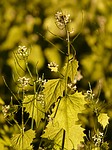
Yellow Dijon uses black mustard (Brassica nigra) seed, the one with the best and most pungent flavour.
This is a hardy annual herb, a member of the cabbage family, from which the globular black seeds are utilised.
Grainy Dijon Mustards
Black mustard probably originated in the Middle East. It is native to Europe and Asia and has become naturalized in America and Britain. It has been cultivated for around 2,000 years, as a medicinal herb and condiment.
Other ingredients include: water, vinegar, salt and proprietary spices (each combination giving unique flavours).
Mustard Cultivation and harvesting
Mustard is grown from seed sown outdoors in spring, and does best in a sunny place and fertile moist soil. Under these conditions black mustard will reach its maximum height. The seedlings should be thinned to 12 to 18 inches (30 to 45 cm) apart, and weeded regularly in the early stages.
Seed is ripe in late summer. It should be monitored carefully in the final week or two, as the seed may be lost easily when fully ripe. It is better to remove the pods before they finish maturing, and allow the seeds to ripen in the pods.
Culinary Uses of Dijon Mustard
As a flavouring in cooking it has a worldwide reputation for enhancing a variety of savoury dishes, such as cold meats and sausages; it is used in sauces and dressings; and with cooked cheese dishes.
The pungency and odour to which black mustard owes much of its value are due to an essential oil developed by the action of myrosin, an enzyme, upon the glucoside sinigrin C10H18KNS2O10.
In the presence of water myrosin acts on sinigrin, splitting it up into the essential oil of mustard, a potassium salt and glucose.
The enzyme is destroyed by boiling water. Essential oil of mustard is an isothiocyanate of allyl, C3H5NCS.
As a condiment, mustard stimulates the salivary, but not the gastric secretions. It increases the peristaltic movements of the stomach.
Medicinal Uses of Black Mustard
Medicinally, the constituents of the mustard seed include glycoside-bonded oil of mustard, a vesicating oil, the enzyme mycosinase, the alkoloid sinapine, mucillage, and protein.
Mustard has been used in smelling salts to relieve congestion, sinus problems and catarrh, as it acts as a decongestant, when allyl isothiocyanates are effective.
Some studies suggest inhibit the growth of cancer cells.
Roland Dijon mustards
These substances give mustard rubefacient (local irritant causing reddening and warming of the skin) and irritant properties. It is used medicinally to improve the blood supply to the skin (soothing of chilblains, for instance), lungs, pleura (covering of the lungs) and kidneys. Plasters and poultices made from black mustard powder ease rheumatic and arthritic pain, muscular spasms, strained muscles and congested lungs. Bath preparations have the same effect. Mustard flour can also be used as an emetic (a substance that causes vomiting), when a tablespoonful is added to luke-warm water. It should be used thus only for the treatment of poisoning in an emergency.
Flavoured Varieties of Dijon Mustard
Wine - Chardonnay, Burgundy, Seyval
Herbs and spices - Taragon, Basil, Herbes de Provences, Garlic, Horseradish, Peppercorn
Nuts (Walnut) & Honey
Recipe - Kale with Dijon mustard dressing.
An Irish winter dish, using sea kale. This vegetable has a nutty flavour, but can be substituted with curly kale or Savoy cabbage. If using the substitutes they will need to be softened by boiling for a few minutes, and then chilled.
Recipe ingredients for 4 servings:
1/2lb (250g) sea kale or curly kale
3 tbsp. (45 ml) olive oil (light)
1 tsp. (5ml) wholegrain Dijon mustard
1 tbsp. (15ml) white wine vinegar
caster sugar (pinch)
salt (to taste)
plenty of ground black pepper.
- Wash, drain, trim and tear kale into pieces (cook if necessary).
- In a bowl, whisk oil into the Dijon mustard. When completely blended whisk in the white wine vinegar, when it should thicken.
- Season the thickened dressing with sugar, salt and pepper.
- Toss kale in dressing.
- Serve immediately.
Recipe - Dijon mustard beef fillet salad.
If entertaining, a lean roasted fillet of beef makes it very special. Combine it with new potatoes, green vegetables and a Dijon mustard-flavored vinaigrette, and you have a masterpiece of simplicity.
Serve with French bread and the masterpiece is framed.
Preparation time: 35 to 40 minutes, plus cooling time.
Ingredients for 4 servings.
1 lb. (450 gm) tail-end beef fillet
1 1/2 tsp olive oil (extra virgin)
12 oz. (340g) new potatoes (scrubbed)
5 oz. (140g) green beans (halved)
3 1/2 oz. (100g) peas (shelled, fresh or frozen)
3 oz. (85g) leeks (finely shredded)
2 tbsp. chives (fresh, snipped).
Mustard vinaigrette
1 1/2 tbsp. olive oil (extra virgin)
2 tsp. red wine vinegar
1 tsp Dijon mustard
caster sugar, salt & pepper (to taste)

Other flavours - blackcurrent, blue cheese, gingerbread, truffles
- Preheat oven to 230°C (450ºF, Gas Mark 8). Rub fillet with olive oil. Place on grill in a roasting tin. Roast for 15 mins (rare), 25 mins (well done).
- Whilst beef is roasting, whisk together ingredients for vinaigrette (as above).
- Remove beef and leave to stand for 5 minutes. Cut into thin slices. Add to the dressing and leave to cool.
- Cook potatoes for 15 mins in boiling water, then drain. When cool, cut into manageable pieces and add to the beef.
- Cook green beans for 1 minute in boiling water. Add peas and cook for further 3 minutes. Drain and run them under cold water briefly, to refresh. Add to beef mixture and toss. Cover and chill.
- Just before serving, add the leeks and chives.
Disclosure: This page generates income for authors based on affiliate relationships with our partners, including Amazon, eBay, Google and others.


Comments