Wizzley
PopularLatestDiscussedEditor's Choice
AuthorsForum
Wizzley

A community of writers publishing stories worth your time — on the topics they know and love.

Explore

  • Popular
  • Latest
  • Discussed
  • Editor's Choice

Community

  • Top authors
  • New authors

Service

  • Help
  • Contact
  • Imprint
  • Terms of Use
  • Privacy

Check out our other international Webhaus communities!

Explore another site:English·Deutsch

© 2026 Webhaus LLC. All rights reserved.

TravelVacations and ExcursionsCulture & SocietyHistory, Religion, PoliticsFood & RecipesCooks and CookingCelebrationHolidays and OccasionsReal EstateHome Buying and Moving
Article

Sandbach Crosses

A comment on my Limn from Lymm post encouraged me to write about the beautiful Sandbach Crosses in Cheshire. From Anglo- Saxon times? Maybe !

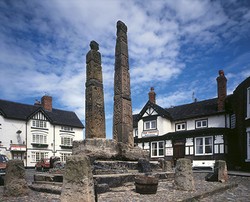
https://wizzley.com/a-limn-about-a-lymm-walk Just a few lines and a short paragraph in my Limn from Lymm post prompted some comments about the beautiful, historic Sandbach crosses In Cheshire . These are two highly decorated and sculpted Anglo-Saxon pillars which stand in Sandbach market square in Cheshire. They were crosses but no longer look like crosses, more like pillars, standing proudly and tale. Some of the pieces are still missing.
The market square

Sandbach

Sandbach  is a small, sleepy  town in Mid Cheshire and its name means sandy stream or valley.

In earlier centuries AD Cheshire was subject to attacks from Saxons, Vikings and Welsh but Sandbach was of sufficient significance to get an entry in Norman King William The Conqueror's Domesday Book of 1086 where it was known and spelt as Sandbec

The Crosses are believed to be of Saxon origins.


Sandbach Town square

The Crosses

The Sandbach Crosses are  two highly decorated and sculpted Anglo-Saxon pillars which are believed to date from the early 800's. Standing  in the  market square  they are  large and carved pillars but do not look like crosses now . They are English Heritage  Grade I listed monuments. It is believed that they were brought to Sandbach in the Middle Ages.

 The crosses show Bible stories on each side. The "crosses"  are two perpendicular columns  on a base of three stone steps. They have no arms on them now. They seem to have always been a pair. It is not known who carved them .They show religious scenes including  The Nativity, Transfiguration and Crucifixion .

 Below,  a delightful Cheshire black and white cottage peeping through the background.

Carvings
Carvings
Carvings
Carvings

The carving above is believed to show saints and Mary.

English Civil War

It is believed that during the English Civil War they were ravaged by Cromwell's men. On the 3rd September 1651, during the Civil War,  opposing sides had an encounter on the town's common where the September fair was taking place. Scottish troops were retreating from the Battle of Worcester and met with Cromwell's men. The villagers were incensed that their crosses had been badly treated and set upon the soldiers.  

The pieces of the crosses though were scattered around Cheshire.


Carvings on the cross

The carvings are still very beautiful and clear despite being over 1000 years old.

In the early 19th century the pieces  were collected together and in 1816 were rebuilt  at the instigation of Cheshire historian, George Ormerod.


Sandbach cross

Updated October 22, 2015

Comments

DerdriuMarrinerAug 20, 2024

Thank you to Frank and Veronica for comments below, on Aug 25, 2017, in answer to my previous, same-day observations and questions.

New red sandstone appeals to me. Why is it called new?

frankbeswickAug 26, 2017

Yes, I had an interview in Sandbach many years ago.

VeronicaAug 25, 2017

Thanks Frank. I hope that helps Derdriu.
Have you ever seen the Sandbach Crosses?

VeronicaAug 25, 2017

I don't know the answer to those I am afraid,. They are remarkable though aren't they . They really should be seen close to in order to get the overall impression.

frankbeswickAug 25, 2017

The crosses are made of New Red Sandstone, which is the bedrock under all of Cheshire, except maybe a thin strip on the edge of Derbyshire. Local stone was almost always used except for great cathedrals that might import stone and maybe some castles.

DerdriuMarrinerAug 25, 2017

Veronica, Does anyone know where the building material came from, and what it was about Sandbach that warranted the crosses' placement there? How were the crosses put back together? I wouldn't know from looking at the images here and elsewhere that they were so extensively reconstructed.

VeronicaSep 28, 2015

Aren't they ! To think they have been built for over 1000 years and still stand there in the town square is amazing indeed. The images are very Biblical and beautifully carved.

GuestSep 28, 2015

Those are really beautiful, Veronica. It must be amazing to walk by them every day. I'd love to study the images more closely.

VeronicaSep 14, 2015

They are one of the special things in England which tourists who only visit the South miss out on.

I love them because they are over 1000 years old and yet the workmanship is such that they are still beautiful to see.

MBCSep 13, 2015

Love the photos and this information. Thanks

VeronicaSep 11, 2015

PS Sandbach in English would be pronounced as SAND BA with "ch" on the end as in cheese or .... " SAND BATCH "

VeronicaSep 11, 2015

Henry, Thank you. I know you have an interest in preserving old sites. These are remarkably well preserved for having been damaged, reassembled and standing out in the open for a few hundred years ! .

VeronicaSep 11, 2015

Frank, it's less than 20 miles away for me but I know it's further from you in North West Manchester. Even so, I suggest they are worth a look.

VeronicaSep 11, 2015

Mira,

They are almost certainly Saxon but local records mention them from Medieval times it seems. They can't have moved very far because of the size and weight of them and I would suspect that they were moved only yards looking at it rationally and realistically.

blackspanielgallerySep 11, 2015

History is well worth preserving and admiring.

MiraSep 11, 2015

Impressive carvings. But where were they placed initially?

frankbeswickSep 11, 2015

The style of carving is Anglo-Saxon, but as with the Lymm cross Irish influence is present.
Veronica
Veronica
130 articles
FollowMessage

Related articles

  • Traditional Cheshire Food
  • Ye Olde Cheshire Cheese London
  • Affordable Italy: 6 Tips for Traveling on a Budget
  • The New York Botanical Garden