

Does Homeschooling Create Shyness? Homeschooling and Socialization
by tandemonimom
Many people worry that the supposed lack of homeschooling socialization opportunities will create shy kids. In fact, the opposite is true.
Can Homeschooling Cause Shyness?
Can the supposed lack of homeschooling socialization opportunities create shy kids?
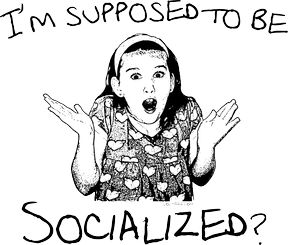 First of all, there is no lack of socialization opportunity in homeschool. (See How to Socialize for Homeschoolers for examples.)
But still, it is perfectly true that no matter how many outside social opportunities homeschoolers take advantage of, they are not with a large group of kids all day, every day, the way students are in institutional schools.
So the question is: is it possible that children who are somewhat disposed toward shyness will be pushed into shyness by being homeschooled, but would be pulled out of shyness by being placed into an institutional school setting?
Image source: The Homeschool Shop
Shy Kids in Public Schools
If homeschooling creates shyness, then ...
This idea that shy homeschooled kids are shy because of homeschooling contains a very big, if unspoken, assumption: institutional schools have no shy kids.
Well, are there any shy kids in institutional schools, whether public schools or private? Here's a shocking fact: yes, there are! How did that happen, if homeschooling causes shyness? And if shy homeschoolers should be put in school to make them not shy, then what should we do with shy public schoolers?
The truth is, homeschooling does not cause shyness. Many things can contribute to shyness, but at least one causative factor is forcing introverts into social situations where they cannot retreat when they feel overwhelmed. Situations like, I don't know, forcing them to be with hundreds of other kids all day, every day, with nowhere to go to get away from bullying, unkindness, or even just the relentless school-day hustle and bustle that is so draining to the introvert.
How do I know that being forced into unwanted social situations can cause shyness?
Well, it did for me.
Why Are Shy Kids Shy?
Should we keep kids from becoming introverts so they won't be shy?
Most people hear "introvert" and think "shy," but that is not quite the case. Introverts are certainly more likely to be shy than extroverts; but an extrovert can be shy, and an introvert can be not shy. Introverts usually are more comfortable in one-on-one situations than in crowds and need more alone time, but that doesn't necessarily mean they are shy.
Dictionary.com clarifies:
EXTROVERSION: the state of being concerned primarily with things outside the self, with the external environment rather than with one's own thoughts and feelings.
INTROVERSION: the act of directing one's interest inward or to things within the self.
SHYNESS: bashful and retiring; or easily frightened away and timid.
So introverts are not just shy extroverts!
Extroverts are externally focused (doers) while introverts are internally focused (thinkers). Introverts are perhaps more likely to be shy, but it is not an automatic condition; conversely, extroverts can be shy but by nature are probably less likely to be.
My Experience as an Introvert and a Shy Girl
I'm an introvert, and I'm not shy. But I used to be.
Shyness and introversion are not the same thing, but they are often close companions. I was born an introvert. I became shy in third grade, and I very deliberately worked myself out of my shyness over a three- or four-year period as a young adult. But I'm still an introvert and always will be.
Introverts do not enjoy social chit-chat, not necessarily because they are shy but because they prefer more meaningful conversations. Forced into an unceasing social milieu (such as institutional school) where lightweight chit-chat reigns supreme and anyone who doesn't participate is automatically labeled "odd," shyness may develop.
In my own case, my family moved around a lot. If we hadn't moved between my second and third grade years, perhaps I might not have developed shyness, but we moved, and I did.
I remember the first day of my second-grade year: I walked into the class, saw a new girl, and thought, "She looks interesting!" so I went and sat down beside her and asked her name. We became best friends.
We moved that summer, and the new school situation combined most likely with the increasing self-awareness of age caused a loss of confidence in my ability to make new friends. I walked into my third-grade room, saw a girl across the room and thought, "She looks interesting!" but I couldn't imagine sitting down next to her and asking her name. I turned and walked to the other side of the room and sat down, and rarely exchanged more than a hello with that girl for the rest of my career in that school system.
The Introvert Advantage
 |
| The Introvert Advantage: How to Thrive in an Extrovert World Workman Publishing Company |
If you are an introvert, or have an introverted child or partner, you need to read this book!
Are you the one out of every four individuals who prefers to listen rather than speak and avoid the spotlight? Do you need plenty of "down" time to recharge your batteries, which are drained by too much social time? Congratulations, you're an introvert!
Dr. Laney first dispels the common myths about introverts (are shy, don't like to talk, are rude, don't like people or public places, always want to be alone, can be "fixed" to become extroverts), then focuses on the strengths of the introvert and provides tools for improving relationships and social interactions with extroverts and other introverts. This remarkable book is necessary reading for any introvert, parent of an introvert, or extrovert who wants to understand introverts.
Most of what I say on this page is my personal experience and common sense, but if you want to understand more about the subject of introversion and shyness, read this book!
There's nothing wrong with being introverted!
Neither E=mc2 nor ‘Paradise Lost’
was dashed off by a party animal.
~ Winifred Gallagher, science journalist
My Experience as a Mother of Introverts
Three of my four children are introverts.
I have four children. My youngest, seven at this writing, is an all-out extrovert who tires the rest of us out. My three older children all fall in varying places somewhere on the introvert side of the scale ... but none of them are shy.
Would they be shy if they were in public school? It's impossible to say, of course, but certainly the possibility is there. One of my children has mild Asperger syndrome (high-functioning autism), but instead of being a social outcast as such children often are, has a wide and stable circle of friends; has frequent social interactions with them such as field trips, parties, and sleepovers; and even more frequent interactions with them online, writing stories and drawing together.
The Homeschooling-and-Socialization Question
Homeschoolers sometimes get tired of answering "the S question" and might resort to a bit of sarcasm.
 |
But ... Introverts Must Learn to Deal with Social Situations!
Introverts should go to school so they'll have socialization opportunities, right?
Wrong. Yes, of course introverts need to learn to deal with social situations, but they don't need to attend an institutional school to do that. In fact, as we've already noted, it often can hinder social development. Shy kids who feel certain they will have a retreat when they need it are more likely to outgrow their shyness - as I did, once I was out of the artifical social environment of public school.
As an adult introvert, I move in social situations where I am comfortable. I'm actually the leader of my local homeschool support group and new members are often shocked to learn I am an introvert, as I welcome them as new members and have no trouble conversing at length (often too much length) about homeschooling practice and advice. Like most introverts, I can talk quite easily about things that are real and interesting to me. I can still freeze and appear shy in some social situations (such as my husband's office parties), but I've learned some social tricks to deal with my own difficulties in this area.
I worked several jobs before I stayed home to have children, and despite recently outgrown shyness, was fully capable of functioning in the social work world. I found jobs that suited my personality, working quietly in proofreading and editing.
But ... School Teaches How to Deal with Difficult Social Situations!
Everyone should know how to deal with bullying and other situations.
An adult in a situation with a bully or other uncomfortable social situation should certainly be able to deal with it. In school days, all most of us can do is learn to bear it. But adults have the power to change their situation. A complaint to a superior or a move to another department is sometimes possible; and in worse situtations, one can get a restraining order, institute a lawsuit for harassment, or even have the offender arrested. Quitting the job is also a possibility.
In no case should an adult feel constrained to stay in a bullying situation ... unless perhaps the adult had been conditioned to accept such things as "normal" somehow.
Shy Kids in Homeschool
There are still shy kids who homeschool.
Of course there are homeschoolers who are shy kids. There are many causes of shyness, and being forced into the social stew of public schools is only one possible factor in its development. The point is, homeschooling neither causes nor prevents shyness, just as institutional schooling is neither the cause nor the cure of shyness. Either could be a contributing factor, as public school was in my own case, but some kids will be shy no matter what their social situation; other kids will never develop shyness no matter what their social situation.
Research on Homeschooling Socialization
The Well-Adjusted Child: The Social Benefits of Homeschooling
 |
| The Well-Adjusted Child: The Social Benefits of Homeschooling Mapletree Publishing Co. |
More About Homeschooling and Socialization!
This article is one of a series on homeschoolers and socialization skills.


All images copyright © tandemonimom. All rights reserved.
Resources: Homeschooling, Socialization, and Shyness
What Is Wrong With Being “Shy”?
"I just don’t understand the perspective that it’s important that young children have the personality trait of going up to complete strangers and being able to talk to them – or rather *wanting* to talk to them. How is that a “better” social trait than to stand back until one has become comfortable with someone before talking to them? Especially for children?"
Homeschooling a Shy Child
"Homeschooling can help shy children to become well-adjusted and confident in social settings by allowing them to develop social skills at a pace that suits their individual needs."
Can Homeschooling Help Anxious or Shy Children?
"The best way to help him out of his shyness and anxieties would be to homeschool him and gradually and tactfully expose and support him to mingle and interact with others."
Develop Self-Esteem Through Home schooling
"Thrusting a child into the crowded hallways of school can be quite overwhelming for them and they may end up having social anxiety attacks."
How to Start Homeschooling a Shy Child
"While most parents agree that it is important to provide their homeschooled child with plenty of opportunities for peer interaction, it can be difficult if your child is naturally shy and reserved. Here are some tips on how to help your shy child become more comfortable in social situations."
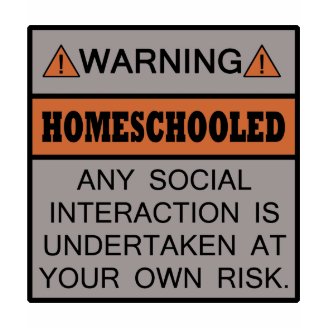
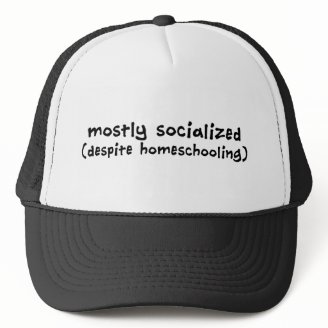
Homeschooling and Socialization Go Together Like T-shirts and Torsos!
A collection of the very best sassy answers to the "S" question on t-shirts, hats, hoodies, and more gear for homeschoolers!
You might also like
Homeschooling Socialization: An Oxymoron?Homeschooling & socialization is like peanut butter & old shoes, according to...
How to Socialize for HomeschoolersBelieve it or not, it's not that hard for homeschoolers to find opportunities...

 Wind Says Good Night | A Best Picture Book Reviewon 04/03/2012
 Tumble Tower | A Best Picture Book Reviewon 12/29/2011
 Jamberry | A Best Picture Book Reviewon 08/02/2011
 Shoes | A Best Picture Book Reviewon 07/27/2011

Don't Be Shy!
All kids are home schooled and I agree public school may not be the best but with guidance it can help a shy child gain confidence by making other friends that may be the same. It saddens me that parents that had a bad experience in school would hold back a child from meeting kids that could become life long friends and teachers that become mentors
I was super shy as a child, I would have loved to have been homeschooled. My son is just like me, that's why he loves being homeschooled.
I was very shy as a child. It was a horrible feeling. I have little doubt that public school very much contributed to my early shyness. My little guy on the other had is not near as "shy" as I was, even though he is considered borderline autistic, somewhat developmentally delayed, and has trouble with social interactions. I feel homeschool has been the best thing for him. It has allowed him to be in social situations where he feels comfortable and then he gets a rest period after that social interaction where he can just be to himself if he needs it. He has done things like been on stage singing and dancing, talked to 4-H judges (at both county and state fair) about his projects and much more. He still has a way to go with social situations, but he's only 9, so he has time. I have little doubt that public school would have destroyed him, knowing his fragile personality. People need to realize, just as homeschooling is not for everyone, neither is public school. Public school is not the savior that people try to make it out to be. It can be a useful tool for some kids, but it can also be the torment to others. For some, public school is just not a good fit.
I did not home school and was not home schooled, and fit your description of an introvert, but always defined it as shy when young...good to see your explanation here. My grown children are at opposite ends of the introvert/extrovert spectrum. The teasing that comes from being a certain way in school would be the only thing that it would be nice to be able to avoid through home schooling or good private schooling. Great page..I have great admiration for home school moms:-)
There is nothing wrong with teens being shy. It's perfectly normal. There is more to socialization than a kid being shy or not. Socialization is about - as LadyLynn says - exposure to teens and other people of various backgrounds.
I'm amazed at how little our public school does to stop bullying, or any bad behavior for that matter. They literally do nothing in most cases. I don't want my kids exposed to an anything goes atmosphere.
I'm never shy about leaving a comment in a comment box, LOL. Great discussion, Carma.
Certainly homeschooling does not cause shyness, in fact, I believe that homeschooling can actually help a shy child learn to deal with situations which trigger shyness. Homeschoolers often choose when, where and with whom they will be interacting and with lots of adults around to help when needed, I believe that homeschoolers have the advantage.
I'm glad to know I'm in such good company! I've noticed before that a majority of homeschooling moms tend to be introverts; I'm sure it's at least partly because school was such a poor fit for us!
Wow, Carma, you and I are a WHOLE lot alike. I'm an introvert and was very, very shy as a child. I have to wonder after reading this if I might have been just an introvert and not shy, but treated as shy and learned to act that way simply because of a more outgoing extended family. Guess I'll never know. I do know that one of my children was forever being called shy, which he really was not, and he and I both disliked that people called him shy. He was just very introverted and disliked "foolish behavior" in others from a very early age, thus withdrawing from large groups, giving the impression of being shy. He's not at all shy today, and was not in any of his college classes (to the delight of his professors), though he still dislikes foolish behavior (also to the delight of his professors!). I'm just glad our children were both able to work through their personalities with more supervision from us in a homeschooling environment, not being forced into certain situations until they were more ready. Long answer - sorry. This is a great article. Thank you!