

Homeschooling Socialization: An Oxymoron?
by tandemonimom
Homeschooling & socialization is like peanut butter & old shoes, according to most people! In reality, the peanut butter of homeschool goes great with the jelly of socialization.
The "S" Question
Everyone's first question to homeschoolers is always "what about socialization?"
If you homeschool your children, or if you are homeschooled, then you have surely heard the "S" question: but what about socialization? It seems that most people who don't homeschool think of it almost as a "gotcha!" question - unanswerable, and as such, a complete reason in itself not to homeschool.
But every homeschooler knows that socialization is pretty much a nonissue - socialization in homeschools happens naturally and in a much more productive and beneficial way than can ever happen in the fabricated environment of an institutional school.
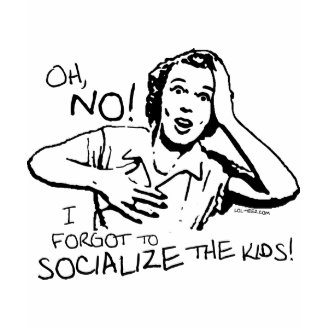
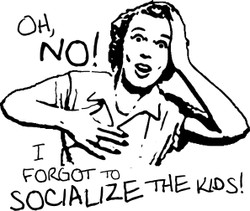
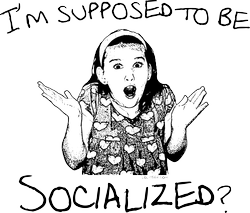
Homeschooling Socialization T-Shirts
Admit it, homeschoolers - you know you've wanted to answer this way at least once!
 |
 |
The Truth About Homeschool and Socialization
Institutional schools do not offer socialization in a real-world setting.
The truth is, the "socialization" that takes place in public schools is frequently negative and even at its best, does not give children a true picture of relationships in that oft-cited paradigm, "the real world."
There is only one place in the "real world" of adult life where a person has no choice but to "socialize" with a specific set of persons and no ability to leave an undesirable social situation, and that is behind prison bars.
Forcing children to "socialize" only within a narrow age range, and with the same set of persons day in, day out, with little more escape than a prison term offers, is not a picture of the real world and does not actually convey a healthy set of skills to deal with the real world once they are out in it.
Homeschooled children, on the other hand, deal with the real world from day one. They learn to socialize from family, of course; but also in all sorts of real-world social settings from the grocery store to the playground at the park, and from all ages of people from children much younger than they to adults and even the elderly.
The Social Benefits of Homeschooling
"Once upon a time, all children were homeschooled ..." Rachel Gathercole, a ten-year veteran of homeschooling, thoroughly refutes the common misconceptions surrounding socialization and homeschooling.
 |
| The Well-Adjusted Child: The Social Benefits of Homeschooling Only $20.07 |
Homeschooling and Socialization: Your Opinion?
Can homeschooled kids get plenty of good socialization?
No, school socialization is still the gold standard because ...
 Kelleigh
on 08/06/2011
Kelleigh
on 08/06/2011
As a former public school teacher, I found myself doing a lot of interventions with bullying and negative socialization every day. The institutionalized school setting provides skewed and sometimes dangerous socialization opportunities for many students. I believe that homeschooled kids have the opportunities to be exposed to real world socialization where they are authentically interacting with people of all ages. That is where the hard work of the homeschool parent comes in (getting the kids out there!). Yah for homeschoolers!
 BumbleBee
on 06/04/2011
BumbleBee
on 06/04/2011
You say "socialization in homeschools happens naturally " - what nonsense.
Socialization has to be artificially created unless you are "homeschooling" a large group of children. So - you want to completely control your child's input.
You wouldn't be religious by any chance? :(
Yes, it is easy for homeschoolers to get plenty of socialization!
Kelleigh
on 08/06/2011
Don't know why it placed me on the "no" side...I'm "YES" all the way!
 BizzyBee
on 06/04/2011
BizzyBee
on 06/04/2011
We homeschooled our now teenage son and I'm very glad that we did. What's more, he's very glad that we did!
 BarbRad
on 06/03/2011
BarbRad
on 06/03/2011
My Jason thrived socially during the years he got his education at home. He had friends of all ages from those much younger to the seniors at church who called him to come help fold church bulletins. I was a scout, a youth group member, and had many friends in the neighborhood. In his first school years he found it much harder, since he had little in common with most of his classmates. He was a very bright boy stuck in special education classes because of his need for one on one instruction.
 Joyce Geleynse
on 06/01/2011
Joyce Geleynse
on 06/01/2011
Amen to all you said!!! I homeschooled my kids and they are now very successful adults with healthy friendships and interesting careers. As children, they learned at a young age how to talk with adults comfortably. They also learned to enjoy life together as siblings.
 thelesleyshow
on 05/31/2011
thelesleyshow
on 05/31/2011
I'm going to be homeschooling next year for the first time and everyone keeps trying to talk me out of it. I won't be persuaded, I would rather my child model my behavior than her peers and as far as socialization, we are involved in sports and church activities all over town.
Guest
on 05/30/2011
I completely agree with you. My girls can talk to anyone and have friends based on common interests rather than age.
 Susan52
on 05/30/2011
Susan52
on 05/30/2011
You said it yourself - socialization occurs naturally in a real-world environment. My homeschool grads are very positively socialized - people, including their employers and college professors, love having them around.
 Dianne
on 05/30/2011
Dianne
on 05/30/2011
Homeschoolers live real life and have many opportunities to interact with people of all ages in daily living situations. This is real and useful socialization. They play on sports teams, go to the swimming pool, church, grocery store, post office, book store, and anywhere else you would go in daily life. These are all opportunities for social interaction with people of all ages.
 "Research examining home-schooled students’ academic achievements have consistently found that they score higher than the national norms on standard achievement tests. So the only grenade left to throw at home-schooling parents is that they are hurting their children socially and emotionally."
~ Dr. Laura, Home-schooling Does Not Hamper Socialization
Why Is Homeschooling Negatively Associated with Socialization?
Why is the socialization question treated like an unaswerable problem?
Why does the non-homeschooling community automatically assume that homeschoolers cannot possibly be properly socialized? Probably because, as children, most of us were raised in an institutional school setting, and it is all we know. All of our friends were met at school ... so if children don't go to school, how will they meet other children?
Well, guess what? People who choose to homeschool love their children and want them to have friends, too. And the parents want friends too - friends who won't be always nagging them about why their kids aren't in school. So in a perfectly natural progression of events, most homeschooling families seek out and find other homeschooling families.
Homeschool groups are formed on a variety of bases: families who use the same curriculum, or who have children of the same ages, or who live in a close geographic area, or who want a study club, or who want to go on field trips together (with the group discount!), or who just want to get together at the park for ... wait for it ... social time.
However they choose to do it, homeschoolers find each other and kids get play time. My own four children, who have never been inside a school building, have been involved for years with their homeschooled peers in art classes, theatrical productions, science co-ops, park play groups, craft clubs, book discussion groups, and too many other social activities to mention.
Every other homeschool family I know is involved in all those activities too. Though new people come into our group every year, or move out of town (just as new people come into and leave schools), my family's local homeschool group has been a stable group of friends - for myself and for my children - for ten years.
This doesn't even take into account all of the other social outlets available to all children: Girl Scouts, Boy Scouts, 4H, sports teams, church groups, community activities, and, of course, kids around the neighborhood. In fact, homeschooled children often have more time and ability to take advantage of social opportunities - such as community theater, choir, volunteerism, and the like - and they also find a much broader range of people with whom to socialize. "Socialization" means learning to get along in the real world, with people in a variety of age groups, not only with people born within twelve months of their own birthdays.
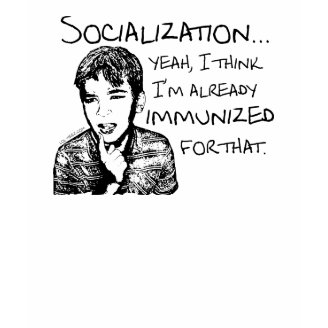
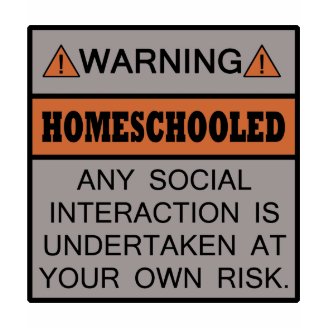
Socialization Shirts for Homeschool Kids
Have a little fun with the "S" question!
 |
 |
 |
 |
As I tell people who ask me about socialization for homeschooled kids: It is less a question of working hard to find enough social opportunities for the kids than it is a question of turning down enough social opportunities to find enough time to stay home and do some lessons!
More About Homeschooling and Socialization!
This article is one of a series on homeschoolers and socialization skills.


More Great Homeschool Socialization T-shirts!
Homeschooling and Socialization Go Together Like T-shirts and Torsos!
A collection of the very best sassy answers to the "S" question on t-shirts, hats, hoodies, and more gear for homeschoolers!

All images copyright © tandemonimom.
All rights reserved.
You might also like
Does Homeschooling Create Shyness? Homeschooling and Socializa...Many people worry that the supposed lack of homeschooling socialization oppor...
How to Socialize for HomeschoolersBelieve it or not, it's not that hard for homeschoolers to find opportunities...

 Wind Says Good Night | A Best Picture Book Reviewon 04/03/2012
 Tumble Tower | A Best Picture Book Reviewon 12/29/2011
 Jamberry | A Best Picture Book Reviewon 08/02/2011
 Shoes | A Best Picture Book Reviewon 07/27/2011


Homeschooling and Socialization - What Do You Think?
@MuminBiz: Yes! Weird parents and families produce weird kids whether they are at home or in school. Good point!
Love the tshirts ;) and agree with you 100%.
Socialization is in the real world, on real situations, and homeschooling should not be looked down upon or as a strange approach. This site also has great articles on the subject - http://www.hslda.org/default.aspx
I have just started officially educating my oldest and this is always the first question I get asked. Personally, I take the time to make sure she is exposed to other people though this is not hard as I am quite a people person myself so they all come with me wherever I go so not really a problem.
In terms of children being weird because of home education! I think before making such a judgement, consider if the parents are weird. Weird parents produce weird children whether they go to school or not! And who defines weird anyway?
Actually, some of this problem of "socialization" depends upon where you live. There are lots of active homeschooled kids who have ample opportunity to meet and socialize with other kids but there are those who are isolated, too. In some rural areas, families would have to drive a long, long way to get together with other homeschooled families. It's not always that simple.
You know, I think one misconception about socialization is that it takes place only from 8:15 to 3:15, during school hours. That's totally not true. Socialization takes place anytime ANY family is out and about, socializing. That means after school clubs, little league games, playing in the park, visiting with friends, even shopping in the grocery store. What I loved about homeschooling is that my children could accompany me to many kinds of social outings, and I could accompany them to theirs. They had plenty of interaction with other children their age, but the advantage was that they interacted with children both younger and older than they were - and with adults, too. That seems so much more "real life" than being sequestered in an age-segregated classroom for six or seven hours a day.
Excellent page. I learned a lot about home schooling.
Homeschooling worked for us!
Interesting article. I think all kids could benefit from better socialization (speaking in generalities here, of course) .
That may very well be. We chose to send our girls to a Jewish day school for their primary and middle school education, and public high school for secondary.
Depending on where people live the public education system may be diverse or not, excellent or not, flexible or not. Our public school system is quite good, and my daughter has gotten a much better education than I could have ever given her at home. However, we have also had an influence on her as well, and as she goes off to college I see our influence clearly.
As I said, I am on the other side of the fence. I believe that all children should attend school in a structured setting outside of the home for at least part of their schooling, because I think the homeschooling parents on this forum are the cream of the crop, and that many people homeschool their children to isolate them from the mainstream of society, never allowing them develop minds of their own.
Paula: Do you really think it takes TWELVE years of 6- to 8-hour days to learn "the system?" And my kids interact with a much more diverse population than they would if they were in any of the public schools around us.