
Talking is something that's easy. The thing is, books written in the same type voice as we actually talk with, are an easy read. Try some of this fiction writing techniques the next time you set down at the keyboard. It will make a difference in your writing!

Memoir How To | Fiction Writing Tips
by mandeesears
This memoir how to explains using the fiction writing tip of "Showing" to engage your reader. Facts are necessary in memoir but the packaging decides if it's worth reading.
Memoir Tips
Use Fiction Writing Tips but Keep it Real!
It's easy to tell a story about yourself at a party, reunion or get together among friends. You have the ability to use gestures, facial expressions, body language and impersonate voices.
In writing, we don't have that luxury. Your story has to be told in a way that engages your reader -- makes them want to know more -- all by using only words on a page. Bringing a story to life for your reader is the goal for authors.
Memoirist do this by using fiction writing tips and techniques. That is not to say that the truth of the event, time period or people you write about is skewed -- "memoir" means it is a true story. If it's not a true story, it's fiction... period.
Poster for Memoir Writers
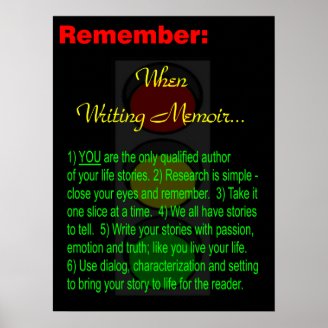 |
Check your story for the words was and is.
These words are telling words.
Make sure they don't show up too often in your story!
Fiction Writing Tips for Memoir Writers
Showing and Telling
A memoir takes a reader on a journey into the past -- your past. No one is better suited to tell or write about your life than you. But, you have to tell it in a way that makes readers want to read more. You know the story but your readers don't. You should write it in a way that allows the reader to experience your story firsthand instead of through narrative telling. Using actions, dialog, thoughts, senses and overall dramatization makes it more real for the reader.
Showing and Telling -- Memoir is a genre that needs both showing and telling from the author. Because it is a story from your life, there will be times you need to "tell" information instead of show. But, "showing" is a technique that is absolutely necessary to keep a reader involved. It paints a picture (cliche, I know, but fitting).
"Showing" correctly means that you understand your reader is smart. With some descriptive language from you, they interpret "Johnny is short" without you outright saying "Johnny is short".
Close your eyes. See the scene play out in your mind. Write the details and descriptions that will create a "mind movie" for your reader.
Writer's Golden Rule...
 |
Showing & Telling
from Writers Digest Books
 |
| Showing & Telling: Learn How to Show & When to Tell for P... Writers Digest Books |
Examples of Showing and Telling
in your writing
Using the showing technique tells your reader you respect them -- that you don't have to hit them over the head with a bold, telling sentence. They will know through the words you carefully chose.
Telling:
She was angry at him.
Showing:
The muscles in her face constricted leaving her eyes barely visible through the incensed slits. Her lip curled to reveal clenched teeth as she continued to glare at him.
Telling:
The car went fast around the corner.
Showing:
The beat up Camaro took the corner of Main and 1st on two wheels.
Telling:
She is old but smart.
Showing:
The lines on her face and sagging eye lids could not hide the sparkle in her clear, blue eyes.
You might notice that the showing examples are longer than the telling examples. Painting a picture, creating a mind movie of images requires more descriptive words.
Just take care that what you are describing is important in creating the scene and helps keep the story moving -- otherwise it's fluff.
When you don't use fiction writing tips,
your story can lack depth and the immediacy of the
"you are there" feeling you want for your readers.
It's too easy to put down.
Tips for "Showing" in Your Memoir
Below are some tips for "showing" in your writing:
- Use dialog -- I know, you didn't have a recorder X number of years ago when this story actually took place. However, you know the gist of it and have even mimiced the conversations when telling the story to family or friends. Do this again in your writing. Dialog between the major and or minor characters is necessary to bring the scene to life in a readers mind. Otherwise it is just a bunch of facts... boring!
- Details and Descriptions -- While none of us wants to read 3 pages about the gorgeous sunset you witnessed, it is important to include details and descriptions -- let the reader know where you are (physically) and when in time the story takes place. This grounds the reader and then allows them to follow along comfortably on the journey.
- Use sensory language. Describe something using more than just sight -- hearing, touching, tasting and smelling can bring a flat image into 3D for a reader. Senses are tied to memories. For example, if you use sensory language to describe a fearful situation, your reader may remember a similar situation in their life and truly feel the emotions you are writing.
- Use specific examples. Similies, metaphors and carefully chosen descriptive words can trigger "mind movies". When I am reading a particularly interesting story, I find that my eyes are reading the words while my mind is spitting out images like film going through a movie camera. I love when that happens!
Fiction Tips that Memoirists can use
 |  |  |
| The First Five Pages: A Writer'S Guid... Fireside | Word Painting: A Guide to Write More ... Writers Digest Books | It Was the Best of Sentences, It Was ... Ten Speed Press |
Start Memoir Writing Today
You may never publish your story or stories but it will be a wonderful gift for family and close friends. Start writing today, you won't be sorry!
Good Luck!
Updated: 01/29/2013, mandeesears
You might also like
Memoir How To | Story ElementsThis memoir how to will break down story elements that should be included in ...
A Peek at Who Is bbethardTake a trip down my lane! It will lead to laughter and to tears, both of whic...
Disclosure: This page generates income for authors based on affiliate relationships with our partners, including Amazon, Google and others.


 Starting with Nothin' and Ending up with Somethin' | My Journey Onlineon 04/23/2012
 Patio Decorating Ideas | Color Schemeson 03/30/2012
 Patio Decorating Ideas | Tropical Paradise Patioon 03/26/2012
 Patio Decorating Ideas | Tuscan Garden Themeon 03/14/2012

Do you use "showing" techniques in your writing?
Grace - Thanks for reading and commenting! Yes, telling has its' place in memoir for sure (more so than fiction). I think I read an excerpt from Tristain Reiner that showed the power of telling... I'll try to find it. Good luck to your friend and you are a great friend to help. :D
What excellent tips. I especially like 'Use Fiction Writing Tips but Keep it Real' , Very important, and I'll keep it in mind when writing
smart and informative tips, well done.
You said it Shelia! :D
Such good tips, Mandee! They make the difference between a boring, dry read and one that sparks with life.
Some really helpful advice which will be very useful for fiction writers
These are some great pointers that I will try to remember in my writing. Thanks.
Yes, I make the effort. So much better to convey your topic, even when challenging philosophical subjects. Thanks!