Wizzley
PopularLatestDiscussedEditor's Choice
AuthorsForum
Wizzley

A community of writers publishing stories worth your time — on the topics they know and love.

Explore

  • Popular
  • Latest
  • Discussed
  • Editor's Choice

Community

  • Top authors
  • New authors

Service

  • Help
  • Contact
  • Imprint
  • Terms of Use
  • Privacy

Check out our other international Webhaus communities!

Explore another site:English·Deutsch

© 2026 Webhaus LLC. All rights reserved.

LiteratureBooks, Genres, ReviewsArt & DesignArt and The ArtsCulture & SocietyHistory, Religion, PoliticsEducationSchool and LearningEntertainmentMovies, Celebs and TV
Article

Irish authors and their use of Irish mythology in their novels

Is the idea of Dracula a European vampire tale, or does the idea of a bloodsucking spirit go back to an ancient Irish myth? Did other Irish authors use their culture in their work?

In this article, I will attempt to show how Irish authors drew on their nation’s mythology to inspire their work. Indeed, it is not only Irish authors who have used myths. J.R.Tolkein used several Norse myths and wove them into his work. Myth and Mythology Definitions The word ‘myth’ comes from the Greek word mythos, which means an ancient tale which explains natural or supernatural events. Myths are passed down in families. Mythology refers all of a society’s myths. Irish myths have always been one of Ireland’s treasures continued through families “yarning “ ( telling stories round the fireside). Many 19th- and 20th-century Irish authors have used this tradition and based their work on ancient folklore. Myths as a cultural memory Cultural memory and tradition are very important to the Irish and their themes are often used to show the struggles that Ireland has endured.

Are Vampires based on Irish mythology ?

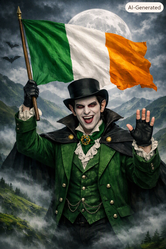
Irish Vampire

How did mythology shape Irish story telling?

How did Irish mythology shape Irish storytelling? 

  • Myths as resistance — mythology became a means of preserving Irish culture. Using mythology and bringing it to the forefront emphasised their national pride. 
  • Myths as story‑building — authors used Gael gods, heroes, and creatures to build heroes and villains
  • Myths as metaphor — Authors use mythic figures to explore modern issues like identity, trauma, and social change.
  • Myths as magic realism — Many Irish novels blend everyday life with supernatural themes, creating an Irish form of realism.

A Pooka (pucca , puca , puck )

Puca - a shape shifter
Lady Gregory

Key Irish authors who draw deeply from mythology

I shall show just a few Irish authors who drew on mythology to enhance their works. 

 Lady Isabella  Gregory

Lady Gregory collected and retold Irish myths, preserving stories of heroes and villains.  Her work made these legends accessible to all people, and she was a major influence on the writers who followed. She was a leading figure in the Irish Literary Revival in the 19th century.  The Irish Literary Revival emphasised folklore and tradition, and so gave a romanticism to the nationalist cause, which was opposed to British oppression. 

James Joyce 

Joyce’s work is steeped in mythological ideas and not just Irish. While Joyce's  Ulysses mirrors the Greek writer, the author also cleverly intertwines Greek and Irish mythology through his use of heroes and characters.  

W.B. Yeats

Yeats was fiercely proud of his heritage and openly included characters from Irish folklore. For Yeats, using mythology was part of his  Irish culture. He directly takes from Irish culture in  "The Wanderings of Oisin"  where Oisin's 300-year journey into another world is reflected upon. 


yates works

Oscar Wilde

Oscar Wilde

Oscar Wilde

Oscar Wilde's mother, Lady Wilde, collected and published Irish myths and fairy tales. Her influence is obvious in his short stories, where the retelling of myths is the theme. In The Picture of Dorian Gray,  Wilde uses the idea of a changeling, which is common in Irish myths. The Selfish Giant has a myth structure in that it has a moral and an element of the supernatural. 

Female Vampire

The " Irish" Vampires

Sheridan Le Fanu and Bram Stoker

20th and 21st stories have vampires set in Eastern Europe, and this is purely because Bram Stoker based his Dracula stories there.  And yet, Sheridan Le Fanu had written Carmilla the Vampyre     (1872 )  decades before Stoker penned his vampire tales.  (1897 )

One of the oldest Irish myths is that of the Abhatach (avotar ), a spirit who rises and drinks the blood of the living to hang on to life. There was also a female blood-sucking spirit called the Dearg due  ( which in Irish translates approx as blood sucker) . These myths were around hundreds and hundreds of years before Stoker wrote his story, basing his vampire in Eastern Europe. Le Fanu and Stoker were both Dublin-born and would have grown up listening to Irish mythology. There is also a female blood-sucking spirit in Scottish mythology called the Baobhan- sith.  (bavan she)

Le Fanu also made his vampire Carmilla a shape shifter and shapeshifters occur throughout Irish myths. 


Other uses of Irish mythology in media

Shapeshifters Addendum Aug 2026 Mary Chase

Leading to the conclusion, Irish mythology is used in other media in later centuries.

The Bard, Shakespeare himself in  "A Midsummer Night's Dream"  uses the mischievous fairy Puck as a shapeshifter. In Irish mythology, one of the shapeshifters is called a Pucca. - Pucca/ Puck 

The Pucca also appears in the 1950s comedy film  "Harvey"  where the invisible shapeshifter appears to  Elwood P Dowd as a rabbit. 

This is just another example of the influence of ancient Irish mythology on our literature and media. 

The author of the play "Harvey " was an American-Irish lady named Mary Chase  born Mary Agnes McDonough Coyle. Irish mythology, as passed down through her family, greatly influenced her writings. 


Conclusion

In my opinion, these two vampire stories are not influenced by Eastern European counts or nobles. The concept of vampires harks back to Irish mythology. Several Irish authors got their inspiration from their culture and mythology.  Le Fanu and Stoker are no different. 

Updated August 15, 2026

Comments

VeronicaSep 17, 2026

Not as far as I know.. i have not read any.

VeronicaSep 17, 2026

Not as far as I know.. i have not read any.

DerdriuMarrinerSep 17, 2026

Thank you for your comments below in answer to my previous observations and questions.

Does Irish mythology deal with carnivorous plants?

VeronicaSep 15, 2026

Not in any of the myths of which I am aware but my knowledge is not fully extensive.

DerdriuMarrinerAug 25, 2026

Thank you for your comment below in answer to my previous observation and question.

Does Irish mythology deal with vampire animals?

VeronicaAug 24, 2026

Human. They drink human blood to keep themselves alive as humans.

DerdriuMarrinerAug 24, 2026

Thank you for your comment in answer to my previous observation and question.

Do Irish vampires delight in only human blood or in any living being's blood?

VeronicaAug 23, 2026

I do not think many people distunguish much between rabbits and hares over here . . They are just........... rabbits

DerdriuMarrinerAug 17, 2026

Thank you for your comment below in answer to my previous observation and question.

Online sources acknowledge as Ireland-inhabiting the European rabbit (Oryctolagus cuniculus) even as they ascribe also the introduced brown hare (Lepus timidus) and the native Irish hare (Lepus europaeus).

Does Irish mythology differentiate between hares and rabbits?

VeronicaAug 15, 2026

I think they are supposed to bring good luck. in the Gaelic mythology

DerdriuMarrinerAug 15, 2026

Thank you for your penultimate paragraph!

Do rabbits draw special designations and details in Irish culture and in present-day Ireland?

VeronicaAug 15, 2026

Aug 15th 2026

I have added a penultimate paragraph about another obvious use of Irish mythology in Shakespeare and Mary Chase.

VeronicaAug 15, 2026

Good morning Tolovaj.
Thanks for your comment. I am a firm believer that many authors use their own national mythology and that of others to inform and influence their writing. Bram Stoker and Sheridan Le Fanu, were both Dublin-born Irish.

TolovajAug 14, 2026

Very interesting! Thank you for all the info:)

DerdriuMarrinerAug 10, 2026

Thank you, Veronica, for your comment below in answer to my previous observation and question.

I do not defer to Eastern-European mythology as ancienter than anything Irish even as I equate Irish culture to early influences on Eastern-European and other cultures.

For example, the 3,800-year-old Tarim-River Basin mummies in their lifetimes interconnected through the Tocharian language, related to no other ... but ... GAELIC! If their desert-mountain-oasis culture logged any vampire mythologies, I look to ancient Irish-language influencers on Tocharian-language speakers, not the other way 'round.

VeronicaAug 9, 2026

Druids were largely based in woodlands in our land, which is why I dismiss the idea that Stonehenge was used by Druids as it is out in the open. There was certainly movement between our land and W. Europe but I think it is highly unlikely that Easter Europenas got this far west at this time to have an influence on Irish mythology.

DerdriuMarrinerAug 8, 2026

Thank you, Frank, for your comment below in answer to my previous observation and question.

Do we know which Indo-European mythology -- for instance, Irish? -- kindled all other Indo-European vampire mythologies?

frankbeswickAug 8, 2026

Irish mythology is part of Indo-European mythology and so there are shared elements in the two mythologies. The influence of the druids plays a little understood element in Irish mythologies

DerdriuMarrinerAug 3, 2026

Thank you for your comment below in answer to my previous observation and question.

So Irish mythology does not do what Bulgarian-vampire mythology does in distracting their Убур, Обур, Вампир vampires with grains, poppy seeds and rice that drive them demented if they do not determine their total numbers (which always delays them to their dawn deaths)!

But is Irish mythology informative, or non-informative, otherwise about whether or not a vampire after a victim is inevitable?

For example, was Dearg due always able to "get her man -- ;-D -"?

VeronicaAug 1, 2026

I don t think myths discuss specific foods in Irish mythology. I do not know if the garlic part of the myth is a Bram Stoker invention.

DerdriuMarrinerAug 1, 2026

Thank you for your comment below in answer to my previous observation and question.

Bulgarian traditions associate their vampires with ordinary food in addition to human blood. Their Убур, Обур, Вампир vampires can be distracted by grains, poppy seeds and rice even as they can be drawn to baked or cooked garlic but repelled by fresh garlic.

So I wondered whether or not Irish-vampire mythology -- undoubtedly carefully constructed like all Irish literature and music ;-D -- warranted non-blood-drinking and feeding by Irish vampires!

VeronicaJul 31, 2026

Ha, well, of course, they are fictitious and mythological, so whatever the author wants them to eat. :)

DerdriuMarrinerJul 31, 2026

Thank you for your comment below in answer to my previous observation and question.

Do Irish vampires only devour male blood or do they delight in such culinary dazzlers as Veronica-recipe -- ;-D [how could they do otherwise?] -- drinks and eats?

VeronicaJul 30, 2026

It is a myth but I think no man was safe . :)

DerdriuMarrinerJul 29, 2026

Thank you for your comment below in answer to my previous observation and question.

Did Dearg due do in men deemed as doing bad deeds or as domiciling the best-energizing, best-looking, best-smelling, best-tasting blood?

VeronicaJul 29, 2026

Certainly, the Dearg due in Irish mythology was seen as an evil but tragic character, unhappily married. The myth tells that after she killed herself, she rose up and preyed on men, drinking their blood . It is a myth from the southeast of Ireland initially .

DerdriuMarrinerJul 29, 2026

The next-last section, The "Irish" Vampires, advises us of female blood-suckers and shape-shifters.

Does Irish mythology deem such blood-sucking, shape-shifting females as bad, good, just trying to survive?
Veronica
Veronica
130 articles
FollowMessage

Related articles

  • Balnamoon Skink ; Irish food
  • Dublin ; The Book of Kells
  • Irish Myths and Legends ( 2 ) - The Children of Lir
  • Book Review: By Its Cover, a Commissario Guido Brunetti Mystery by Donna Leon