Wizzley
PopularLatestDiscussedEditor's Choice
AuthorsForum
Wizzley

A community of writers publishing stories worth your time — on the topics they know and love.

Explore

  • Popular
  • Latest
  • Discussed
  • Editor's Choice

Community

  • Top authors
  • New authors

Service

  • Help
  • Contact
  • Imprint
  • Terms of Use
  • Privacy

Check out our other international Webhaus communities!

Explore another site:English·Deutsch

© 2026 Webhaus LLC. All rights reserved.

Culture & SocietyHistory, Religion, PoliticsBeauty & FashionClothes, Hair, BodyCelebrationHolidays and OccasionsTravelVacations and ExcursionsWeddingsEverything but the groom
Article

Aesop: unclear biography, no written fables, with timeless morals

Aesop was most popular fabulist in the world. He still is. But we don't know much about him. Fortunately his fables are much more clear than his biography.

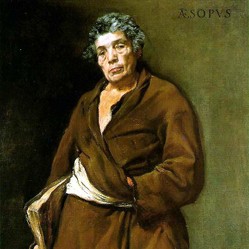
Aesop and fables are among most related words in the world of literature. But people too often confuse Aesop with Greek philosophers and fables with fairy tales. So I decided to collect top 10 facts about Aesop, the mysterious man who never wrote any of his fables, but still managed to become one of most popular authors of all times. (Image credit: Diego Velasquez, all used images are in public domain)

Who is Aesop?

or: who was Aesop?

1. Nobody knows who was Aesop. All what we can find about him is unreliable and old. There is pretty wide agreement he was a slave who was freed and became a great rhetorician. But it is not clear where this happened.

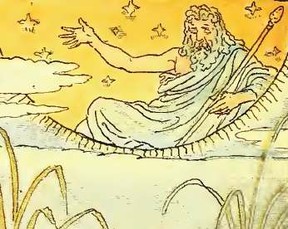
Or when.Vignette by Walter Crane
Or where he was from.

Or if he even existed.

Aesop's biography can be found in several books but all of them belong to the fiction section.

So when we try to answer the question 'Who is Aesop?' we should probably say, it is a trademark used to sign famous fables. Many of Aesop's fables were written more than thousand years after he supposedly lived.

2. Reality or fiction, several historians from Old Greece mentioned Aesop's name. His cleverness helped him not only to get freedom, he became adviser to influential people (that includes kings) too. His low social status did not allow him directly criticizing decisions of nobility, so he was forced to use fables to illustrate their mistakes and provide them with proper advice.
Aesop's Fables are extremely popular at children (and parents) for centuries

The man that pleased none

Privately

3. Like every celebrity Aesop should be described in as many details as possible. His appearance is certainly at the top of the list. There are speculations about African origin and dark tone of his skin. The word Aesopus was for centuries translated as 'from Ethiopia' or simply 'dark man'.

Etymologically this is wrong but in 1971 they still made a TV movie with Bill Cosby playing Aesop. Thanks to imagination of medieval artists he was also a dwarf, stutterer, hunchback and a lame. It seems for many centuries writers and painters competed in showing his ugliness.

4. Ugly or cute, Aesop was supposedly involved in a romance with one of the most popular ladies of questionable virtues in his times (about 5 centuries AD).

Rhodopis was a courtesan from Thrace (part of today's Bulgaria), one of other possible origins of Aesop.

She was a slave and maybe served as a role model for earliest versions of the main character in the most popular fairy tale of all times - Cinderella. By the way - name Rhodopis, meaning 'with rosy cheeks', can also came from Rhodope (mountains in Balkan), her possible origin.

We can see both portrayed on the painting by Angelica Kaufmann on the right.

Aesop and Rhodopis by Angelica Kauffmann

Endless source of inspiration

5. Aesop's work, no matter who's originally was, inspired many writers to write their own fables in verses or prose, or rewrite Aesop's, often with humorous and surprising, even shocking twists.

Greatest fabulist ever?

13 votes

We don't have enough space for all the names, but we should mention at least Ambrose Bierce and Jean de La Fontaine as two of the greatest.

The influence of former slave from Ancient Greece didn't stop in literature.

Many paintings, musical compositions, theater plays, movies... were made after 'his' tales.

Why? Their characters and structures are simple and their morals are useful for different reasons. Some are really evergreen and can be used as such and some are so outdated they almost scream for artistic reinterpretation.

Because they are public domain, nobody don't have to worry about copyright issues either, so it is a win win ...

Painting of entrance to labyrinth of Versailles

Aesop and Cupid by Jacques Bailly

Greece or India?

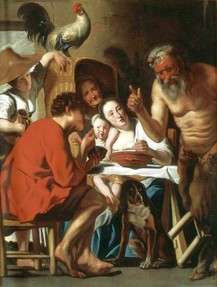
Satyr visiting a peasant, painting by Jacob Jordaens6. Many of the Aesop's fables are almost the same as tales in another famous collections from India and Southeast Asia. Dozens of stories from Panchatantra and Jataka tales share the same plots and morals, many others differ in characters or plots and others have completely different morals.
Nobody knows how many of fables from Ancient Greece originate in India and in how many cases the opposite is true.

7. What we can say for sure, some of the more famous fables attributed to Aesop could never be his work. Among these are: Mice in council, Milkmaid and her pail, Scorpion and frog, Wolf in sheep's clothing... So when talking about Aesop we should think more as of a brand than writer.

Quotes by Aesop

'Aesop quotes'

8. The so called Aesop quotes are often attributed to Aesop although some of them come from stories written many centuries after he supposedly lived. Any excuse will serve the tyrant origins in The wolf and the lamb, One cannot be first in everything comes from Juno and the Peacock, Crying over spilt milk from The milkmaid and her pail, ...

Fox and grapes

9. There are also many everyday expressions like sour grape (The fox and the grapes), lion's share (Lion and wild ass), wolf in sheep's clothing (the title is the same), put one's head in the lion's mouth (The lion and the crane)... We'll probably never know if Aesop ever lived but his wisdom will stay incorporated in our society forever.

(Images above and on the right are work of Arthur Rackham)

I can't reach these grapes, so they ae probably sour

Aesop's death

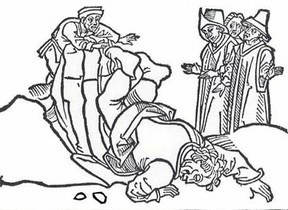
10. As we can expect from his mysterious life Aesop's death should be nothing but spectacular. Citizens of Delphi, afraid to be shown in not so favorable light, accused him stealing from the temple of Apollo (bribed servant helped them) and sentenced Aesop to death.Aesop's death, woodcut from 15th century

Before he was thrown from the cliff, he said: 'You can kill me, but my death will be revenged by great misfortunes.'

After he died Delphi was really affected by many problems, and the situation settled down only after people from Delphi built a temple dedicated to Aesop and punished his murderers. That's what I call the power of the word.

More on Aesop, his work and its influence

Esop's life, fables, morals, followers
If you want to know who was Aesop (sometimes called Esop), what are his most famous fables (with short summaries and morals) and some background, don't hesitate to visit this page.

Updated May 17, 2019

Your thoughts on most famous fabulist of all times?

TolovajSep 3, 2023

Yes, Aesop was probably not Greek but Greeks invested most in the 'distribution' of his work. Which by the way, is maybe not his at all:)

DerdriuMarrinerJun 14, 2023

Your first fact about Who Was Aesop? intrigues me.

Why is it that we know more about how and what he thought through his fables than who he was and why he thought the way that he did?

I'm not being facetious when I say that it makes me think of songs like Secret Agent Man -- "they've given you a number and taken away your name" -- and television series like The Prisoner.

It makes me think that Aesop was not Greek, certainly suggested by some such biogeographical origins as Lydia and Sardis in what is now Türkiye.

TolovajSep 21, 2014

Thanks, frankbeswick, for your contribution and sorry for my late response (life happened). You are right about the connections, for me this is part of the charm of old tales and fables. We can learn a lot about history and about ourselves just by reading the fables.

frankbeswickSep 9, 2014

It is unsurprising that there is an Indian parallel with Aesop, for Greece and India were in contact through the trade routes through the east. A sea route to India ran from India to the Red Sea ports of Egypt, and the shipping connections between Egypt and Greece were regular. Furthermore, Greek and Sanskrit are related and similar languages [Latin as well.] The similarities led Greeks and Romans to speculate on a common origin for both theirs and the Sanskrit language. Thus there were no significant barriers to an interchange of stories between the two.

There were very strong cultural connections between India and South East Asia, as we see in the export of Hinduism to Indonesia, so tales could go back and forth.

But many folk tales rise from deep in the human psyche,in the collective unconsciousness that holds the archetypes and which gives birth to myths, so the same ones tend to spring up, and so cultural networks tend to arouse what is implicitly, potentially present in the human mind.

TolovajSep 8, 2014

Esop is a class on his own;)

TolovajFeb 11, 2014

Thanks, VioletteRose, for stopping by!

VioletteRoseFeb 11, 2014

I have heard about him, but never knew this much. All those tales are lovely. Thanks for writing this!

TolovajJul 13, 2013

You are right, sheilamarie. Simplicity is probably the main reason for popularity of the fables. And we should never underestimate the wisdom of people with lower social status. We don't know why Aesop became a slave, we don't know almost anything about his education, but we know he earned freedom what definitely wasn't an easy task.

GuestJul 12, 2013

I love the simplicity of the tales. They are great for telling orally. I find the idea of a slave who has the wisdom to see into people's motivations and wants to give advice in a slant way very appealing.

TolovajJun 5, 2013

Thanks for you visit:)

davestone13Jun 5, 2013

Really interesting and all news to me, just the right entertaining touch in information. Thanks.

TolovajJun 4, 2013

Thanks, Mira. You are too kind:)

MiraJun 3, 2013

I enjoyed this. You pointed out some really fascinating things about him, and the ending topped them all. Thank you for the article! And great thumbnail painting, too!

TolovajJun 1, 2013

But remember, JoHarrington - we don't know if he ever existed and we do know for sure he never wrote ANY of his fables, so these sayings really came from other authors, actually their works absorbed in the collections of Aesop's fables (written by Demetrius of Phaleron, aka Phaedrus).
;)

TolovajJun 1, 2013

Yes, MikeRobbers, he was probably one of the most interesting men who maybe never existed:)

JoHarringtonJun 1, 2013

All proof that the pen really is mightier than the sword! I didn't realise how many of our sayings came from Aesop!

MikeRobbersJun 1, 2013

Great article, tolovaj. The mystery that surrounds Aesop's life sparks a further interest in his fables.

TolovajMay 31, 2013

We'll never know;)

katiem2May 31, 2013

Yes it all seems so imaginary or so did as a youngster and so it brought out vivid and wild imaginations as I rationalized, as a child who knows?

TolovajMay 30, 2013

My pleasure, Ragtimelil:)

RagtimelilMay 30, 2013

I've read the tales but never thought about who Aesop was. Thanks for the article.

TolovajMay 25, 2013

Considering we don't know for sure if Aesop really existed, I hope I provided some useful info anyway:)

sandyspiderMay 25, 2013

I have seen these drawings before but did not know the bio.

TolovajMay 17, 2013

You have good point, cmoneyspinner, Aesop is definitely one of people who could make super cool company:)

cmoneyspinnerMay 17, 2013

Didn't really know him. But if his fables are an indication of his character, seems like someone I would have gladly added to my circle of friends. :) This article is another one of your masterpieces.

TolovajMay 17, 2013

I guess, we'll keep wondering, BrendaReeves:)

TolovajMay 17, 2013

We don't really have any reliable data about Aesop, katiem2, so we can use out imagination to its full potential. Anything is possible! Thanks:)

BrendaReevesMay 16, 2013

Aesop fables were part of the language arts curriculum when I was in school. I never even stopped to wonder who he was. Nice article.

katiem2May 16, 2013

Tolovaj, I relate in the regard, what I meant was it was a coping mechanism as a child. I often wondered why the teachers felt it necessary to teach such lessons. I imagined this man must be like a boy with a very inventive and creative boy naughty edge. I grew up with three rotten brothers so my view is skewed. Great article none the less. In fact as an adult I wondered if he had not appropriated the books from an unknown writer, maybe a dark villain, drunk and broken without money. I do have a bit of an imagination.

TolovajMay 16, 2013

Yep, katiem2, Aesop is the man of many faces, but we should probably focus on his tales (or at least attributed to him). Based on some which are pretty cruel I never thought of him as Mr. Nice... The Ant in 'Grasshopper and Ant' is actually too cruel for my taste.

katiem2May 16, 2013

Hmmm to determine real or not, never thought about it but always imagined a gentle and warm grandfather figure when hearing the childhood stories that delivered useful message appropriate for life's highs and lows. Great Article.

TolovajMay 16, 2013

Well said, WriterArtist, after all only stories count!

WriterArtistMay 16, 2013

The Aesop's fables were a great read when I was a kid, in every story there is a lesson to be learnt. As you have pointed out, we might never know whether he was a real person, but his stories will live for generations.
Tolovaj
Tolovaj
103 articles
FollowMessage

Related articles

  • Brothers Grimm: the men behind the standards of Western civilization
  • Little Red Riding Hood
  • 1001 Arabian Nights: The Stories Behind the Story
  • The Promise