
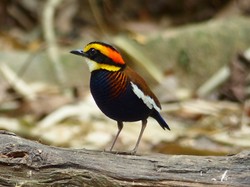
 Tmat Boey, in Cambodia, is one of the last examples of extensive tracts of lowland dry dipterocarp forest with traditional, low intensity, farming of rice fields scattered within the woodland and as such the last stronghold of the Critically Endangered Giant Ibis, a dinosaur of a bird that has not adapted well to the modern world as well as the almost as rare White-shouldered Ibis (pictured).
At times the forest here can look bare and barren, when the trees lose their leaves in the dry season, but in reality the forest of Tmat Boey is one of the most ecologically rich examples of this type of habitat remaining in the whole of Asia. A host of exciting woodpeckers can also be found here from the gigantic Great Slaty Woodpecker to the diminutive Grey-capped Pygmy Woodpecker. At Tmat Boey local communities protect the forest and, as a consequence, the biodiversity; the result is a forest where birds are abundant.

 Way Kambas, in South East Sumatra, is, most simply put, one of the most standout birding locations in the whole of Asia, I have been to few birding sites that can compare with it. Lowland rainforest has been devastated by the palm oil industry throughout Asia and there is very little of it left at all but Way Kambas protects one of the larger fragments that remains.

 Casting a view across the salt pans at Pak Thale between the months of November and March will reveal huge numbers of shorebirds both feeding and roosting at high tide. The numbers of birds present can be mind-boggling and the variety is superb with over thirty species possible in a morning at the best times. Add to this the rarity of birds such as Spoon-billed Sandpiper, Nordmann's Greenshank and Asian Dowitcher and this is arguably the richest shorebird site in the world.
 These snow-capped mountains along the Kazakhstan-Kyrgyzstan border with alpine meadows and fringing woodland provide one of the most stunning settings for any birding location in Asia that I have visited. With access from downtown Almaty, by taxi, taking only around 30-40 minutes this is both an easy place to visit and one that provides some superb birds.

 Braving the cold, snowy weather in the early morning at White Horse Hill is worth it for the spectacle that follows. Standing on this small hillock overlooking rice fields and the hills in the DMZ between North and South Koreas gives birders the perfect place to watch "The Flight of the Cranes".

 Crossing the river by boat in the early morning and then walking through the steamy gardens, plantations and forest at Kitulgala is a dreamy way to start birding in Sri Lanka and this site is often the first one that birders visit on a tour to the country.

 This part of the island of Sulawesi, in Indonesia, has some great forest along an undeveloped coastline both of which are great biding habitats. Comfortable accommodation, great local guides and some extremely stunning birds make this one of my favourite birding locations in the region.
 Crossing the river and arriving at Cat Tien National Park is exciting for birders as you see the top quality habitat and huge forest trees get closer and closer until you disembark into some of the best habitat in Vietnam. With pleasant accommodation and a good network of tracks this is the perfect location to track down desirable species that include Bar-bellied Pitta, Germain's Peacock Pheasant and Blue-rumped Pitta.

 Lowland rainforest in Southeast Asia is a habitat that has suffered greatly due to logging and conversion to palm oil plantations. However, at Taman Negara large areas of primary lowland rainforest are protected and a pleasant lodge along with a good network of trails allowing birders access to some of the best habitat in the region.

 Approaching Zaamin National Park by car is a breath-taking experience, passing through villages and farmland before entering vast steppe landscapes and thenclimbing into juniper-forested hillsides backed by towering snowy mountains which form a wonderful habitat to go birding within.
 Staying in a ger camp half way up the Jargalant Mountains offers remarkable views across the plains below with the solitude the Mongolian wilderness provides. The birding here is very productive with a wide variety of species as one climbs from the foothills to the peaks at over 3000 metres above sea level.
 These great birdwatching sites in Asia feature frequently in the birding tours I offer through my company, Calidris Birding Tours.
Comments
nickuptonDec 16, 2022
Actually the accommodation at Tangkoko is simple but very clean, comfortable and has en-suite bathroom and air con in every room. I really like the place. Taman Negara actually has a fairly high end resort on site, right in the forest. Most of the other locations require staying in a nearby hotel.
DerdriuMarrinerDec 15, 2022
But as a hot-weather lover and as a wildlife mapper, I also like the Indonesian, Korean, Malaysian, Thai and Vietnamese sites and wildlife.
How "simple" would simple accommodations be at Tangkoko, and would Taman Negara be the only above-mentioned location with "very comfortable accommodation available on site"?