Maureen was first to spot them, a column of small figures descending from the mustering point. "They' coming!" she cried and we scrambled to our feet. Nearby a young mother retrieved her infant from the droveway out of the cows' path. Cries of excitement went up from the crowd.
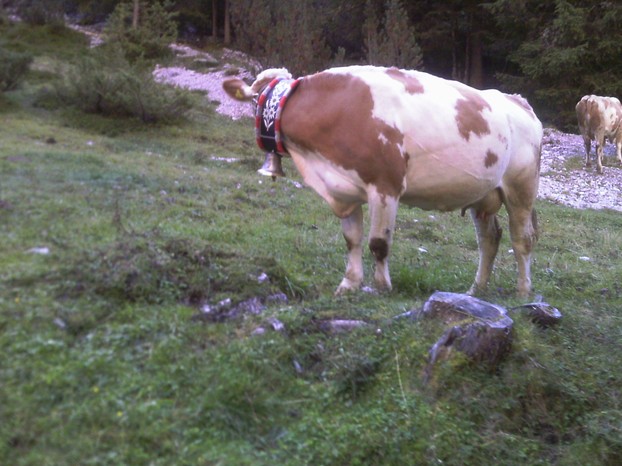
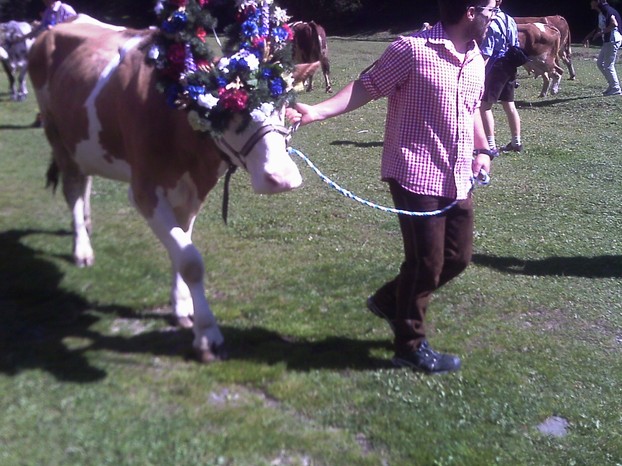
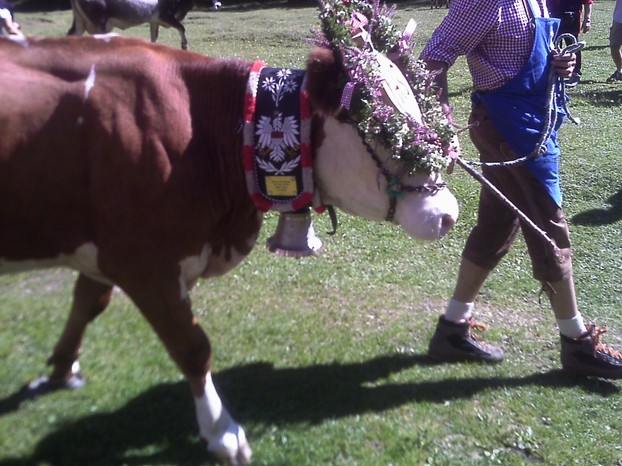
They came past, with the adorned cows leading and the others kept behind. Each cow was led by the farmer. It was no light task, for each cow weighed much more than a man. There were occasions when the farmer had to physically grapple with the cow when it strayed, and I saw the muscle required for the job.There were sturdy men driving large beasts. The men were not in national dress, for this was a heavy job that required work clothes.
Yet women and children accompanied them down One matron carried a conical wicker basket on her back as she strode authoritatively down to the ring in her Tirolean dress. I was later to see her retrieving her cow's horn adornment to carry home in the basket.She acquired a role giving out the contestants' numbers to them. I get the feeling that she liked to organise. I saw children in the ranks, herding the unadorned cows down. One girl of about eleven impressed me with her control of cattle, and she too walked in national costume, but to be fair she had a brother of about thirteen who did just as well.
As the languages in which the proceedings were carried out were French, German and the local language Ladin, I could not tell you much about what the judge said, but we saw the cattle parading the ring displaying their adornments. One was adorned with the Catholic symbol IHS [Iesu Hoc Sacramentum] and this pleased me, though she did not win.
The cheers went up as the first, second and third were decided. I think that the matron's entry came second and the impressive pair of children came third. The cows were paraded again led by the three winners. then all dispersed and the ceremony was over.
As one who loves country shows it was a lovely day for me, and Maureen has read it over to see how far it conforms to her experience. Tradition is a wonderful thing that enriches our lives. For a day I was privileged to be a spectator, but when I applauded I became for a brief moment a participant in the tradition.





 In the new national forest26 days ago
 The Boat Raceon 04/04/2026
 Darkness over the Earth the skies darkened when Jesus was crucifiedon 02/09/2026
 TheThousand Year Gardenon 11/26/2025


Comments
I think that the difference in speling atose from the fact that Amer8cans went for a more rational system ofspelling than the traditonal British system. A new country thought that the traditional spelliingrules were anachronis58c and drop0ed some of them
Thank you for your comment in answer to my previous observation and question.
Goat cheese and milk are appreciated in the United States even as their coats and meat account for respective trends -- such as goat-hair jackets very attractive in their grayness -- and constancy.
A related question -- about goats -- that can be considered somewhat unrelated -- about spelling -- concerns why Unitedkingdomers and Unitedstatesians spell the word respectively grey and gray?
Goats are not disliked, but they are more suited to dry conditions, such as those found in arid lands than sheep are, because wet conditions are bad for their feet. Goats are found in limestone country, such as the Great Orme in North Wales and in the Burren in Ireland, where the largest goat flock in the British Isles, is kept.
Goats are not disliked, but they are more suited to dry conditions, such as those found in arid lands than sheep are, because wet conditions are bad for their feet. Goats are found in limestone country, such as the Great Orme in North Wales and in the Burren in Ireland, where the largest goat flock in the British Isles, is kept.
Goats are not disliked, but they are more suited to dry conditions, such as those found in arid lands than sheep are, because wet conditions are bad for their feet. Goats are found in limestone country, such as the Great Orme in North Wales and in the Burren in Ireland, where the largest goat flock in the British Isles, is kept.
Goats are not disliked, but they are more suited to dry conditions, such as those found in arid lands than sheep are, because wet conditions are bad for their feet. Goats are found in limestone country, such as the Great Orme in North Wales and in the Burren in Ireland, where the largest goat flock in the British Isles, is kept.
Thank you for your comment below in answer to my previous observation and question.
Are goats not popular everywhere in the British Isles?
Is the afore-indicated dislike and unpopularity inherit in appearance, behavior, product (drinkable, edible, wearable, workable)?
Possibly. Or it might reflect an established dislike of goats, which have never been popular in the brirtish ixles
The book Collapse by Jared Diamond equates Faroe, Greenland, Iceland, Vinland Vikings with emphasizing pigs, cows and horses over goats and sheep.
Might that be an abandoned or a continuing cultural legacy from Viking England, Ireland, Manx, Orkney and Shetland?
cows are sometimes sent into cowsheds in winter.