
MONS, Belgium
The Battle of Mons has a resonance, especially with people in the UK, partly because the battle took place in the opening weeks of the war and the British suffered major losses here and partly because of the myth of the Angel of Mons which, according to the legend, protected the soldiers from the advancing enemy.
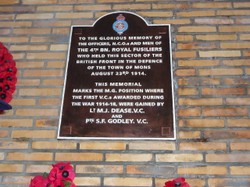
There are many Memorials dotted about the areas surrounding the town of Mons including a Memorial on the spot where the first shot of the war was fired  and a plaque on the opposite side of the road where the last shot was fired. There are plaques in the Grand Place of Mons and plaques on bridges, railway crossings and at Obourg Station.

Probably the most beautiful cemetery in Belgium is the Saint-Symphorien outide Mons, a place that invites reflection and meditation. 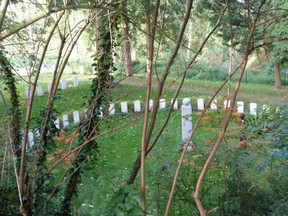 In a quiet spot surrounded by fields and trees lie the majority of those killed during the Battle of Mons.
The largest number of graves are those of the 4th Middlesex Regiment and those who died liberating the city in November 1918. It is unlike the upright row upon row of white stones one finds on most battlefield cemeteries. Here the graves are on many levels, in groups curved round a grassy sward, or down a track to a hidden copse. It is also a place of reconciliation as there are two areas, one devoted to German graves and one to British graves.
The image below shows two white headstones one behind the other, the one in the foreground dating from 1914 and one behind it and to the left dated 1918. It couldn't be more poignant.

The new Mons Memorial Museum is due to open in 1915 and I am sure this will be a place that all visitors will want to visit. I have seen the advance publicity for this and I am very impressed.


 The illustration shown here is the house in its original state, not as it now appears.

Comments
No comments yet.