Scaredy Squirrel is a New World flying squirrel, of which only two species exist.
Geographical distribution of the Northern Flying Squirrel (Glaucomys sabrinus).
borders of the Glaucomys sabrinus range drawn according to IUCN Red List spatial data: Darekk2/The author of the work and the IUCN Red List spatial data, CC BY SA 4.0, via Wikimedia Commons @ https://commons.wikimedia.org/wiki/File:Northern_flying_squirrel_Glaucomys_sabrinus_distribution_map.png
Owls, especially Northern Spotted Owls (Strix occidentalis caurina), are nightmares for their preferred prey, New World Flying Squirrels.
Northern Spotted Owl near McKenzie River, central Oregon.
John and Karen Hollingsworth/USFS Region 5 (Pacific Southwest): US Fish and Wildlife Service, Public Domain, via Wikimedia Commons @ https://commons.wikimedia.org/wiki/File:Northern_Spotted_Owl.USFWS.jpg; Public Domain, via USFWS National Digital Library @ https://digitalmedia.fws.gov/digital/collection/natdiglib/id/2222
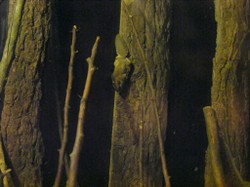
Scaredy Squirrel is a New World flying squirrel, of which only two species exist; flying squirrels are nocturnal.
Southern flying squirrel (Glaucomys volans) at Ark Animal Sanctuary: Marie Hale, CC BY 2.0, via Flickr @ https://www.flickr.com/photos/15016964@N02/5921781884/
Southern Flying Squirrels (Glaucomys volans) consider a variety of food sources in their foraging.
Cleveland, Cuyahoga County, northeastern Ohio: LASZLO ILYES (laszlo-photo), CC BY 2.0, via Flickr @ https://www.flickr.com/photos/laszlo-photo/927878825/
The New World's two species of flying squirrels (Glaucomys) number among small mammal predators of pesky Gypsy Moth (Lymantria dispar).
closeup of Gypsy moth (Lymantria dispar) larvae: USDA Forest Service -- Northeastern Area, USDA Forest Service, Bugwood.org, CC BY 3.0, via Forestry Images @ https://www.forestryimages.org/browse/detail.cfm?imgnum=1396067



Comments
No comments yet.