

The letters of the Burmese alphabet assume the rounded shapes of broken and intertwining circles. The shapes betray the traditional instruments and materials for writing the language: styluses applied to palm leaves. The stylus configures in the writing of many of the world’s languages, from ancient Sumer’s cuneiform of about 3500 B.C. onward. It cooperates nicely with the Burmese alphabet, which combines consonant letters and vowel notations into units. The Burmese language’s writing system dates back to the tenth or eleventh century. It exists today in a fluid form which responds to:
- Commercial, scientific, and technological updates;
- Latin alphabet transliterations.
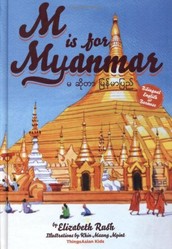
It has to count among the world’s prettiest writing systems, as evidenced in M is for Myanmar.




Comments
DerdriuMarrinerDec 13, 2014
MBCDec 12, 2014