Wizzley
PopularLatestDiscussedEditor's Choice
AuthorsForum
Wizzley

A community of writers publishing stories worth your time — on the topics they know and love.

Explore

  • Popular
  • Latest
  • Discussed
  • Editor's Choice

Community

  • Top authors
  • New authors

Service

  • Help
  • Contact
  • Imprint
  • Terms of Use
  • Privacy

Check out our other international Webhaus communities!

Explore another site:English·Deutsch

© 2026 Webhaus LLC. All rights reserved.

LiteratureBooks, Genres, ReviewsArt & DesignArt and The ArtsCulture & SocietyHistory, Religion, PoliticsEducationSchool and LearningEntertainmentMovies, Celebs and TV
Article

Childrens Book Review of Pascual and the Kitchen Angels by Tomie dePaola

Angels are Earth’s guardians. Their workloads get eased by and shared with saints. The story of the cook’s guardians and patron saint is told in “Pascual and the Kitchen Angels.”

Kitchens appear to occupy no middle ground. They assume the personalities of their cooks and vice versa. They can be as; • cheerful, commodious, and creative as their most accomplished, applauded chefs; • daunted, desperate, and disorderly as their most fearful, overwhelmed hash-slingers. Either way, they generally do not get included on lists of quiet get-away places, rooms, and spaces. Unmistakable screams of horror apart, the level of kitchen-emanated noise typically gives no clue as to course or outcome of the food being prepared. For example, the Franciscan friars of the Alcantrine Reform at the Loreto monastery have no idea of the cluelessness behind the noisy kitchen of culinary Patron Saint “Pascual and the Kitchen Angels.”

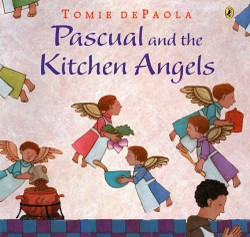
Pascual's angelic experiences in the kitchen, for which he is honored as Patron Saint of Bakers and Cooks, are depicted charmingly in Tomie dePaola's children's story, "Pascual and the Kitchen Angels."

Museu de Belles Arts de València, east central coastal Spain
Museu de Belles Arts de València, east central coastal Spain — Public Domain, via Wikimedia Commons


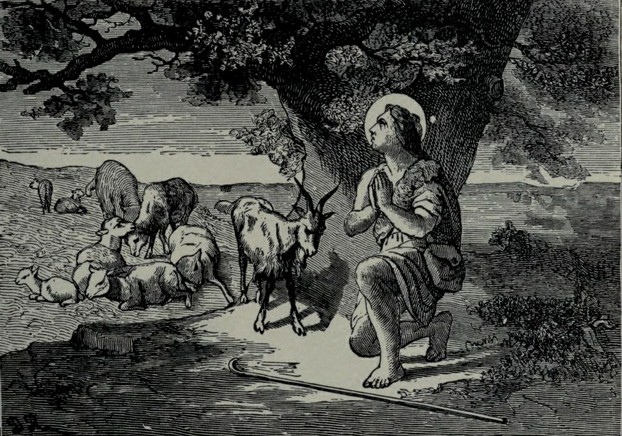
Pasquale Baylón Yubero (May 16, 1540 – May 17, 1592) was born in the village of Torrehermosa (“Beautiful tower”) in what then was the Kingdom of Aragon at what now is the Aragonese autonomous region within the Kingdom of Spain. He was given his Christian name for being born on la Pascua de Pentecostés (“the Feast of Pentecost”). Because of his love for animals, he was guided by his humble parents, Martino Baylón and Isabella Yubero, into being a shepherd. But he subsequently was permitted to make a career change because of:

  • Getting disputes ended peacefully;
  • Giving his food to the hungry;
  • Learning to read and write;
  • Perusing religious books;
  • Praying throughout the day;
  • Singing with the sheep.


Young Pascual expressed his love for animals through prayer-filled care as a singing shepherd.

John Gilmary Shea, Pictorial Lives of the Saints (1922), p. 259
John Gilmary Shea, Pictorial Lives of the Saints (1922), p. 259 — Not in copyright, via Internet Archive


Pascual was accepted as a lay brother by the Franciscan friars of the Alcantrine Reform at Loreto’s monastery. As an autodidact (“self-taught”), he was allowed to do menial tasks instead of:

  • Feeding the poor;
  • Preaching.

Despite not knowing how to cook, he was assigned to kitchen duty for gifting the friars his Mother’s basket brimming with:

  • Cheeses;
  • Dried beans;
  • Eggs;
  • Flour;
  • Fruits;
  • Vegetables.

While he prayed with eyes closed and knees against the hard stone floor, his work was completed by angels and witnessed by the kitchen cat. Pascual thenceforth was given:

  • A friar’s habit for putting on the table apricots, beans, breads, cheeses, and oranges;
  • The responsibility of cooking for the friars and feeding the hungry.


St. Pasquale (Paschal) Baylon with sheep (bottom right)

Couvent Saint-François (St Francis Convent), Paris, north central France
Couvent Saint-François (St Francis Convent), Paris, north central France — GFreihalter, CC BY SA 3.0 (https://creativecommons.org/licenses/by-sa/3.0/deed.en), via Wikimedia Commons

Conclusion


The story of Pascual -- Patron Saint of bakers, cooks, and shepherds -- numbers among the inspiring biographies of subsequently famous people who know early on what they hope to accomplish in life. In this regard, his résumé parallels that of author - illustrator Tomie dePaola, who remembers planning an artistic career as a four-year-old. Pascual and the Kitchen Angels indeed respects childhood experiences and personal preferences through the astute choices of:

  • Gina DiMassi and Marikka Tamur as designers;
  • G.P. Putnam’s Sons as publisher;
  • South China Printing Co. Ltd. as manufacturer.

Painted in acrylics and gesso on 140-pound handmade rough watercolor paper and typeset in Raleigh Demi Bold, the 2004-released publication welcomes ages 4 years and upward.


"Telling Stories with Tomie 'Food as Storytelling'" (2:49)

Uploaded May 10, 2013, by The Jim Henson Company to YouTube ~ URL: https://www.youtube.com/watch?v=tTnT1O7rYWI

Telling Stories with Tomie "Food as Storytelling"

Acknowledgment


My special thanks to talented artists and photographers/concerned organizations who make their fine images available on the internet.


Image Credits


Pascual's angelic experiences in the kitchen, for which he is honored as Patron Saint of Bakers and Cooks, are depicted charmingly in Tomie dePaola's children's story, "Pascual and the Kitchen Angels."
Aparició de l'Eucaristia a Sant Pasqual Bailon ("Apparition of the Eucharest to Saint Pasquale Baylon") by Bernardo López Piquer (August 20, 1801 – August 1, 1874)
Museu de Belles Arts de València, east central coastal Spain: Public Domain, via Wikimedia Commons @ https://commons.wikimedia.org/wiki/File:SantosBailon.jpg

Young Pascual expressed his love for animals through prayer-filled care as a singing shepherd.
John Gilmary Shea, Pictorial Lives of the Saints (1922), p. 259: Not in copyright, via Internet Archive @ https://archive.org/details/pictoriallivesof00sheauoft/page/259/mode/1up

St. Pasquale (Paschal) Baylon with sheep (bottom right)
Couvent Saint-François (St Francis Convent), Paris, north central France: GFreihalter, CC BY SA 3.0, via Wikimedia Commons @ https://commons.wikimedia.org/wiki/File:Paris_Chapelle_des_Franciscains172.JPG

"Telling Stories with Tomie 'Food as Storytelling'" (2:49)
Uploaded May 10, 2013, by The Jim Henson Company to YouTube ~ URL: https://www.youtube.com/watch?v=tTnT1O7rYWI


Sources Consulted


dePaola, Tomie. 2004. Pascual and the Kitchen Angels. New York, NY: G.P. Putnam's Sons.

“Pascual and the Kitchen Angels.” Tomie.com: Tomie’s Books > Bibliography. Retrieved December 8, 2014.

  • Available at: http://www.tomie.com/books/bibliography/2004/pascual.html

“17 de mayo San Pascual Bailón (1540 – 1592).” Directorio Franciscano: Santoral Franciscano. Franciscanos.org. Retrieved December 8, 2014.

  • Available at: http://www.franciscanos.org/santoral/pascualbailon.htm

Shea, John Gilmary. 1922. Pictorial Lives of the Saints With Reflections for Every Day of the Year: Compiled from "Butler's Lives" and Other Approved Sources; To Which Are Added Lives of Certain Saints Contained in the Calendar of Special Feasts for the United States and Some Others Recently Canonized. New York, Cincinnati, Chicago: Benziger Brothers.

  • Available via Internet Archive at: https://archive.org/details/pictoriallivesof00shea


the end which is also the beginning
the end which is also the beginning — OpenClips, Public Domain, via Pixabay

Pascual and the Kitchen Angels by Tomie dePaola ~ Available via Amazon

Tomie dePaola stories

Advertisement

Me and my purrfectly purrfect Maine coon kittycat, Augusta "Gusty" Sunshine

DerdriuMarriner, All Rights Reserved

Updated April 18, 2026

Comments

No comments yet.

DerdriuMarriner
DerdriuMarriner
536 articles
★ Editor's Choice
FollowMessage

Related articles

  • Childrens Book Review of The Night of Las Posadas Written and Illustrated by Tomie dePaola
  • Childrens Book Review of The Legend of the Poinsettia Retold and Illustrated by Tomie dePaola
  • Childrens Book Review of Adelita: A Mexican Cinderella Story by Tomie dePaola
  • Childrens Book Review of The Santero's Miracle: A Bilingual Story by Rudolfo Anaya