
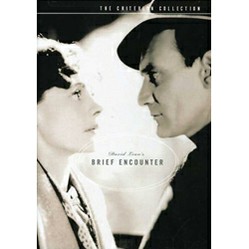

I won’t spoil the details of the story for you. I’ll just say that it’s about a romance between a married housewife (Laura Jesson, played by Celia Johnson) and a married doctor (Alec Harvey, played by Trevor Howard) that grows out of “brief encounters” at a railway station and in the countryside.
In terms of film technique, the direction and choice of symbols here are truly wonderful, even as they are rather clichéd by now in cinema: steam trains puffing out of the train station and intense, dramatic music (Rachmaninoff’s Piano Concerto No. 2) for sexual passion; the lying other seen in a mirror; Laura’s interest in Rachmaninoff, which suggests she was more than a colorless, sedate housewife; the text frames in the films they see at the cinema, reading “Flames of Passion” in blaring letters; the lightning that brings out, subtly or forcefully, Laura’s emotions; the lackluster backdrop of a railway station that fits the story of repressed emotion; the stir around the counter in the refreshment area (manned by Myrtle Bagot as Joyce Carey), where, in the manner of literature and films on social class manners there’s a foil to the main romance; dark, rainy streets that echo the mood of the story . . . all this makes for memorable cinema.


Comments
MiraNov 29, 2016
DerdriuMarrinerNov 29, 2016
P.S. Good use of the word "git," one of those great slang words that Brits use to perfection and that don't get used near enough on this side of the pond.
MiraFeb 11, 2013
WiseFoolFeb 11, 2013
MiraFeb 11, 2013
GuestFeb 10, 2013