
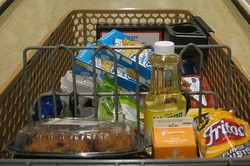
 Inventory Your Meats
Unless you are a vegetarian, I suggest you begin with meats. Make a written list of all the meats you have in the freezer or refrigerator. If the portion will make enough for multiple meals, indicate that on your list. Dig way back in the freezer and find all the possibilities.
After the meats are listed, think of non-meat protein sources like beans and eggs. Write those down too as meat alternatives.
Brainstorm Main Dishes
Looking at your list of meats, begin to think of possible meals you can create around them. Jot down the ideas. Take a glance at your staples, canned goods, and produce to get inspiration for meat dishes. If you have lots of beans and canned tomatoes, maybe you can make chili with that ground beef. If you have lots of wilting produce, making a pot of soup is probably the best choice.
Since your goal is to stretch what is on hand, consider casseroles that include rice and pasta so that less meat is needed for each meal. Can you make that 2 pounds of meat stretch to three meals instead of the normal two meals by adding a bit more rice to the dish?
If you think of a dish but don't have all the ingredients, consider modifying the recipe. Can you substitute pepper for the celery or pasta for the rice? Be inventive!
Look at the links at the bottom of this page for some online recipe finders that use the ingredients that you enter.
Think Outside the Box
Try making breakfast for dinner. Pancakes or omelets are still good at night, and you probably have the ingredients on hand.
Literally think outside the box. Instead of relying on a packaged mix that you don't have, try making it from scratch if you have the ingredients.
Plan for a Smorgasbord Night
Are there leftovers in the refrigerator that should be eaten? It could be that there is a little bit of many different dishes. Set it out and let everyone prepare a plate to reheat in the microwave.
Or to make smorgasbord night a bit classier, put the food on baking sheets to heat through and crisp up. Add cheese or bread crumbs to liven up leftovers.
Share Your Budget Stretching Tips Here
Jerrico_UsherMay 27, 2012
SaraOct 15, 2011
holly-daySep 27, 2011
dustytoesSep 21, 2011
lakeerieartistsSep 14, 2011
mandeesearsSep 4, 2011
T_Harmon_ArtSep 4, 2011
GuestSep 3, 2011
Regarding one of the comments, emergency food storage, at least in NW Montana, emergency food is a process done completely "separate" from a pantry - it is emergency food put in storage containers for its intended purpose...never mixed in with a normal pantry! I understand you're talking about normal food in our homes...:)
Our tips? Well, as frugalrvers, we don't have a lot of space, but we absolutely use everything we have. We don't plan a menu and then shop. We make the rounds at 3 different grocery stores a few times per month, picking up what is on sale, and make a menu around those items...otherwise you can easily overspend. We know one store always has a huge bag of boneless chicken breasts for $4.95, we go there for that item, etc. We also don't get hooked with coupons, because it makes us overspend, not save money! We also make big meals and then have them 2 nights later, or freeze them, because usually buying larger quantities is cheaper.
So, living frugally, we follow a lot of your tips and have some of our own. You can save a fortune on food costs if you only buy what is on sale, and buy in large quantities. We appreciate every dollar in our hand, and picture (when contemplating overspending) throwing a dollar in the garbage if we buy that item. We don't need a $2.30 roll of paper towels, for example. If you have to go to the store (and we eat mainly fresh produce, etc. which can spoil), it might be for just an "extra" you ran out of or need, but not a $100 grocery bill you didn't need.
Loved your article!
SBSep 2, 2011
JoeBlowSep 2, 2011
TerriRexsonSep 2, 2011
ohcarolineSep 2, 2011
kajohuSep 2, 2011
chefkeemSep 2, 2011