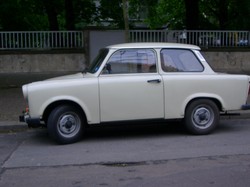
The thumbnail picture above the title of this article is one of the old Trabants that at one time was the only available car to the citizens of Leipzig. No longer. Today that city from the former East Germany is a powerhouse of trade and a cultural centre for all things musical, attracting visitors throughout the year to worship at the shrines to the many famous musicians who once resided here.
But Leipzig has more claims to fame than just its musical heritage. The Nikolaikirche (St. Nikolai Church) was the ignition point of the peaceful revolution which brought down the Berlin Wall in 1989. The demonstration of Octobe r 9th attracted 70,000 people a number that increased to 120,000 the following week and to 320,000 on October 23rd when the demonstrators marched from Nikolaikirche to the Stasi HQ. By November 9th the Berlin Wall was down.
 Even if not shopping, stop in for a coffee at one of the delightful coffeee houses where the coffee mit kuchen just has to be sampled, and listen to the carillon of Meissen porcelain bells which, I hope, are still ringing out. Built before the First World War it has glass ceilings, marble floors and walls, a cellar hall with wooden panelling, painted arches and elaborate light fittings. It attracts an artistic Bohemian clientele partly because of the coffee shops, oyster and champagne bars, and live piano music. Leipzig's Central Station is one of the most modern shopping centres in Germany and several well-known department stores can be found here.
 And everywhere, you will find a statue to a famous musician who once resided in this beautiful cultural city.
Comments
MaritravelAug 14, 2013
jptanabeAug 14, 2013