
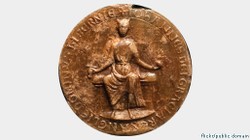
Apart from seeing a Prime Minister spout on about democracy, this a Prime Minister who wants to repeal the Human Rights Act, it was the sight of a child saying he can go to school today because of Magna Carta, so infuriated me. The child had obviously been told to say this. Magna Carta has nothing whatsoever to do with children going to school today . It has nothing to do with democracy . The Barons would have been absolutely appalled at the idea that 800 years later Magna Carta was being used to help "the lowest in society " take their place and have rights. The clauses of Magna Carta have nothing to do with equality and democracy. The ideas that it was an ancient right of protection is the stuff of myth and legend. It is quite incorrectly seen as a symbol of liberty. It wasn't.
Magna Carta was an agreement between the King, Church and Barons that secured the rights of first and foremost the Church and then the Barons. Indeed the first and last clauses concern the rights of the Church. What is little known is that indeed, King John had scrapped Magna Carta within a few weeks of it being sealed. He had not in fact signed it. It was sealed.
Background to the Magna Carta
John's father King Henry 11 had tried to set up legal and administrative systems in England that would make for smooth government but a feuding family, his son King Richard's expensive Crusade campaigns had left the country in a poor shape financially. John was a good administrator and built up the finances of the land very well, largely through impositions placed on the Church and Barons. This made him very unpopular and he became even more so when he lost his inherited French lands to France. He spent several years trying to regain them, lost the money and taxed the Barons further so upon his return to England was facing a rebellion. The Church and the Barons were ready for confrontation. The rights of the poor had nothing to do with the confrontation. The Barons were in this for themselves as was the Church.
Events and consequences
John met the Barons and Church leaders at Runneymede near Windsor in June 1215 and after a few days had thrashed out details which protected the Barons and Church from excessive taxation, imprisonment and set out the rights of Church, Barons and Freemen. Serfs and peasants who accounted for much of the population, were totally excluded. It promised to protect church rights, protect for the Barons from illegal imprisonment, give Barons access to swift justice, and limit payments to the Crown.
Within weeks John had appealed to the Pope saying that Magna Carta compromised the Pope's rights and had Magna Carta overturned. It was issued and reissued many times over the next decades.
Most of the clauses in Magna Carta are obsolete today. The clauses have no bearing on 21st Century life and it is good that some certainly no longer apply, such as Clause 11 which states that if anyone dies in debt to a Jew, the Jew doesn't have to be repaid. Laws of liberty and democracy have superseded Magna Carta.
Nowhere in Magna Carta is democracy mentioned. But its clauses have been adapted into many national constitutions and it is held in reverence as the role model for a constitution, The American Bill of Rights for one. Magna Carta was a temporary peace agreement between King, Church and Barons.
It was never intended to be a symbol of democracy and equality.
Comments
DerdriuMarrinerMay 10, 2024
It impels me to mull why no societal money- and power-holders between barons and king merited mention.
Might King John have been leaving viscounts, marquesses and dukes alone or might he have been not quite so outrageous according to their perceptions of perceived infractions and intrusions?
frankbeswickSep 5, 2017
Was Edward the First a good king, yes as long as you consider subduing Wales and launching unjustified invasions of Scotland and France, during which he launched a massacre at Berwick upon Tweed, as constituting a good king! I regard him as a murderous thug.
frankbeswickSep 5, 2017
VeronicaSep 5, 2017
Robin Hood as a legend is still seen as a jolly fellow. The truth of the matter is that he was an outlaw and bribed the poor not to give him up to the authorities by giving them part of his loot.
Edward 1 is seen as a good king but the others you mention don't get a look-in. Robin is traditionally believed to have lived in the time of King Richard The Lionheart an Richard's brother John.
VeronicaSep 5, 2017
Magna Carta was never for "society ". It was for the benefit of the church and nobility. The ordinary people had nothing to do with it.
frankbeswickSep 5, 2017
DerdriuMarrinerSep 5, 2017
The Navajo believe that good leaves this world with death whereas evil lingers. It's interesting that King John's reputation here lingers as evil, possibly because of losing the royal treasure in the Wash and predominantly because of Magna Carta's and Robin Hood's good reputations on this side of the Atlantic pond. And yet King John may have been an effective administrator and chief financial officer whereas Magna Carta at its time and in fact may have been very different from its twenty-first-century presentations.
Also, historians here prefer Kings Henry III, Edward I or Edward II, not King John, as Robin Hood's monarch. What is the interpretation on your side of the pond?
GuestJul 9, 2015
frankbeswickJul 4, 2015
I think that people took it up and declared their support for it because it promoted the values that would eventually give rise to democracy.
VeronicaJul 4, 2015
frankbeswickJul 4, 2015
blackspanielgalleryJul 4, 2015
VeronicaJul 4, 2015
You are right ; it has been invoked by many fighting against government oppression. Maybe this is a good thing if it helps a cause for liberty. It's just unfortunate that "imprisonment of an individual without due process" actually referred to the Church and Barons only.
DavidPaulWagnerJul 4, 2015
VeronicaJul 1, 2015
MiraJul 1, 2015
VeronicaJun 16, 2015