
Wizzley
PopularLatestDiscussedEditor's Choice
AuthorsForum
Wizzley

A community of writers publishing stories worth your time — on the topics they know and love.

Explore

  • Popular
  • Latest
  • Discussed
  • Editor's Choice

Community

  • Top authors
  • New authors

Service

  • Help
  • Contact
  • Imprint
  • Terms of Use
  • Privacy

Check out our other international Webhaus communities!

Explore another site:English·Deutsch

© 2026 Webhaus LLC. All rights reserved.

TravelVacations and ExcursionsCulture & SocietyHistory, Religion, PoliticsFood & RecipesCooks and CookingCelebrationHolidays and OccasionsReal EstateHome Buying and Moving
Article

Norton Priory, Runcorn, Cheshire

A tasteful and sympathetic re-development of a much loved attraction has lost none of its original charm. Today, I went to Norton Priory, Cheshire.

Whenever I hear about a well loved site being "redeveloped" or "improved" my heart sinks into my boots and I ask myself if a place has been "ruined " in my opinion. My fears were in vain when I visited the newly developed Norton Priory today. It's excellent in every way and the development has lost none of the original features whilst adding new ones. Visitors to the NW England, please take time out of your schedule and call in to Norton Priory, where you will get a taste of hundreds of years of British History all on one site. I am very intuitive and always have been. The moment I stepped into the new Reception area, I "felt" that I had walked in to something remarkable. The two staff members on the desk were welcoming and knowledgeable. Nothing was too much trouble for Lesley. She knew everything that we could possibly need for an enjoyable visit. I am a historian of course and own a small history business so I was interested to see how the subject matter was presented. It was all excellent. Take a look at what I found today. This is not a history of Norton although that is involved. This is a description of a gentle, quiet and wonderful tourist attraction. The photos are my own and were taken by me today. REFERENCE MATERIAL http://www.augustinian.org/order/ Norton Priory guide book
old map of local priories and abbeys

Norton History in a nutshell

(  EDIT ) A Community of Augustinian Canons not to be confused with Augustinians who were founded in 1244,  needed a larger building and moved from Runcorn to Norton in 1134 to build a new Priory.  

The Augustinian Canons  worked in the community and helped the people. Locals were welcome to visit the Priory and receive medical treatment as it was then.

The Priory was constantly being added to over the centuries and developed, becoming  a private house during Tudor times, 16thC. The family sided with Parliament  against King Charles 1 during the 17thC English Civil War. A Georgian house was built on the site during the 18th C.  The house was sold in 1921 and mainly demolished in 1928.

Thus Norton's history has spanned over hundreds of years and there is still evidence of it around.

St Christopher

I was delighted to see the St Christopher Statue was still at Norton. It is made of local sandstone, stands about 12 ft tall and depicts the legend of St Christopher carrying the Christ child across the river. The image of St Christopher is continued in a stained glass window in The Undercroft. How beautiful!

The statue dates from the late 1300's.

St Christopher
St Christopher window

Tiles

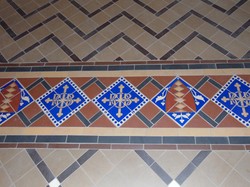
Norton has a large collection of beautiful, mosaic Medieval tiles cut in clay.  The tiles were made on site and a tile kiln was found by archaeologists working on the site.  

Beautiful tiles

The Undercroft

The Undercroft is the only remaining part of the building from the Medieval era. It was a large storage area for food. drink and cloth. The ceilings are magnificent and full of medieval arches as seen below. The storage areas are still evident. It was built in the late 12thC.

The undercroft arched ceilings
Storage facility

The Cloister reconstruction

The Cloister was at the centre of the Priory and part of it has been reconstructed in the museum area. Look at the detail.

The ruins outside show how thick the Priory walls were.

13thC Cloister arcade
The ruin walls

The bell

Archaeologists discovered the remains of a bell foundry at Norton and this bell is believed to be a faithful copy of the HUGE  Priory Bell.

The replica bell

The reconstructed herb garden

A monastic herb garden has been developed based on designs from other cathedrals and abbeys. Raised beds have been used and there are several herbs for medicinal uses which reflect Norton's past as a place of healing. Here are just a couple of herbs.

Herb garden

Herbs
Lungwort in herb garden

Medicine and Paget's Disease

Osteo- archaeologists have discovered that many of the skeletons at Norton have signs of Paget's disease which can have viral, genetic or environmental causes. The disease causes bone malformations.

Medicine

Skeleton with signs of Paget's Disease
Medical equipment !

These are some replicas of medicinal equipment used at the time.

Walled garden

The gate

The walled garden is the best I have seen. It is completely enclosed. Cleverly, they had a flower pot people trail for the children to follow and find. This made it far more interesting for little children and our grandson loved it. The flower pot people had names such as Harry Pot- ter , Beatrix Pot-ter.

Apple trees were trained against the walls and the Spring flowers were spectacular. Look at those colours placed together.

Last of all, there was a different type of Bee Hotel, this one for solitary bees.


Flower pot people search

The flower pot people
Flower pot people
Flower pot people

Flowers

Stunning flowers
The colours
The combination of red and blue here. Beautiful
Trees trained against the walls

And another bee hotel

Bee hotel

Norton Priory

What a wonderful day at Norton. It is a must-visit if you have a chance so just GO THERE.

It is clean, accessible, fascinating, beautifully maintained, well staffed,  soothing and restful. Enjoy it.

We will return.

Updated October 24, 2019

Comments

VeronicaAug 27, 2024

ENGLISH SURNAMES come into only a few categories, :- place names, father's first names, occupations ...etc

Norton is a place name reflecting position ..... North of a settlement in a clearing

DerdriuMarrinerAug 27, 2024

The computer crashed before I commenced other history-concerned components to my comment below.

Names, more of families and places than of things intrigue me. But in this case Norton Priory intrigues me.

Is it known why Norton is in the name?

DerdriuMarrinerAug 26, 2024

Thank you for your comment below, on Apr 20, 2017, in answer to my previous observation and statement.

The third paragraph to the first subheading, Norton history in a nutshell, alerts us that "The Priory was constantly being added to over the centuries and developed, becoming a private house during Tudor times, 16thC. The family sided with Parliament against King Charles 1 during the 17thC English Civil War. A Georgian house was built on the site during the 18th C. The house was sold in 1921 and mainly demolished in 1928."

Does history keep for us the names of those two families even as people did not keep the houses that they built?

frankbeswickJan 8, 2019

I had forgotten that you were in Florida. Florida is rather different from Britain. When looking up bees in my books I I noted that even Southern Britain has more bee species than we have in Northern England, so we are not well blessed with variety. We do, though, have mason bees, which like to tunnel, so they may be attracted to the bee hotel. I have definitely seen them on my allotment.

Maybe I will do an article on bee hotels, but not today. I am relaxing today.

VeronicaJan 7, 2019

He knows he is my favourite brother. I am his only sister so he hasn't much choice in sisters.

dustytoesJan 7, 2019

That is good info Frank, but I doubt it applies to Florida. We have bugs, and bees, year round. There is also no shortage of blooming plants, although not necessarily in my yard. I have searched online and found info at the University of Florida site with a page about "Pollinator Hotels".
BTW... you are the "favorite" brother Frank... did you read that?
I think you should do a whole Wizzley on this subject, or have you begun that already?

VeronicaJan 7, 2019

Frank..... Maybe a bee hotel article is timely

VeronicaJan 7, 2019

great information

frankbeswickJan 7, 2019

You can set up bee hotel whenever you like, but you will have to wait for results, as the bees are currently [January] in their hives/cells/nests and unlikely to move until spring. The best strategy to take is to research bee-friendly flowers and plan to plant them in your garden. The best way is to plant a succession of flowers that will provide summer-long nectar for the bees.

In fall, don't be worried if you see a tunnel in your bee hotel blocked with mud, for this is a sign that a female bee has laid her egg there.

VeronicaJan 7, 2019

Thank you. Dusty. If you don't find enough information about them on Wizzley then I am sure my favourite brother Frank would have some ideas if you asked him. In fact... he's likely to give his ideas whether he is asked or not. :)

dustytoesJan 7, 2019

You two will be the first to know if I have success!

VeronicaJan 7, 2019

The point Frank makes is though that his bees were nesting in WOODEN pallets. So maple logs, bits of wood of different sizes , wooden logs sound ideal .
If you go ahead, Frank and I would LOVE to hear about it here on Wizzley and who knows your efforts may inspire others.

VeronicaJan 7, 2019

Dusty
You have nothing to lose by trying to make one. If anything, they are a great talking point . I am not an expert on them. I do know that having two has increased the bee population in my garden. Mine are for solitary bees .

frankbeswickJan 6, 2019

Bee hotels cater for solitary bees, of which there are several species. A properly made bee hotel contains holes of different sizes to cater for different bee species.I think that you need to research American bee species.

But bees can find homes in many places. I once found that bumble bees were nesting in a pile of pallets on my allotment.

dustytoesJan 6, 2019

Well, Americans may know about them, but it's new to this American! Haha...I have some maple logs that might work. Occasionally my son has an evening fire, so he collects wood when neighbors cut down trees.

VeronicaJan 6, 2019

Dusty
That is amazing and thanks for " doing your bit " . It is possible to buy some hollow wood tubing and there are tutorials online in how to make them . I am surprised that Americans don't know more about them . As I say, I have two.

dustytoesJan 6, 2019

I guess it couldn't hurt to try it! I don't have many flowering plants in my yard, but I do see bees coming to my vegetable flowers, which grow year round here.

VeronicaJan 6, 2019

possibly I am no expert on this topic.

VeronicaJan 6, 2019

Bees are vital to our environment but the destruction of their habitats is causing a decline in numbers. Therefore in Uk people have started putting even the smallest bee hotels in their gardens . They do seem to attract bees to our gardens to help pollinate plants.

I do hope you can find one or even make one. The big tourist locations have these huge ones . Mine are tiny but still attract bees.

dustytoesJan 6, 2019

Thanks to both of you for the answers to my question. Your mention of a bee hotel got me searching for more info. Now I am wondering if Florida bees would live in one. But there are so many creatures here, I doubt it. I'll have to do more research.

frankbeswickJan 5, 2019

The tree that you picture looks fan-trained.

VeronicaJan 4, 2019

Frank
Thank you. You are the best to answer this with your vast horticulture knowledge.

frankbeswickJan 4, 2019

Trees trained against walls can be espalier, cordon or fan trained.Apples and pears are often espaliered, meaning that they have at best six long, horizontal branches. Cordon apples are trained to be diagonal, but can have more branches. Stone fruits, such as plums and cherries, are often fan trained, as this method involves less pruning and stone fruits dislike being pruned.

Not all apples are suitable for espalier.

VeronicaJan 4, 2019

Dusty
Looking at today's currency converter, admission to Norton museum ruin and walled garden would be Sterling/ dollar ….
Adult approx. $10.00
Child approx. $7.00
Tickets just for the walled garden would be equivalent to only $4.

It is not an expensive day out.

VeronicaJan 4, 2019

Dusty, thank you, Isn't it a delight ?
The priory itself is open every day but the Walled Garden is open 12pm - 4pm April to October and is closed from November through March.
The trees trained against walls such as at Chadkirk and at Norton are usually fruit trees . Obviously in NW England it would be apples which are quite hardy. It can get a bit chilly here at times :)

Bee hotels are very popular now in UK as we try to encourage bees in order to protect the environment. I have two tiny bee hotels with single holes or solitary bees. The bee population in my garden has increased.

As you say, the gate to the Walled Garden is beautiful. I once took a class of 5 year olds to Norton and they loved the gate and walled garden. the wardens took them into the herb plot and allowed the children to tickle the herbs to release the scents. The children were delighted!

dustytoesJan 4, 2019

I would love to go there...!! The Bee Hotel is quite unique. What types of trees are generally trained against the walls? It looks like an apple, or some type of fruit tree. That gate is gorgeous as well. Can you visit year round, or does it close for winter?

VeronicaAug 14, 2018

I visited Norton Priory again today and had a wonderful day out again.

They are holding a Quince and Apple Day in the walled garden on October 14th 2018 so if you are in the area you need to get along there for a fantastic day out.

VeronicaApr 21, 2017

Frank ( happy anniversary )

Yes the point is that a higher percentage of the 130 skeletons had signs of Paget's than would normally be found in a population generally so it is likely that there was a genetic disposition in the locality.
It is amazing what can be discovered these days.

frankbeswickApr 20, 2017

Many monasteries drew their members from local people, so genetic diseases common in an area would be present in a monastery.

VeronicaApr 20, 2017

Derdriu

Great point ! Yes indeed, it is believed that having so many together may indicate that it was part of the same extended family. But then Norton was a bit of a medical centre and people went there for help.

I think there must have been some genetic disposition.

DerdriuMarrinerApr 20, 2017

Veronica, Thank you for yet another beautiful tour! My favorites are the bee hotel, the espaliering and the undercroft.
Do you know why so many of the burials from the community indicate the prevalence of Paget's disease? Could it be that many were members of an extended family?

VeronicaApr 17, 2017

Thank you. You are right but not only does the history go back thousands of years but people have done much to preserve it too, as Angela points out.

Norton is reasonably priced and there is more to discover under the ground too.

blackspanielgalleryApr 17, 2017

It is always interesting to see images f ancient places, and read the histories. Your country goes back with a rich history.

VeronicaApr 15, 2017

Angela, Thank you so much.

The Priory has been there for visitors for years now but this new development has boosted numbers, and deservedly so. In fact, numbers have doubled so far. The History is beautifully preserved.

I can always "feel " the presence of people in a place and walking around the old areas gives a sense of " people in the past " walking there.

Norton is so reasonably priced too. £6.70 ( approx US$ 7 ) for an adult . £5.95 for over 60's Children under 5 free. Children over 5 £4.75 ( approx. US$ 5 )

The website is here. http://nortonpriory.org/

AngelaJohnsonApr 15, 2017

I'm so thrilled people are dedicated to preserving the past. The Priory is beautiful and also educational. I enjoyed your photographs, too.

VeronicaApr 14, 2017

yes that s the impression I got from being there but I have done an edit in the interests of accuracy.

frankbeswickApr 14, 2017

I have just done some research on the matter of Augustinian canons, and it seems that the date and place of their origin goes back probably into the time of Charlemagne, but the institutions were not formed into a regular order then. However, they do go back into the pre-Norman period, so an Anglo-Saxon community of canons regular, who kept the rule of Augustine, is quite possible.

VeronicaApr 14, 2017

They were Augustinian Canons which are not the same as Augustinians who were founded in 1244. My mistake. Thank you.

frankbeswickApr 13, 2017

You are right that the rule was from Augustine, but 355 was when he was one year old. The Augustinians were friars rather than monks, and friars came into existence in the twelfth century with the Carmelites, Franciscans and Dominicans

VeronicaApr 13, 2017

Thanks for that . The rule of ST Augustine however was written around the year 355 so was well known before its wide scale use in 12th C

frankbeswickApr 13, 2017

The Augustinian Order was founded 1244, so the Anglo-Saxon foundation could not have been Augustinian, as Anglo-Saxon dates terminate in 1066. I suggest that it might have been Celtic, but that as Celtic Christianity declined the priory took on a new identification. Another possibility is that the original community were Carmelite, as these moved into Europe at the time of the crusades, but this community might have swapped over to the Augustinian rule.

However, good photojournalism and a good work on one of your niche areas, Cheshire.
Veronica
Veronica
130 articles
FollowMessage

Related articles

  • The Shrigley Heiress Abduction 1826 ; Cheshire
  • Flower Festival at Bramall Hall, Cheshire
  • Affordable Italy: 6 Tips for Traveling on a Budget
  • The New York Botanical Garden