
Wizzley
PopularLatestDiscussedEditor's Choice
AuthorsForum
Wizzley

A community of writers publishing stories worth your time — on the topics they know and love.

Explore

  • Popular
  • Latest
  • Discussed
  • Editor's Choice

Community

  • Top authors
  • New authors

Service

  • Help
  • Contact
  • Imprint
  • Terms of Use
  • Privacy

Check out our other international Webhaus communities!

Explore another site:English·Deutsch

© 2026 Webhaus LLC. All rights reserved.

EducationSchool and LearningBusiness & CareerThe Working LifeHobbies & CraftsGames, Crafts, CollectingPersonal DevelopmentSelf Improvement, LearningWizzley TipsTutorials & Community
Article

Sleeping Beauty: Facts

The fairy tale about the Sleeping Beauty has been around for centuries. Its history and symbolism hides many interesting facts.

Today's children know it as a classic tale about good defeating evil. While this is true for most fairy tales, including this one, Sleeping Beauty in its numerous variations hides many additional fascinating interpretations. Being one of the most popular stories of all times it certainly deserves in depth exploration which will eventually reveal how rich is actually this fairy tale. Here we go with 10 versions of Sleeping Beauty!

Top 10 facts about Sleeping Beauty

Picture of Sleeping Beauty by Henry Meynell Rheam

History

1. Disney's Sleeping Beauty (1959)

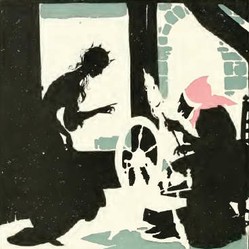
This is typical good versus evil story based on Grimms', and Perrault's tales with additional characters, humor and action. There are only four (three good and one evil) fairies altogether, prince and the princess met before she falls asleep and the evil fairy is punished what is not the case in Grimms' collection.


Disney's movie disappointed at the box office and it was last adaptation of a classic fairy tale in Walt Disney's lifetime. Only full three decades later they continued with their visualizations of classic tales what eventually built a powerful Disney Princess franchise.
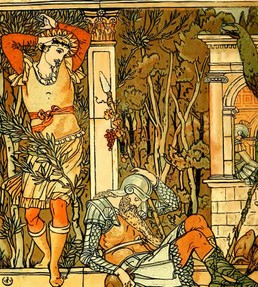
Illustration by Walter Crane2. Brothers Grimm called her Little Briar Rose (1812)
It was their version which became one of the most popular fairy tales ever. Why? Probably because their editorial interventions.

They changed many not so unimportant details in first half of the older version and used the second part as standalone tale named The Evil Mother-in-Law which is not included in later versions of Children and Household's Tales.

Here are some of the changes:

- they increased the number of fairies from eight to thirteen what emphasized the mythological side of the tale (lunar calendar can have 13 months while solar always have 12 what makes a difference for the uninvited fairy)
- they gave more power to the king who desperately tried to save his daughter who is after all the victim of his mistake
- they added a thorn hedge growing around the castle and many princes who died trying to penetrate the hedge
- they added a kiss (in earlier versions this is done by her son (!) and in Perrault's version arrival of the prince awakens her)
- Grimms' story ends with a marriage and we don't hear anything about the kids or prince's first (!) wife

3. Perrault titled it The Sleeping Beauty in the Woods (1697)

In his version prince secretly marries the Sleeping Beauty and has two kids before he dares to introduce her to his parents.

The problem is in his mother, who is a man-eating ogress.

She really tries eating the kids and the princess but in the end she dies and the family lives ever after.

4. Basile named the story Sun, Moon and Talia (1634)

Illustration by Harry Clarke

We have astrologers instead of fairies in this oldest known written version of the Sleeping Beauty.

When Talia (this is the sleeping beauty's name) falls asleep, her father simply leaves the castle. Few days (not a hundred years) later another king enters the castle, finds the sleeping princess and joins her in bed. She woke up much later, when one of her kids (Sun and Moon are names of her twins) sucked out a flax which was pricked under her nail.


Then things really became complicated. While Talia wasn't angry on the king who took advantage of her condition, his wife became totally pissed off.

Painting by Edward Burne-Jones

5. Perceforest (1528)

While this is the date of first known printed version, we know parts of Perceforest (lengthy series of adventures very similar to so called Arturian novels) were written and performed at least two hundred years ago. Among other adventures of the king Perceforst we can find an episode with a sleeping beauty in a castle who is raped by him and wakes up only after she gives a birth to a child.

This theme was quite populer in many medieval romantic novels what can be a nice start of debate in the spirit of Sigmund Freud.

Your favorite 'original' is:

21 votes

Main themes

6. Sexual maturity

This is without doubt the most common theme in all fairy tales. While superficial readers in most cases focus only on passivity of heroines, we can easily identify related subthemes of rebelious teenagers (prince and princess don't listen to advices of older and wiser people) and arrogant-turned-into-helpless father (at first he ignored the evil fairy, later he tried to protect his kid with futile action of burning spindles).

7. Isolation

This is not so obvious, but also pretty common theme in fairy tales. Sometimes a hero is isolated due his/her tasks (travel to the end of the world), sometimes isolation is caused by enemies (imprisonment), sometimes it is form of protection (caused by parents). No matter which version of the Sleeping Beauty we examine, she is all alone in the castle, just like unpopular teenager feels isolated from the world in his/her own home.

Painting by Edward Burne-Jones

8. Forest

It's hard to find a decent fairy tale without a forest, representation of labyrinth of life, a place where the hero and/or heroine has to be lost if he/she eventually wants to transform in a responsible adult (what is the ultimate task in most fairy tales). In all variations of The Sleeping Beauty (Perrault added word 'Woods' even in the title) a forest serves as sort of protection and a media from where the conqueror/rescuer/danger comes.

Painting of Sleeping Beauty by Paul MeyerheimSleep as symbolical death and journey in the Underworld, especially if it is accompanied with dreams. World literature is full of characters who are sleeping until something will happen.

We can find them in Bible, Arthurian legends and of course in the myth about Brynhildr which convinced Jacob and William Grimm to include The Sleeping Beauty with clearly French origin into collection of German tales.


Storytellers and writers were really fascinated with mysterious reasons for sleep, sleeping disorders and dreams. We still are.

9. Messages

There are numerous messages in Sleeping Beauty. Let me write down just a few:


- No matter how powerful somebody is (king), some things still can't be avoided (fulfillment of the curse).

- With enough attempts (hundreds and hundreds of knights trying to get through the thorns), succes (Prince Charming) will come.

- Even the most terrifying conditions (one hundred years of sleep) can eventually pan out well (marriage with a prince).

Fairy tales similar to the Sleeping Beauty

10.

a) Beauty and the Beast (isolation, incompetent father, jealousy, sleeping...)
b) Snow White (jealousy, sleeping, awakening kiss, isolation...)
c) Rapunzel (isolation, incompetent father, vengeful witch, extramerital children...)
d) Bluebeard (isolation, curiosity, life saving postopenement, blood
e) Red Riding Hood (symbolical death, disobedience, bed, sleep...)


I could go on and on until I would use up the whole alphabet but this is probably enough to prove how many similarities share classic fairy tales.

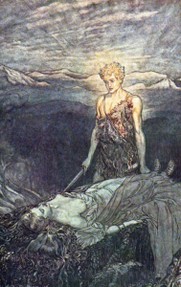
Both illustrations above are made by Arthur Rackham, on the left we see a scene from The Ring of Nibelung and on the right the same scene from the Fairy tale about the Sleeping Beauty.

All used images are in public domain.

You can find more about them on this address:

http://topillustrations.wordpress.com/2012/10/14/sleeping-beauty-by-various-artists/

Additional reading:

http://tolovaj.hubpages.com/hub/Surprising-messages-and-interpretations-of-Sleeping-Beauty

Updated October 24, 2023

Enough Sleeping Beauty facts?

TolovajSep 16, 2023

Definitely, DerdriuMarriner!

DerdriuMarrinerJun 14, 2023

Kenneth Branagh came up with a simultaneously authentic and authoritative and imaginative Sleeping Beauty. Have you seen it?

That version really makes me wonder what is the earliest date of a Sleeping Beauty story and what biogeography that version is linked to.

In a way, Sleeping Beauty suggests a May-December romance of an older woman with a younger man, which trends against the so much more common younger woman with a man old enough to be her grandfather or even -- perish the thought -- great-grandfather: Yuk!

Wouldn't it be interesting if Kenneth Branagh would help settle discussions about Sleeping Beauty by making his own film version?

TolovajJun 21, 2015

Yes, sheilamarie, we usually forget about the connection of cycles in nature with stories. Fairy tales, myths and stories in Bible are full of similar associations. Thanks for stopping by!

GuestJun 18, 2015

I remember the thirteen fairies, too. I hadn't connected them to the twelve months and thirteen moons. I didn't know the version in which the princess had children. I think I'll look up some of these earlier stories. Thanks, Tolovaj.

TolovajFeb 3, 2014

Enjoy and thanks, Maggie Crooks:)

Maggie CrooksFeb 2, 2014

I've read most of them, only missing the 2 earliest. Guess I need to make a trip to the library. Really good article.

TolovajJan 25, 2014

Thank you very much, VioletteRose. I enjoyed in my research as well:)

VioletteRoseJan 24, 2014

One of the beautiful childhood stories, I didn't know this many versions of the story existed. Enjoyed reading this!

TolovajJan 23, 2014

It seems all of them have happy endings for the girl in the role of sleeping beauty (whatever her name) and for the prince (no matter if he is honest or not). It is the prince's wife or mother who dies is some variations... Thanks, WriterArtist, for stopping by!

WriterArtistJan 23, 2014

Well I did not know there were so many variations of the "sleeping beauty" fairy tale. I still like the ones that have happy endings.

TolovajJan 19, 2014

Good point, April_M, too many people think about fairy tales only as an entertainment for kids and forget how much we (age is not important) can learn about us. Thanks for your visit and comment!

April_MJan 19, 2014

I really enjoyed this! We spent a small amount of time at Uni on fairy tales but I always wished I'd taken that line of study further. They can tell us so much about ourselves.

I remember the 13 fairies version from when I was little. I can see the picture in my mind now. :)

TolovajJan 19, 2014

@Mira: Jungian perspective can coexist with personal interpretation. We are still talking about right and wrong, we still have the same archetypes. If two people have account on the same social platform, they certainly create two different mini realities with different circles, friends, followings.., but the Universe is still there with its own laws. It is just their perception which differs.
It's just like in politics. Everybody knows what is best for everybody but in the end of the day almost every individual makes a decisions regarding what is best for him/her.

MiraJan 18, 2014

So then where are we with fairy tales understood from a Jungian perspective to illuminate deep truths and archetypes? You make good points, though, ones that I, too, wondered about (everyone along the line modifying the story: they didn't want to tell their kids things which didn't sit well with their beliefs). Thanks for your response.

TolovajJan 17, 2014

@KathleenDuffy: Great to hear that. Thank you very much!

TolovajJan 17, 2014

@Mira: Sometimes I feel the same. But recent studies surprisingly show the so called folk material may be overrated. We know brothers Grimm edited the stories heard from storytellers until they fitted their personal beliefs. This is a well documented fact.

We also know all storytellers adapted material heard from somebody else until this fitted their goals. And now we have more and more proofs about literary origins of certain fairy tales which were written as novellas or ballades at first and entered in the folklore, from where they returned (transformed, of course) to literature. Sleeping Beauty is just one of these cases. The Beauty and the Beast is another. And so on and on...

I believe the responsibility of parents is mostly to give their kids versatility: not just Disney, not just Grimms, not just Harry Potter etc. This is the best we can do. Adaptations always were and will always be. The biggest threat to our culture are brands with too much power/influence.

Thanks fro your thoughts!

TolovajJan 17, 2014

@kinworm: Briar Rose is my favorite too, maybe because I grew up with it. I have seen Disney's adaptation only few year ago and I must say it is done really well from dramaturgical point. It is occasionally fluffy, as everything commercial, but overall it is good story. I didn't feel cheated after watching as I feel at some newer cartoons where everything is abut special effects. Anyway, Grimms' will always be 'mine'.

KathleenDuffyJan 17, 2014

Really fascinating article. And great pics too!

MiraJan 17, 2014

What I don't understand is how come those who published the tales could decide to change them so much and still present them as folk tales. The archetypes are changed somewhat and the story loses much of its truth and power. I do see from your articles that they tried to make changes that made sense and could have stemmed from the popular imagination, but still, they changed too much, I feel.

MarieJan 17, 2014

I like the Little Briar Rose version as that was the one which I was most familiar with growing up - I didn't have Disney versions of anything back then.
Tolovaj
Tolovaj
103 articles
FollowMessage

Related articles

  • 1001 Arabian Nights: The Stories Behind the Story
  • The Frog Prince (aka Frog King)
  • Importance of Fairy Tales
  • Little Red Riding Hood