Wizzley
PopularLatestDiscussedEditor's Choice
AuthorsForum
Wizzley

A community of writers publishing stories worth your time — on the topics they know and love.

Explore

  • Popular
  • Latest
  • Discussed
  • Editor's Choice

Community

  • Top authors
  • New authors

Service

  • Help
  • Contact
  • Imprint
  • Terms of Use
  • Privacy

Check out our other international Webhaus communities!

Explore another site:English·Deutsch

© 2026 Webhaus LLC. All rights reserved.

TravelVacations and ExcursionsCulture & SocietyHistory, Religion, PoliticsFood & RecipesCooks and CookingCelebrationHolidays and OccasionsReal EstateHome Buying and Moving
Article

Walking the Bible With Bruce Feiler: Book and Documentary Film Review

Bruce Feiler provides a riveting introduction and welcome review of what ancient sites and modern cultures have for readers and viewers Walking the Bible.

Walking the Bible connects ancient sites, modern cultures The title Walking the Bible assumes a necessary, versatile place on all shelves as the moniker of: • a journey by land through the five books of Moses; • a photographic journey; • a two-disc audio-visual; and • an illustrated journey for kids through the greatest stories ever told. The audio-visual and the land and photographic journeys bring together the same content and perspective from voice-over, textual, and still-image angles. All four titles nevertheless converge to complement the author/host/photographer Bruce Feiler’s publications on: • Abraham: A Journey into the Heart of the Three Faiths; and • Where God Was Born: A Journey by Land to the Roots of Religion. As a result, readers and viewers disembark as wonder-filled participants in wondrous Bible-walking experiences. ***** Website: http://www.brucefeiler.com/books/walking.html *****

Bruce Feiler documented in book and film formats his exploratory journey of 10,000 miles through the real places of the first five books of the Old Testament.

History and Biography Pavilion, National Mall, Washington DC; Sunday, September 30, 2006, 12:22:51
History and Biography Pavilion, National Mall, Washington DC; Sunday, September 30, 2006, 12:22:51 — Ellen (ellen.w), CC BY-ND 2.0 (https://creativecommons.org/licenses/by-nd/2.0/), via Flickr

Walking the Bible describes Eurafrasian events and peoples


Itineraries emphasize places actually or apparently linked with events in the lives of:

  • Abraham (21st century B.C.E.); and
  • Moses (13th century B.C.E.).

They also follow other earlier and intervening bio-geographies. The trek indeed goes from Adam’s and Eve’s mysterious Garden of Eden out of whose river flow the still-known Euphrates and Tigris Rivers and the unknown Gihon River of Cush and Pishon River of gold-, jewel-, and perfume-rich Havilah.

The biblical stroll heads on to the Northern Kurdistan cultural sub-region of modern-day southeastern Turkey. It thereby accesses Mount Ararat, final resting-place of Noah’s animal-sheltering, family-filled, flood-proof, football field-sized ark. It then jumps forward spatially and temporally to the geo-historical address of Abraham, descendant of Noah’s son Shem. 


Bruce Feiler visits Mount Ararat to explore reference in Book of Genesis to Mountains of Ararat as resting place of Noah's Ark.

Image courtesy NASA/GSFC/MITI/ERSDAC/JAROS, and U.S./Japan ASTER Science Team
Image courtesy NASA/GSFC/MITI/ERSDAC/JAROS, and U.S./Japan ASTER Science Team — NASA, Public Domain, via Wikimedia Commons

Walking the Bible encourages looking inward, outward, upward


Villagers keep alive traditional beliefs in Abraham as a native son of Sanlıurfa in Turkey, not Ur in ancient Iraq. Either way, biblical peregrinations lead to:

  • Aramea, where Abraham’s father Terah dies in Harran; and
  • Canaan, where Abraham and his half-sister and wife make northward and southward stops in Shechem and then Bethel and Negev;
  • Egypt; and
  • southern Canaan, where Abraham and Sarah die in Hebron, Abraham’s child Isaac escapes sacrifice on Moriah (at modern-day Jerusalem’s Temple Mount), and Abraham’s nephew Lot’s wife expires outside Gomorrah and Sodom (near the present Dead Sea).

Before considering the events and places in Moses’ bio-geography, they memorialize Abraham’s son Isaac, grandson Jacob, and great-grandson Joseph of the 18th century B.C.E. 


Saint Catherine's Monastery was built in 6th century to enclose site of burning bush seen by Moses.

Sinai Peninsula: Mediterranean Sea to north, Red Sea to south
Sinai Peninsula: Mediterranean Sea to north, Red Sea to south — Berthold Werner, CC BY SA 3.0 (https://creativecommons.org/licenses/by-sa/3.0/deed.en), via Wikimedia Commons

Walking the Bible favors repeat reads and views


Isaac’s biography necessitates sojourns within the Negev at:

  • Gerar;
  • Hebron; and
  • Kadesh.

Jacob contrastingly opts to relocate to Egypt. Goshen to the northeast of modern-day Cairo indeed protects Joseph, Joseph’s brother and half-brothers, and their descendants from the 18th century onward.

But well before Moses’ adoption into the royal household, Egyptians question continued thanks to Jacob’s people for Joseph’s problem-solving famine and plague. Collective amnesia results in Moses’ exodus of Jacob’s descendants through the Reed Sea (at modern-day Lake Timsah) to the Sinai wilderness. Bible walks with Moses then stop at:

  • Jebel Musa, near St. Catherine’s burning bush monastery;
  • Kadesh; and
  • Mount Nebo’s view of Canaan.

But their representation by Bruce Feiler touches readers and viewers forever. 


Bruce Feiler and his guide, archaeologist Avner Goren, consider the possibility of Lake Timsah, one of the Bitter Lakes, as the sea of reeds (erroneously written as "red") that enabled Moses and the Israelites to escape their Egyptian pursuers.

Lake Timsah on Lower, or northern, Egypt's Nile Delta spans isthmus between Red Sea and Mediterranean.
Lake Timsah on Lower, or northern, Egypt's Nile Delta spans isthmus between Red Sea and Mediterranean. — Terry Cliss from Frome, Somerset, United Kingdom, CC BY SA 2.0 (https://creativecommons.org/licenses/by-sa/2.0/deed.en), via Wikimedia Commons

Acknowledgment


My special thanks to talented artists and photographers/concerned organizations who make their fine images available on the internet.


Image Credits


Bruce Feiler documented in book and film formats his exploratory journey of 10,000 miles through the real places of the first five books of the Old Testament.
Bruce Feiler appeared as one of 11 History and Biography speakers at 2006 National Book Festival in Washington DC.
History and Biography Pavilion, National Mall, Washington DC; Sunday, September 30, 2006, 12:22:51: Ellen (ellen.w), CC BY-ND 2.0, via Flickr @ https://www.flickr.com/photos/ellenw/257498077/

Bruce Feiler visits Mount Ararat to explore reference in Book of Genesis to Mountains of Ararat as resting place of Noah's Ark.
NASA-generated image of Mount Ararat
Mount Ararat's two volcanic peaks, year-round snow-covered Big Ararat (center) and Little Ararat (right) in NASA's 3-D perspective view, from southwest; simulated natural color image over ASTER-derived digital topography model; June 25, 2002
Image courtesy NASA/GSFC/MITI/ERSDAC/JAROS, and U.S./Japan ASTER Science Team: NASA, Public Domain, via Wikimedia Commons @ https://commons.wikimedia.org/wiki/File:Ararat_ast_2002176_lrg.jpg

Saint Catherine's Monastery was built in 6th century to enclose site of burning bush seen by Moses.
Historic monastery, with old, unique books and living burning bush, was inscribed in 2002 as UNESCO World Heritage Site.
Sinai Peninsula: Mediterranean Sea to north, Red Sea to south: Berthold Werner, CC BY SA 3.0, via Wikimedia Commons @ https://commons.wikimedia.org/wiki/File:Katharinenkloster_Sinai_BW_2.jpg

Bruce Feiler and his guide, archaeologist Avner Goren, consider the possibility of Lake Timsah, one of the Bitter Lakes, as the sea of reeds (erroneously written as "red") that enabled Moses and the Israelites to escape their Egyptian pursuers.
dhow (traditional sailing vessel of Red Sea and Indian Ocean) on Lake Timsah
Lake Timsah on Lower, or northern, Egypt's Nile Delta spans isthmus between Red Sea and Mediterranean.: Terry Cliss from Frome, Somerset, United Kingdom, CC BY SA 2.0, via Wikimedia Commons @ https://commons.wikimedia.org/wiki/File:Flickr_-_casillero_-_Dhow_in_Lake_Timsah.jpg

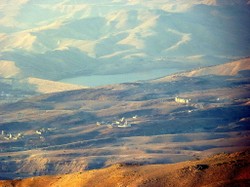
Bruce Feiler's journey of 10,000 miles follows Moses' footsteps to Mount Nebo, where clear panorama afforded view of Promised Land to the determined patriarch responsible for drawing the Israelites out of Egypt.
Sea of Galilee from Mount Nebo, northwestern Jordan: Maya-Anaïs Yataghène from Paris, France, CC BY 2.0, via Wikimedia Commons @ https://commons.wikimedia.org/wiki/File:Mount_Nebo_(9808067103).jpg

 

Sources Consulted


Feiler, Bruce. Abraham: A Journey to the Heart of the Three Faiths. New York, NY: William Morrow imprint, HarperCollins Publishers, 2002. 

Feiler, Bruce. Walking the Bible. KQED presents a production of TMC Entertainment executive produced by Drew S. Levin, produced by Rebecca Dobbs, directed by David Wallace. Telescript by Alex Gregory & Joan Meyerson edited by Ash Hasen. Boston, MA: WGBH Video, 2006.

Feiler, Bruce. Walking the Bible: A Journey by Land through the Five Books of Moses. New York, NY: HarperCollins Publishers, 2001. 

Feiler, Bruce. Walking the Bible: A Photographic Journey. New York, NY: William Morrow imprint, HarperCollins Publishers, 2005. 

Feiler, Bruce. Walking the Bible:  An Illustrated Journey for Kids through the Greatest Stories Ever Told. New York, NY: HarperCollins Publishers, 2004. 

Feiler, Bruce. Where God Was Born: A Journey by Land to the Roots of Religion. New York, NY: William Morrow imprint, HarperCollins Publishers, 2005. 


Bruce Feiler's journey of 10,000 miles follows Moses' footsteps to Mount Nebo, where clear panorama afforded view of Promised Land to the determined patriarch responsible for drawing the Israelites out of Egypt.

Sea of Galilee from Mount Nebo, northwestern Jordan
Sea of Galilee from Mount Nebo, northwestern Jordan — Maya-Anaïs Yataghène from Paris, France, CC BY 2.0 (https://creativecommons.org/licenses/by/2.0/deed.en), via Wikimedia Commons
the end which is also the beginning
the end which is also the beginning — OpenClips, Public Domain, via Pixabay

Walking the Bible: A Journey by Land Through the Five Books of Moses ~ DVD format ~ Available now via Amazon

Walking the Bible

Advertisement

Walking the Bible: A Journey by Land Through the Five Books of Moses by Bruce Feiler ~ In Book and Kindle formats ~ Available now via Amazon

Walking the Bible

Advertisement

Walking the Bible: A Photographic Journey by Bruce Feiler ~ In Hardcover format ~ Available now via Amazon

Walking the Bible

Advertisement

Walking the Bible CD: An Illustrated Journey for Kids Through the Greatest Stories Ever Told - Written and Read by Bruce Feiler ~ in CD format ~ Available now via Amazon

Walking the Bible

Advertisement

Me and my purrfectly purrfect Maine coon kittycat, Augusta "Gusty" Sunshine

DerdriuMarriner, All Rights Reserved

Updated September 11, 2026

Comments

DerdriuMarrinerSep 26, 2026

St Catherine's Monastery accedes to another title even as that holy-pilgrimate site answers to the Arabic and the Greek languages of the respective Eastern Orthodox and Orthodox Christian faiths.

The Greek title appears as follows: Ιερά Μονή Αγίας Αικατερίνης Όρους Σινά.

DerdriuMarrinerSep 25, 2026

For those asking about the monastery name, the English language generally accepts St Catherine's Monastery.

The official title for English speakers nevertheless is Sacred Autonomous Royal Monastery of Saint Catherine of the Holy and God-Trodden Mount Sinai.

DerdriuMarrinerSep 24, 2026

The computer crashed afore I communicated another component of my comment in the answer box below.

The Romanized rendition of the Arabic articulation دير القدّيسة كاترين appears as follows: Dayr al-Qiddīsa Katrīn.

DerdriuMarrinerSep 23, 2026

For those asking about the site-language name for St Catherine's burning bush monastery, Egyptian Arabic acts as Sinai-Peninsula language name.

The Arabic articulation appears as دير القدّيسة كاترين.

DerdriuMarrinerJul 1, 2015

sheilamarie, It's impressive that the monks have such a commitment to preserving ancient collections and spiritual exercises. Is the traveling exhibit something that you can share on Wizzley as an article? It's quite an experience to be in the same place as awe-inspiring icons.

GuestJul 1, 2015

St Catherines Monastery has some wonderful icons. I've seen some of them in a traveling exhibit.

DerdriuMarrinerJun 29, 2015

Mira, Fortunately for me (and for Wizzley readers like you), Bruce Feiler's books and DVD were recommended to me ! ;-]

MiraJun 29, 2015

How did you learn of Bruce Feiler? Sometimes it's hard to find a good author/book amid all the clamor.

DerdriuMarrinerJun 29, 2015

Mira, Bruce Feiler is a captivating, intelligent host and writer. His books are difficult to put down, and he has such a respect for reader/viewer interest. (The same may be said of Avner Goran.)
One of my favorite moments in the documentary is where he's observing the early services at St Catherine's burning bush monastery, looks so astutely at the camera, and confides so engagingly that "I've done the math" about the total number of services ever held there.

MiraJun 28, 2015

I watched 38 minutes of it and it's quite enthralling. It's really well done as a documentary, moves along really nicely. I'll watch the rest as well.
DerdriuMarriner
DerdriuMarriner
536 articles
★ Editor's Choice
FollowMessage

Related articles

  • How the States Got Their Shapes: History Channel Documentary Film With Brian Unger and Mark Stein
  • Film Review: The Pilot Episode to The Mentalist
  • Film Review: The 100th Episode of The Mentalist
  • Jesus' Synagogue Church in Nazareth, Israel