
Wizzley
PopularLatestDiscussedEditor's Choice
AuthorsForum
Wizzley

A community of writers publishing stories worth your time — on the topics they know and love.

Explore

  • Popular
  • Latest
  • Discussed
  • Editor's Choice

Community

  • Top authors
  • New authors

Service

  • Help
  • Contact
  • Imprint
  • Terms of Use
  • Privacy

Check out our other international Webhaus communities!

Explore another site:English·Deutsch

© 2026 Webhaus LLC. All rights reserved.

Art & DesignArt and The ArtsCulture & SocietyHistory, Religion, PoliticsEntertainmentMovies, Celebs and TVLiteratureBooks, Genres, ReviewsMusicInstruments, Musicians & Genres
Article

A Brief Life of Atkinson Grimshaw - The Man Who Loved Moonlight

Atkinson Grimshaw is remembered for his nostalgic moonlit cityscapes. His works represent contradictions between Victorian industrialisation and a Romantic longing for times past.

John Atkinson Grimshaw’s art, particularly his evening and moonlit works, can evoke a variety of emotions in the viewer - alienation, nostalgia, longing, to name a few. He manages to capture that strange, almost eerie nostalgia that can often flood over us when we find ourselves alone in an autumn street at dusk, or those times when we are suddenly struck with the thought that life is a fleeting illusion. These thoughts, sometimes unsettling, sometimes filling us with a sweet nostalgia for something beyond the present, soon pass - but Atkinson Grimshaw has captured such moods as permanent fixtures for our contemplation. He was a Victorian, and for many living through those times of great change, life had few certainties.
At the Park Gate - John Atkinson Grimshaw — AllPosters

Little is known of Grimshaw's life. We do know he was born in 1836 in Leeds, Yorkshire, to struggling, deeply Protestant, working-class parents. His father was a clerk on the railway and his mother ran a grocery shop.
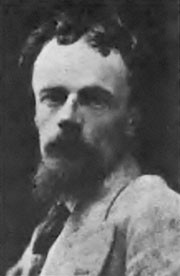
Photograph of Atkinson GrimshawIn 1852 Grimshaw also became a railway clerk with Great Northern Railway, but against his parents’ wishes began painting in his spare time despite, it is believed, his mother burning his work and turning the gas off in his room.


When Grimshaw married Frances Hubbarde in 1852 the couple lived in a small house in Leeds. Frances, an essential companion to Grimshaw, bore fifteen children, only six of whom reached adulthood. Grimshaw’s artistic success eventually enabled them to occupy larger homes in Leeds and Scarborough.

Summer - Atkinson Grimshaw — AllPosters

Atkinson Grimshaw and Industrial Revolution


Leeds at this time was a booming Victorian city. A manufacturing elite was reaping the rich harvest of the Industrial Revolution. They demonstrated their new wealth by building gothic houses to rival the landed gentry, furnishing them with original artworks. Grimshaw reflected these times and his work eventually attracted rich industrialists.

Boar Lane, Leeds - Atkinson Grimshaw — Wikimedia Commons

His patrons ensured Grimshaw a steady flow of work. Not only did he satisfy his clients’ needs by interpreting the civic pride of Northern cities through architectural accuracy but, by his representations of sunsets and moonlight, he touched them with his ability to replicate a feeling of nostalgia and alienation. Despite the triumphs of industrialism, there was a romantic longing for simpler times, a feeling that something of the human spirit was being eroded.

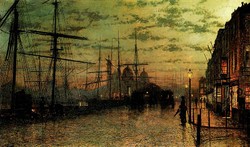
The hub of Victorian commercial life depended on the docks. Grimshaw’s paintings, particularly of the docks at twilight, rain-swept, lamp-lit, with their ambiguous figures, were hugely popular.

Humber Docks by Atkinson Grimshaw — Wikimedia Commons

Contemporary Influences on Atkinson Grimshaw


His moonlight works became known as ‘poems in paint’ and indeed, he was particularly influenced by Tennyson’s Idylls of the King. Another literary link was mentioned by Grimshaw’s daughter, Elaine, who claimed that her father’s rendition of Whitby by moonlight had influenced Bram Stoker’s description of that town in his novel, Dracula.

Even his Scarborough home was named Castle-by-the-Sea from the poem by Longfellow.

Whitby Harbour by Moonlight - Atkinson Grimshaw — AllPosters
Scarborough by Moonlight - Atkinson Grimshaw — AllPosters

Other works demonstrated his interest in the artistic and scientific innovations of the day. Grimshaw’s landscapes of North Yorkshire and the Lakes were influenced by the Pre-Raphaelites. Nature is enhanced with a hallucinatory, jewel-like detail of form and colour. Photography helped him achieve such perfection.

Bowder Stone, Borrowdale - Atkinson Grimshaw — Wikipaintings
Colwith Force by Atkinson Grimshaw — WikiPaintings

By contrast, his beach scenes with their small figures and mass of sand and sky, point to Darwinism, the passing of time and humanity’s fleeting presence.

Scarborough Beach - Atkinson Grimshaw — Wikimedia Commons
Southwark Bridge From Blackfriars by Night - Atkinson Grimshaw — AllPosters

Grimshaw rented a studio in Chelsea in 1885.  During his London sojourn he painted nocturnal views of the Thames and well-known landmarks, as well as more socially aware works featuring prostitutes and their clients.

There is no actual evidence that Grimshaw ever met James McNeil Whistler.  Their moonlit cityscapes have often been compared.  Grimshaw's  daughter described her father’s supposed friendship with James McNeil Whistler as a close one, and said that Whistler acknowledged ‘Grimmy’s’ greater technique when it came to moonlight and perspective.

Books Relevant to Appreciating Atkinson Grimshaw

Atkinson Grimshaw
The Pre-Raphaelite Landscape, Second edition
Building a Great Victorian City: Leeds Architects and Architecture 1790-1914

Advertisement

Atkinson Grimshaw Last Years.


The paintings executed by Grimshaw towards the end of his life saw the stripping away of inessentials. His work seems to anticipate the St. Ives school of the 1920s.

His last paintings were snow scenes. In Snow and Mist a solitary figure walks towards a snowy horizon bereft of anything yet completely at one with the bleached out landscape. 

Snow and Mist - Atkinson Grimshaw — Wikipaintings

For a man who represented the contradictions of Victorian society, the expansion of cities coupled with a sense of decay and alienation, these last works seem to represent a Zen-like calm. Atkinson Grimshaw died in Leeds of cancer, aged fifty-eight.


Sources:

  • Atkinson Grimshaw by Alexander Robertson (Phaidon, 2000)
  • Catalogue of a Loan Exhibition (City Art Gallery, Leeds 1897)
  • Atkinson Grimshaw, Knight's Errand Sandra K Payne (Corporate Link, 1987)

Updated July 13, 2013

Comments

No comments yet.

KathleenDuffy
KathleenDuffy
169 articles
★ Editor's Choice
Follow

Related articles

  • See 'The Glasgow Boys' Paintings at Kelvingrove Art Gallery, Glasgow
  • Book Review: The Art of Dora Carrington by Jane Hill
  • Miners in Art and Pitmen Painters
  • Modernity in Edgar Degas : Women on the Terrace of a Cafe, Evening