
Wizzley
PopularLatestDiscussedEditor's Choice
AuthorsForum
Wizzley

A community of writers publishing stories worth your time — on the topics they know and love.

Explore

  • Popular
  • Latest
  • Discussed
  • Editor's Choice

Community

  • Top authors
  • New authors

Service

  • Help
  • Contact
  • Imprint
  • Terms of Use
  • Privacy

Check out our other international Webhaus communities!

Explore another site:English·Deutsch

© 2026 Webhaus LLC. All rights reserved.

EntertainmentMovies, Celebs and TVArt & DesignArt and The ArtsLiteratureBooks, Genres, ReviewsMusicInstruments, Musicians & GenresVideo GamesPC & Console Gaming
Article

Annual Grimaldi Clown Church Service, London

Each February, at a church service in London's East End, clowns from all over the world gather to celebrate the life of the greatest British clown, Joseph Grimaldi.

The service, at Holy Trinity Church, Dalston, takes place every year on the first Sunday in February. It is a riot of colour as clowns from all over the world appear in full clown costume, to celebrate the life of Joseph Grimaldi, respected as the greatest British clown of all. The clown services began in 1946 at St James Church, Pentonville Road, Islington because that is where Grimaldi is buried. (The church has been demolished but Grimaldi's grave is still intact.) These services have continued annually ever since. In 1959 the service moved to its present venue at Holy Trinity Church, Beechwood Road, Dalston, Hackney,London. Holy Trinity is now known as the official “Clown’s Church”. Originally clowns attending the service wore their everyday clothes. But in 1967 Clown Smokey gained permission for clowns to attend resplendent in their individual clown costumes and full makeup. This has certainly made the Clown Service a unique event in the United Kingdom.

Clowns and the Church

Clown Service in Dalston

It may seem strange that clowns should meet in a church for a religious service, when nowadays clowning seems to be such a secular activity, enjoyed mainly by audiences at circuses. However, the clown is a symbolic image for the Holy Fool, a much respected figure in the early church.

Clowns, or fools, were seen in their child-like natures as representing the purity and simplicity of saints like St Francis of Assissi and St Basil, the Russian saint. The early Catholic church used the Holy Fool to comically, and sometimes frighteningly, simplify and illustrate the church’s doctrine to an illiterate audience.

Books on The Holy Fool

God's Fool: The Life of Francis of Assisi (Perennial library)
St. Basil And His Rule: A Study In Early Monasticism
The Clown of God

Advertisement

As society became more complex and urbanised, particularly with the Reformation, clowns in the theatre became agents questioning how the individual should live life, rather than how the mass of the common people could understand the Biblical teachings. In Shakespeare’s plays one of the reasons religious and political arguments were put amusingly into the mouths of clowns was to avoid problems over censorship.

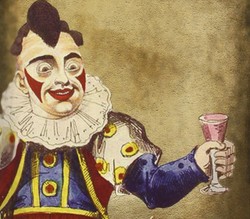
Joseph Grimaldi or ‘Joey’

Statue of Grimaldi at Holy Trinity Church, Dalston

The Clown Service in Dalston celebrates the life of the great Joseph Grimaldi. He was born in London on 18 December 1778 and died on 31 May 1837, the son of Italian immigrants.

According to many eye witnesses, Grimaldi is said to be one of the ghosts that haunt the Theatre Royal in London's Drury Lane.

His greatest contribution to the clowning world was to increase the complexity of the clown personality through his creation, Joey.

Biographies of Grimaldi

The Pantomime Life of Joseph Grimaldi: Laughter, Madness and the Story of Britain's Greatest Come...
Grimaldi: King of Clowns
Memoirs Of Joseph Grimaldi, Ed. [and Partly Written] By C. Dickens...

Advertisement

Grimaldi built on the original concept of naivete and foolishness by mocking his audiences and encouraging their participation. He is said to have been the inspiration behind the invention of the pantomime dame. He introduced the concept of the sad clown, the happy mask that hides a tragic soul. Grimaldi raised the profile of the clown by placing him centre stage.

The clown in one form or another is still seen as an absolutely vital element of entertainment culture worldwide. The Grimaldi Memorial Service is a tribute to that great tradition as well as a  thanksgiving for the gift of laughter.

'The Clowns Prayer' in Holy Trinity Church, Dalston

Updated January 26, 2014

Comments

KathleenDuffyDec 4, 2013

I'm glad you found the article interesting ologsinquito - there's quite a lot of info on the internet about Holy Fools.

ologsinquitoDec 3, 2013

It seems odd to me as well. But it also looks as if there's some sort of tradition behind it. I'm going to follow that link in your article and read about the Holy Fool. You learn something new every day. :)

KathleenDuffyDec 3, 2013

Yes, I agree, it does seem odd. but when you are there, somehow it seems perfectly natural! :)

AbbyFitzDec 3, 2013

This is really interesting, I'd never heard of it before. It looks funny seeing clowns in church!
KathleenDuffy
KathleenDuffy
169 articles
★ Editor's Choice
Follow

Related articles

  • The Life of Joseph Grimaldi - Britain's Greatest Clown
  • A Guided Tour of The Theatre Royal Haymarket, London
  • The Royal Opera House, Covent Garden, London - A Guided Tour
  • The Cinema Museum, South London - A Guided Tour