
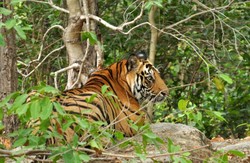
Spread over 1100 sq km the parking area is under the aegis of Project Tiger hence it is also known as a tiger reserve. The forests received early protection as they were the hunting preserve of the Maharajas of Rewa Estate. In order to maintain a robust number of animals, wood logging and hunting by locals and commoners were not allowed.
Somewhere near these forests now known as Sanjay Dubri Tiger Reserve, the white tiger was discovered by the then Ruler H.H.Martand Singh. All the white tigers are the progeny of this male tiger who was named Mohun.
The park is home to many mammals typical to Central India. More than 250 avian species are found in the park some of which are migratory in nature.
The population of tigers is estimated to be above fifty. With greater conservation measures the population could rise much higher.
The park comprises rough terrain with about 32 hillocks or low-rise hills encompassing glens and marshy meadows. A number of rivulets run through the park creating a lifeline crucial to the survival of the ecosystem as a whole.
For management purposes, the park is divided into core and buffer areas. The core comprises of critical tiger habitat while the buffer just acts as such. In the core area, no human habitation is allowed.
Comments
pateludayApr 15, 2021
People living inside the core area are forest staff on duty.
DerdriuMarrinerApr 14, 2021
You mention under the subheading National Park Tiger Reserve that no human habitation occurs in the Bandhavgarh core area. Would there be human inhabitants of the buffer area, and if so, what would they be doing there? Would they be people, such as arborists and naturalists, who tend the park?