
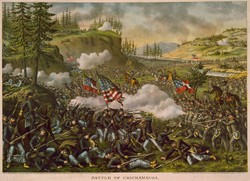


 Chickamauga is a Cherokee word and it translates as 'river of death'.
The creek itself looks so beautiful winding its way through the valley. Woodland and open pasture aplenty line its way. But long before the American Civil War wrought such carnage here, the area had an unhappy reputation amongst the native people.
Those who camped there found themselves quickly sickening. The Cherokee avoided it.
The situation could only have been made worse, when it's considered that the majority of the fallen, during the famous civil war battle at Chickamauga, were buried where they lay. Such was the intensity of the war just then, that it took two months for a burial detail to return. Until they arrived to undertake that grisly task, bodies decayed in the open air, unless retrieved beforehand by their families.
Chickamauga Battlefield is filled with unmarked graves. Some are trenches, where three or four men were laid side by side. Others are pits, where a large number of corpses were interred together. Or there are also thousands of single burials, ranging in depth from the standard six feet to some quite shallow affairs.
Occasionally maintenance workers will stick a shovel in the ground there and accidentally uncover human bones. The point being that these internments were not supervised. Health and safety and the preservation of the water sources did not factor in, so much as the need to swiftly remove from view thousands of decomposing remains.
The 'river of death' aspect of the area did not stop with the coming of modernity. During the Spanish-American War of 1898, over 70,000 men (many with horses or mules) used the National Chickamauga Park as a base camp. It turned out to be an error.
The barracked soldiers began to fall ill in droves. The officers, and then the government, ordered repeated testing of the water, but the results came back clear. Nevertheless typhoid fever still broke out, followed by malaria. More men died of disease in the Chickamauga camp than were killed during the entire Spanish-American War.
However, the official investigation blamed not the water, but unsanitary conditions in the camp itself. Food was being transported in carts, which had not been hosed down after carrying manure and trash. Malaria had not appeared until soldiers had returned from the battlefields of Cuba and the Philippines.
Rank and file soldiers referred to the earlier Cherokee legends, as evidence that the place was cursed. But their superiors were having none of it. It was smallpox which killed the Native Americans, they claimed. The Trail of Tears ran right along Chickamauga creek.


 You would think that no added horror was necessary. After two days of fierce fighting, the terrain around the Chickamauga Creek was strewn with bodies.


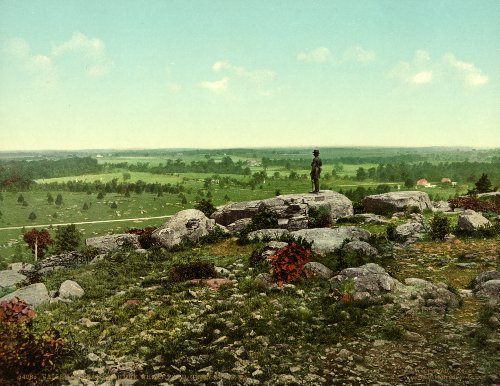
 The tourist thought it was a nice touch, when he heard the Fife and Drum band playing. It was early in the season and Chickamauga was practically deserted. The distant music, contemporaneous with the historical battle tunes, felt atmospheric.




Comments
JoHarringtonApr 12, 2013
Unfortunately it's a different Headless Horseman. The Sleepy Hollow one was in New York State. You seem to be having an epidemic of them over there!
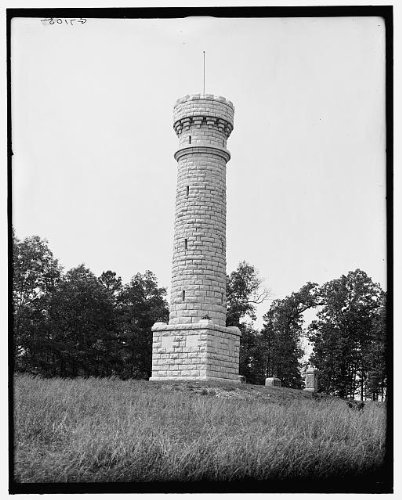
That Wilder Tower one is creepy to me because we don't know what he saw. Our imagination supplies the rest and that's the worst thing for ghost stories.
EmberApr 12, 2013
Is this Headless Horseman the same as the one from Sleepy Hollow? Or the inspiration at least.
This was interesting...until I got to the end section. That was terrifying and made my heart sink. He may not be able to say what he saw, but to be honest, I really really don't want to know. :c I'm going to go do something that isn't thinking about this for the rest of the afternoon if I'm ever going to be able to walk through the park to get to my friend's house tonight. :c
JoHarringtonApr 11, 2013
PaulApr 11, 2013