What little is known about Giovanni Benedetto Castiglione has been gleaned from court documents rather than from his art.
After training in Genoa in north-west Italy, Castglione acquired an early reputation for pastoral scenes of animals and shepherds. Before too long he was creating large-scale religious, allegorical and mythological paintings, and if it hadn't been for his foul temper he might have become Genoa's leading painting. In 1646, after hearing that the Doge of the Venetian Republic, Giovanni Battista Lomellini, had refused to accept a painting he had commissioned, Castiglione destroyed the painting in a fit of pique and fled the city.
He worked in various cities including Rome, Florence, Naples, Venice and finally Mantua, coming into contact with artists such as Anthony van Dyck and Nicolas Poussin. He soaked up numerous stylistic influences and was the first artist known to borrow motifs, or even whole works, from other artists such as Rembrandt and Titian. In the 1630s he reproduced Titian’s Sacred and Profane Love (1514) in the Baroque style.
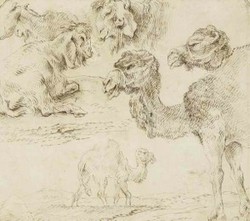
His work may well have been unique – most 17th-century artists made preparatory drawings before committing to major works, but either this artist made no such initial preparations, or he systematically destroyed all his preparatory work. His output includes numerous spontaneous, but roughly finished, large-scale drawings in oil, as well as approximately sixty etchings and prints. Castglione is regarded by many as the inventor of monotype, a technique adopted some two hundred years later by artists such as Gaugin and Degas.

Comments
FrancesSpiegelNov 15, 2013
MiraNov 11, 2013