Wizzley
PopularLatestDiscussedEditor's Choice
AuthorsForum
Wizzley

A community of writers publishing stories worth your time — on the topics they know and love.

Explore

  • Popular
  • Latest
  • Discussed
  • Editor's Choice

Community

  • Top authors
  • New authors

Service

  • Help
  • Contact
  • Imprint
  • Terms of Use
  • Privacy

Check out our other international Webhaus communities!

Explore another site:English·Deutsch

© 2026 Webhaus LLC. All rights reserved.

Pets & AnimalsDomestic, Livestock, WildlifeEducationSchool and LearningFamilyKids and ParentingHobbies & CraftsGames, Crafts, CollectingScienceFields of Knowledge
Article

Diabetic Dogs - New Blood Glucose Testing Monitor Coming Soon?

A device which continually monitors the blood glucose levels in humans is being successfully used on dogs suffering with diabetes.

It can be stressful for both owner and pet when a dog with diabetes has to endure traditional blood sampling ( involving the retrieval of a blood sample, usually from the ear) to monitor glucose levels. However, a device which continuously monitors glucose levels of diabetic humans is being used by Charles Wiedmeyer, Assistant Professor of Clinical Pathology in the Missouri University College of Veterinary Medicine to monitor the glucose levels of diabetic dogs and other animals such as cats, cows and horses. A similar device is being offered to pet owners for use at home by the Veterinary Teaching Hospital at the University of Georgia.

Just What Is Continuous Glucose Monitoring (CGM)

The CGM device is commonly used in humans to record glucose levels.  In the case of animals,  It  is a small chip that goes about an inch into skin, between the animal's shoulder blades and records glucose concentrations every five minutes over about three days.  

At the  University of Georgia. their  Veterinary Teaching Hospital is one of the few organisations in the USA that  now offers its dog and cat diabetic patients the  iPro continuous glucose monitoring device to use at home.

This means that animals don't have to have blood drawn every two hours with the conventional glucose monitoring system.

Living With A Diabetic Dog: How To Keep Your Dog Healthy, Prevent Common Problems And Avoid Compl...
Dogs, Diet, & Disease: An Owner's Guide to Diabetes Mellitus, Pancreatitis, Cushing's Disease, & ...
Sugarbabies: A Holistic Guide to Caring for Your Diabetic Pet

Advertisement

So, what does using this CGM device involve?  

At the hospital, one end of a small disposable sensor is inserted under the animal's skin.   Then a small recorder, about size of a small coin, is plugged into the exposed end of the sensor. This collects data every five minutes.  The animal then has a well fitting garment put on so that the device can stay in place.  Then, off go dog or cat back home with its owner to continue its normal, everyday life.

After a few days the sensor and the recording device are removed and sent back to the veterinary hospital. The recorder is plugged into a computer and the resulting data can be downloaded and analysed.  In this way suggestions can be made for management of the animal's diet and levels of insulin.

Advantages of Continual Monitoring Device for Dogs with Diabetes

Wild Dog Photograph Poster Giclee Handsome Coyote Photo Picture 8x10

Advertisement

The monitoring device would be ideal for dog owners whose pets suffer with diabetes. It has several obvious advantages:

  • It would enable the owner to monitor glucose levels over several days, without the guilt of having to cause unnecessary stress to an animal that is dependent on its owner for managing the situation.

  • In addition, the very act of extracting a blood sample can cause stress to the animal which means obtaining a truly accurate glucose level is less likely. Using the continuous glucose monitoring device will cause no stress to the animal as, after its insertion, it is accessed non-invasively and therefore will give a more accurate reading.

  • There will also no longer be any need to use a blood glucose meter (glucometer). This is a portable device which tests the drop of blood that has been taken, usually by lancing, from the dog's ear. The blood glucose concentration then shows up on the meter’s digital display.

  • Nor will there be any need for blood glucose strips. Using these, after the blood is extracted from the dog, usually from the ear, it is dropped onto the blood glucose strip. This results in the strip changing colour, which is then checked against a chart.

All these present systems are vital. However, there is no denying they are invasive, time-consuming and often stressful to both dog and owner.  

If My Dog Doesn't Like You I Don't Like You Distressed Retro Vintage Tin Sign

Advertisement

Brief Checklist for Symptoms of Diabetes in Dogs

The following symptoms often occur in a dog with diabetes:

  • Drinking excessive amounts of water
  • Urinating frequently
  • Weight loss that can’t be explained, often accompanied by increased appetite
  • Unnatural lethargy

Any of the above symptoms should be reported to the vet. If diabetes is confirmed he or she may then decide to set in motion a regime of insulin injections, glucose level monitoring and diet changes which will ensure the dog continues to have a fulfilling life. Complications can occur, but they are usually less severe than those which occur in humans.

It can be a challenging time for both pet-owner and animal, but with a calm, reassuring approach and loving kindness the procedure will soon become routine.

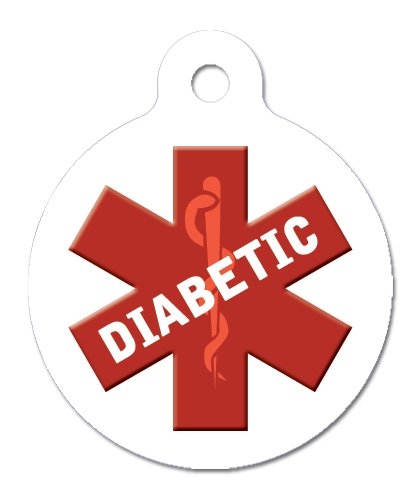
Diabetic Dog Tags

  • Dog Tag Art Custom Pet ID Tag for Dogs - I Have Diabetes - Large - 1.25 inch

    Dog Tag Art pet tags are made of high-quality recycled stainless steel and are each permanently infused with full-color graphics and personalized text. They are fully customizab...

  • Medical Alert, Diabetic - Pet ID Tag, 2 Sided, 4 Lines Custom Personalized Text Available

    Your Pet Will LOVE It! Express your pet's personality while also ensuring their safety. Have some fun! Gone are the days of boring engraved tags. Our custom designed pet ID tags...

  • Dog Bone Pet ID Tag "Medical Alert, Type 1 diabetes" - Neonblond

    Dog Bone Pet ID Tag "Medical Alert, Type 1 diabetes" - Neonblond

  • Dog Bone Pet ID Tag "Medical Alert, type 2 diabetes" - Neonblond

    Dog Bone Pet ID Tag "Medical Alert, type 2 diabetes" - Neonblond

Advertisement

Dogs with Diabetes May Soon Benefit From the Continuous Glucose Monitoring Device

Anyone who is responsible for a diabetic dog or other pet will be under particular stress, and the thought of causing one's beloved animal any kind of pain is hard to take. Obviously, anything that can alleviate the situation is welcome.

Assistant Professor Wiedmeyer is hopeful that the continuous glucose monitoring device, specifically designed for animals, will soon be on the market, in which case caring for a diabetic dog will be much less stressful.


After all, as Science Daily has pointed out, in 1922 insulin, through scientific research and testing, was isolated from dogs to the great advantage of the human population.

Now perhaps science can show its appreciation.

Source:

  • University of Missouri-Columbia. "Diabetes Monitoring Device Benefits Not Just People but Dogs and Other Animals, Too." ScienceDaily 24 July 2010.
  • 'UGA's veterinary hospital offers take-home glucose monitors for diabetic pets' at UGA Today

Updated January 30, 2014

Comments

MBCJul 6, 2016

I think it's wonderful all the advances they have made in veterinary medicine! Great news!

KathleenDuffyFeb 2, 2014

Hello DerdiuMarriner - I am so glad that you enjoyed this article. yes - hopefully this advancement will be available soon...

DerdriuMarrinerFeb 2, 2014

KathleenDuffy, It's quite saddening to realize that diseases such as cancer and diabetes may show up in our brave pets. It's heartwarming, though, to know that medical advances are sought, not only for humans, but also for other creatures such as beloved pets. Cats, dogs, and mice have helped people so much as participants in medical experiments that it is a nice repayment for their unselfish, oftentimes painful service to have an advance such as this device be designed for them.
Thank you for spotlighting this helpful device which hopefully will be available for home use soon.

KathleenDuffyJan 31, 2014

Hello VioletteRose - I'm glad you think its useful. Thanks for that! A lot of dogs these days are overweight, which doesn't help things. :)

VioletteRoseJan 31, 2014

I never knew about diabetics in dogs, this article is really helpful!

KathleenDuffyJan 30, 2014

Hi Abby - Yes, it would be really helpful. It would save having to lance the dog's ear to retrieve the blood. They seem to be taking their time producing it for home use though. :)

AbbyFitzJan 30, 2014

I had no idea dogs could get diabetes. This looks like it would be a helpful device for dog owners.
KathleenDuffy
KathleenDuffy
169 articles
★ Editor's Choice
Follow

Related articles

  • Strollers/Pushchairs for Dogs - Push Your Pooch in a Pram
  • Dogs and Cats as Hospital Volunteers – 'Pets as Therapy'
  • Dogs as Assistants and Hearers to Deaf People - Hearing Dogs
  • Plants that Attract Birds to your Garden