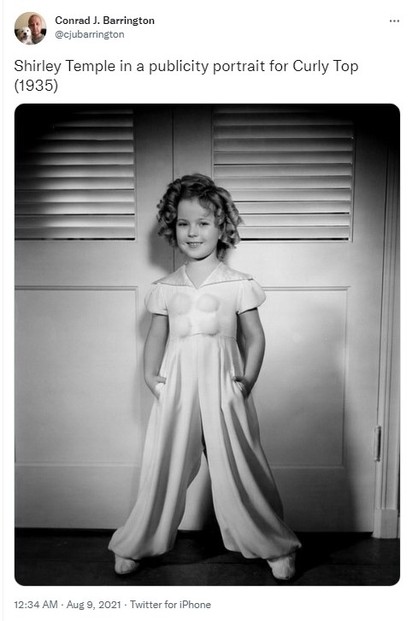
A charming waif cherishes animals, family, and orphans in Curly Top by writers Arthur J. Beckhard and Patterson McNutt; producer Winfield R. Sheehan; and director Irving Cummings. John F. Seitz, Jack Murray, and Ray Henderson handle cinematography, editing, and music. Filming showcases California’s Movietone City.
The 74-minute musical adapts Jean Webster’s (born Alice Jane Chandler Webster, 1876-1916) 1921-published novel Daddy-Long-Legs. Its distributor was 20th Century-Fox. Its USA-release date was July 26, 1935.
The movie begins with Elizabeth Blair (Shirley Temple) sheltering her pony from downpours. Lakeside Orphanage’s kindly matron Mrs. Henrietta Denham (Jane Darwell) finds Spunky sleeping in the bed next to Elizabeth’s. Strict superintendent Mrs. Higgins (Rafaela Ottiano) orders Betsy’s and Spunky’s sale. Elizabeth protests since the duck and pony were performing animals until Elizabeth’s vaudevillian parents’ deaths in an automobile accident.
Lakeside trustee James Wyckoff (Etienne Girardot) belittles heating drafty rooms. He favors selling Lakeside his company’s cough mixture. He hears Elizabeth mimicking him in her sister’s (Rochelle Hudson) composition, “Animal Crackers in My Soup”. He intends to send such a “wicked child” to a public institution. Mary Blair labels him a “hateful” and “mean” man.
Trustee Edward Morgan (John Boles) intervenes. He nicknames Elizabeth Curly Top. He pretends to be a lawyer who acts on the behalf of fictitious, wealthy, world-traveling businessman Hiram Jones. Elizabeth requires:
-
Mary’s removal from dormitory, kitchen, and laundry work;
-
Charity bazaars and variety shows to raise money for Lakeside.
Edward and Mary enjoy composing songs. The storyline gives Edward credit for composing “It’s All So New to Me” and “The Simple Things in Life” and Mary credit for “Animal Crackers in My Soup”. It gives no credit for “When I Grow Up”.
Edward’s Aunt Genevieve Graham (Esther Dale) keeps Betsy, Elizabeth, Mary and Spunky company in one of Long Island’s summer estates at Southampton. English butler Reynolds (Arthur Treacher) reacts to Elizabeth’s spontaneity by:
-
Dancing and singing “When I Grow Up” with cook (Billy Gilbert);
-
Saying “my word” to Elizabeth’s “Oh, my goodness”.
Edward buys Elizabeth a pony cart. He pays Mary’s music school tuition. He showers both sisters with clothes, jewelry and silk pajamas. He takes them water-skiing.
Navy pilot Jimmie Rogers (Maurice Murphy) asks Mary out dancing and flying. They become engaged after Edward denies Genevieve’s charges of envying Jimmie and loving Mary. Edward offers congratulations. He prepares to sail for Europe.
The movie ends with:
-
Mary breaking her engagement;
-
Edward identifying himself as Hiram;
-
Edward and Mary planning their marriage and European honeymoon;
-
Edward singing “Curly Top” to Elizabeth grand piano-top tapdancing;
-
Elizabeth stating “Oh, my word!”








 Mailing Addresses for 2025 Form 4868 Extending 1040 and 1040SR April 15, 2026, Due Dateon 04/02/2026
 Mailing Addresses for 2025 Forms 1040 and 1040SR Filed in 2026on 03/31/2026
 Are Hawaiian Huakai Po Nightmarchers Avenging Halloween Thursday?on 10/02/2024
 Mailing Addresses for 2023 Form 4868 Extending 1040 and 1040SR April 15, 2024, Due Dateon 04/15/2024

Comments
The computer crashed afore I concluded my comment below.
Perhaps her quick study of dance moves exemplifies Shirley Temple as entertaining both instant music recall and photographic memory.
Her short stature and her young age favored her even as her ears and eyes guarded a learning curve-friendly proximity to model and teacher legs!
Might one say that the above manifestation merits front-row seat learning of the dance moves?
For those asking about her knowing her parts, Shirley Temple knew her dances and her songs through disciplined training, practice and performance.
No readily-available online information lists Shirley as having instant musical recall whereby she rendered something choreographically, musically, vocally after hearing and afore seeing music scores.
Online information mentions Shirley Temple as merging photographic memory with disciplined training, practice and performance.
So why not instant music recall for one so accomplished, conscientious, generous and intelligent years afore elementary-school years?
For those asking about her knowing her parts, Shirley Temple knew her lines because of a photographic memory and because of practice outside the film set with her mother, Gertrude.
Online information mention Shirley Temple as memorizing her own lines and those of her fellow actors and never resorting to such prompts as cue cards!
For those asking about Shirley Temple's vocal range, online sources associate her singing with a 1.5-octave range.
Information online call Shirley Temple a young soprano even as the afore-considered performer counted as respectively lowest and highest known pitches B♭3–B♭4 in Animal crackers in my soup and E5 in The world owes me a living.
Quite a dazzling deed in such a young actress, dancer, singer, correct?