

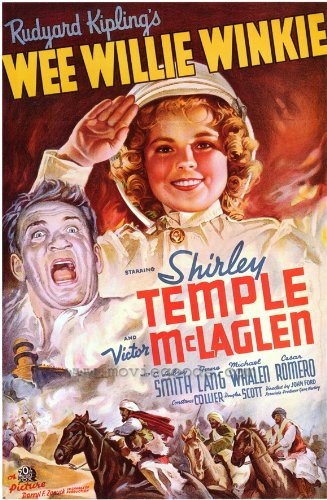
A charming girl combines effective diplomacy and soldiering in Wee Willie Winkie by writers Julien Josephson and Ernest Pascal; producers Gene Markey and Darryl F. Zanuck; and director John Ford. Arthur C. Miller, Walter Thompson and Alfred Newman handle cinematography, editing, and music. Filming showcases Chatsworth’s Iverson Movie Ranch in California.
The 100-minute adventure film adapts Rudyard Kipling’s (December 30, 1865 - January 18, 1936) story. Its distributor was 20th Century-Fox. Its LA; Baltimore, Richmond, and Philadelphia; NYC-premiere; and USA-release dates were June 25; July 16; 23; and July 30, 1937. It was Oscar-nominated for Best Art Direction.
The movie begins with Sergeant Donald MacDuff (Victor McLaglen) meeting impoverished, widowed Joyce Williams (June Lang) and daughter Priscilla (Shirley Temple) at a north Indian train station in 1897. Priscilla retrieves a talisman which captured rebel leader Khoda Khan (Cesar Romero) drops.
Joyce’s father-in-law (C. Aubrey Smith) commands the fort. Priscilla concludes that Colonel Williams disdains bad soldiers, children and women. She decides to prove the wrongness of his prejudices by training to be a private. Errand boy/Private Mott (Douglas Scott) is unwilling to help. Priscilla looks to Lieutenant Brandes (Michael Whalen). Coppy refers Priscilla to Donald.
Donald calls Priscilla Wee Willie Winkie in honor of William Miller’s (August 1810 - August 20, 1872) 1841-published rhyme. Priscilla considers Private Winkie the credible, worthy name for a wannabe soldier to Queen Victoria (May 24, 1819 - January 22, 1901). Donald gives Mott’s new uniform for Priscilla to wear. Priscilla returns the talisman during a visit to Khoda.
Donald holds special drills. Priscilla learns marching. The Colonel punishes the drill’s participants. He relegates Joyce and Priscilla to quarters. Priscilla nevertheless succeeds in:
-
Conveying the Colonel’s servant/Khoda’s spy Mohammed Dihn’s (Willie Fung) note to Khoda;
-
Convincing the Colonel to escort Joyce to the company dance.
Rebels manage to release Khoda. The Colonel orders Coppy’s arrest for deserting his post to dance with Joyce. Joyce threatens to leave.
Rebels cut the town’s communication wires. Donald gets wounded during morning patrol. Before dying, he receives Priscilla’s:
-
Bouquet of stolen flowers;
-
Rendition of “Auld Lang Syne”.
The Colonel tells Priscilla that Donald’s death is Khoda’s fault.
Mohammed accompanies Priscilla to Khyber Pass. Priscilla becomes Khoda’s hostage. Khoda and his chieftains mock Priscilla’s suggestion of resolving issues with the Colonel.
The Colonel commands the regiment to attack if Priscilla is not released. Khoda and the Colonel know that rebels outnumber soldiers. The Colonel treks up to Khoda’s fortress.
The movie ends with:
-
Khoda agreeing to peace negotiations after snipers fire at the Colonel and Priscilla runs to protect her grandfather;
-
Mott complimenting Priscilla upon her soldiering;
-
The Colonel and Priscilla reviewing the troops.



Comments
DerdriuMarrinerAug 24, 2026
The afore-named noun is Romanized as xudā or xodâ.
DerdriuMarrinerAug 22, 2026
DerdriuMarrinerAug 21, 2026
the musical comedy Bright eyes, in 1934;
the musical comedy The little colonel, in 1935;
the musical drama Wee Willie Winkie, in 1937.
DerdriuMarrinerAug 20, 2026
One such film was a musical drama even as the two other movies were musical comedies.
DerdriuMarrinerAug 19, 2026
DerdriuMarrinerAug 18, 2026
Heidi;
Wee Willie Winkie.
DerdriuMarrinerAug 17, 2026
That Middle-Eastern word wynken connects with the Modern-English infinitival phrase "to wink."
DerdriuMarrinerAug 15, 2026
That time period carries the moniker Middle English.
The Middle-English word is wynken.
DerdriuMarrinerFeb 19, 2014
AbbyFitzFeb 19, 2014