
Britain was in many ways an environmental disaster. Coal mines and factories spoiled the landscape, but Britons dreamed of a greener world, so the land lovers set out to make a better world. Many initiatives sprang up and were gently nourished by devotees, many of them who are now volunteers who are now seeing the fruits. For many of us there is a future that our children will live to see, but others know that they are leaving a legacy to future generations.

In the new national forest
by frankbeswick
Britain just celebrated the planting of the ten millionth tree in one of the new national forests
Redemption
It is 2026 and the world is darkened by war. Missiles burn their malevolent paths to bring death, destruction and unhappiness, often on civilians and children. Drones patrol the skies of war zones and foot soldiers make war on the ground. But in a quiet corner of the East Midlands of England two young people walked along a path that led them into a young wood. Then they awaited the coming of a camera crew. The crew were to include a presenter in his eighties who knew the wood from many years before, for he was the presenter who had been filmed planting the first sapling to be planted in the forest project. Now he was back to film the ten millionth tree in the wood.
The two young people were forestry workers. The male was the grandson of the farmer who had once attempted to wrest a land from the soils of that part of the East Midlands. He had inherited the leased land from his grandfather but turned it into forestry, which seemed to promise better returns than conventional farming did. Much of the land in the young man's possession was a disused claypit, which extracted brick clay from the ground of the East Midlands. But when the demand for clay had diminished the hole was converted into landfill to contain waste from the conurbations of the East Midlands. That became part of the forest. Readers may be surprised that landfill could be used for growing plants, because I once had an allotment that was constructed by landfill, and its soil, though not natural was very good.
What is in the wood?
British forestry underwent a great change in the period subsequent to the end of World War Two.. The previous war, World War One, had exposed the dangerous shortage of wood in the countryside, as for centuries ground had been cleared for wood. Furthermore, the wrong wood had been planted. Felled were the mighty oaks that had been integral to British history,. The Sessile Oak nearly disappeared entirely. I have seen a few in Newlands Valley in the Lake District in Cumbria, in North West England.We were losing much of our hardwood trees and replacing them with softwood, such as spruce and pine. There is some value in these softwoods, for they are good for funiture making, but they are not evolved to grow in Britain, and are not good for our native wildlife. The oak, for example, is home to a rich variety of small wild creatures, such as insects and mites. Bird species nest in the great boughs of the oak
The Elm is an unfortunate tree, as has been massacred by Dutch Elm Disease, which kills elm trees after they reach the age of six. Scientists are working hard to find immune varieties of elm, and so while the problem is being successfully addressed. Once known for its frequency in the Midlands, where it was known in Shakespeare's day as the Warwickshire Weed [ Warwickshire, Shakespeare's home county, is in the West Midlands] this tree is now at risk and so is a species being planted in the new forestry project being planted in England's woods.
Ash is another tree in trouble. Once a well-represented arboreal member of Britain's flora it has become infected with Ash dieback, and many of the nation's ash trees have died. But the identification of this Fungal disease carried by insects who bore into the tree trunks is helped by the discovery of Ash trees that seem to possess some natural immunity. The race is on to save the Ash and the forests can play their part, along with a variety of others.
.
Other trees such as sycamore, which is known for self seeding with its prolific seed production make for an element in the forest that does not need help. Other trees such as hazel and birch grow on the forest's fringes Land that was once agricultural will contain the remnant of hedges. Staffordshire, a county on the edge of the forest, is one of the counties where dry stone walling was practised, and this practice did not accomodate trees, but the other counties, for example, Warwickshire, used hedges made of trees. The technique for hedges is known as pleaching, which is when a sapling is half cut and then bent over,. Once a hedge of these was constructed the wooden hedge is then concluded by planting a set of poles, with which the bent saplings are interwoven. The trees are allowed to grow. the result is a very strong hedge of trees. Often you see the remnants of hedges such as these as lines of trees at the edge of an old field. You willl find a variety of trees in the old hedge. When walking in an old parkland once belonging to a manor I came upon a hedge containing medlar, once planted by a long dead farmer. Other hege plants that may well be preserved include hawthorn and holly.
Britain's forests are not on an American scale, for we are a small island and our forests are correspondingly small on a world scale. Patches of wood co-exist with small villages and farms. These are integral to the charm of our forests. Our forests are places of leisure where visitors stroll along carefully made paths. It is hard to get lost in a new British forest, for signposting is well made.
The Fauna of the Forest.
Large wild fauna are not common in Britain, but insects are common. But the large fauna include roe deer. The red deer is common in Britain, but it is not a wild species present in the Midlands, as it is more common in Scotland and parts of Northern England. Sika, a smaller relation of the red deer is known in areas where the red deer is present, and the two species interbreed. A small Japanese immigrant species is the muntjac, which is the size of a large dog. Muntjac are good at hiding in thickets and so I expect that this small deer will soon be known in the new forests.
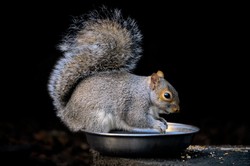
The Grey Squirrel gets everywhere. An American species introduced by estate owners it is widespread in British woodlands Its introduction was at the expense of the native red squirrel. The red squirrel only has its drey in softwoods, so the red squirrel is not likely to benefit from this new forest project unless there are areas to be specially planted with softwood plantings. Another mammal which might be planted in the project is the pine marten. This was hunted near to extinction by other rodents in the nineteenth century, as it was regarded as a predator who would endanger game birds such as grouse, the hunting of which was reserved for rich people. Foxes are likely to find homes in the forests, but they are often tempted by urban situations, where there is more prey to forage. Wild boar have now found a place in British woodlands. Once kept well guarded on farms Some escaped due to their being released by green activists, and they have now settled in the woodlands.
The new forests have a future derived from their role as preservers of nature. A green future awaits them
Updated: 05/02/2026, frankbeswick
You might also like
Invasive Species in BritainBritain has some trouble with plants and animals that have been introduced an...
How I Use Fabric Pots For GardeningFabric garden bags come in a variety of sizes from small to extra large. Onc...
The Rise of Food Cooperatives and Food Buying Groups; Consumer...Exploring food cooperatives and food buying groups; defining food cooperative...
Disclosure: This page generates income for authors based on affiliate relationships with our partners, including Amazon, Google and others.

frankbeswick
432 Pages 100%Author for 13 years
 Country Shows29 days ago
 The Chelsea Flower Showon 05/24/2026
 The Boat Raceon 04/04/2026
 Darkness over the Earth the skies darkened when Jesus was crucifiedon 02/09/2026
Community Supported Agriculture (CSA)
The Rise of Food Cooperatives and Food Buying Groups; Consumer Power and Sustainable Living
Exploring food cooperatives and food buying groups; defining food cooperatives, how they can create employment and why they may be a desirable alternative to supermarkets.
Comments
Thanjks for this information
Thank you for your comment below in answer to my previous observation and question.
Online sources count 70 of 300 earthworm species as non-native even as they consider the species Amynthas agrestis ("common field/garden/manure/red worm") and Lumbricus terrestris ("common earthworm") particularly cantankerous.
The afore-mentioned sources match the most native species with the United States' Pacific Northwest and Atlantic Southeast.
I do not know. I would need to research these species
Thanks, but L am not that old.
You wrote as though you were there the entire time of the developing trees.
Thank you for your comment below in answer to my previous observation and question.
West-Atlantic pond-siders sometimes assert that the east-pond earthworm abides where once abided the native-American species.
Are east-pond earthworms British or are they immigrant-American species?
ZThe grey squirrel. Imported from America it has outcompeted the native red squirrel. Similarly, the American signal cray fish has nearly extincted the diminutive, much smaller, British species
Thank you for your comments below in answer to my previous observations and questions.
Is there the introduced-species downside of displacing an outcompeted native species?
The Sika was introduced by landowners who sought exotic specimens for their deer parks. As sika are biologically similar to the European red deer they can inhabit regions similar to those inhabited by its red deer relative. Furthermore, sika and red deer hybridise quite easily, rendering the sika well adapted to the British forests and deer parks.
Thank you for the comment below in answer to my previous observation and question.
How does the non-native sika dwell in British-Isle forests even as distant China, Japan, Korea, Russia, Taiwan domicile them natively?