Wizzley
PopularLatestDiscussedEditor's Choice
AuthorsForum
Wizzley

A community of writers publishing stories worth your time — on the topics they know and love.

Explore

  • Popular
  • Latest
  • Discussed
  • Editor's Choice

Community

  • Top authors
  • New authors

Service

  • Help
  • Contact
  • Imprint
  • Terms of Use
  • Privacy

Check out our other international Webhaus communities!

Explore another site:English·Deutsch

© 2026 Webhaus LLC. All rights reserved.

Pets & AnimalsDomestic, Livestock, WildlifeEducationSchool and LearningFamilyKids and ParentingHobbies & CraftsGames, Crafts, CollectingScienceFields of Knowledge
Article

My Travels With Clara, the Indian Rhinoceros, by Mary Tavener Holmes

My Travels with Clara by author Mary Tavener Holmes and artist Jon Cannell etch a Dutch captain’s and Indian rhinoceros’ eighteenth-century European tours.

My Travels with Clara concerns Indian rhinoceros super-stardom My Travels with Clara acknowledges Clara (1738 - 1758), an Indian rhinoceros (Rhinoceros unicornis) of: • Bangladesh, Bhutan; • India; • Nepal; • Pakistan. Biographical aspects by author Mary Tavener Holmes and illustrator Jon Cannell bear imagined reminiscences of second owner, Knabenhoe sea captain Douwemout Van der Meer. Travelogues consider: • rafting the Rhine River; • visiting Ansbach, Augsburg, Basel, Bern, Breslau, Frankfurt-am-Main, Freiberg, Hanover, Leiden, Leipzig, London, Mannheim, Munich, Nuremberg, Paris, Regensburg, Rome, Strasbourg, Stuttgart, Venice, Würzburg, Zurich. They likewise detail Clara’s private audiences with: • Augustus III (1696 – 1763) in Dresden; • Francis I (1708 - 1765) and Maria-Theresa (1717 - 1780) in Vienna; • Frederick II (1720 – 1785) in Kassel; • Frederick II (1712 – 1786) in Berlin; • Louis XV (1710 - 1774) in Versailles. ***** Website: http://www.getty.edu/education/teachers/getty_books/clara.html *****

Clara's first owner, Jan Albert Sichterman (September 19, 1692-January 15, 1764), officer in the East India Company (Vereenigde Oostindische Compagnie), gave the tyke free access to his opulent house on VOC property in paradisical city of Chinsurah.

Groninger Museum, Groningen, northeastern Netherlands
Groninger Museum, Groningen, northeastern Netherlands — Public Domain, via Wikimedia Commons

My Travels with Clara describes Europeans welcoming wildlife


Clara’s story elucidates the heartwarming tale of an Assam-born, month-old orphaned calf who perfects, at the Calcutta-area estate of the first -- Dutch East India Company director Jan Albert Sichtermann -- of two owners:

  • eating from plates;
  • moving around furniture;
  • sleeping indoors.

It then finds Clara experiencing six or seven landless months by departing from Calcutta in northeastern India and disembarking at Rotterdam in northwestern Holland on July 22, 1741. The voyage generates such fun facts as Clara’s daily needs for:

  • bowl of beer;
  • 14 to 15 buckets of fresh water;
  • orange peels;
  • 60 pounds of hay;
  • skin lotions of fish oil-enriched mud against parasites, sunburns, and ticks;
  • sniffs of Douwe’s tobacco pipe;
  • 20 pounds of bread.


After rescue from snare in Assam, where her mother was killed, 1-month old Clara was welcomed into resplendent home of Jan Albert Sichterman on grounds of VOC Chinsura Trading Post overlooking Hooghly River.

Rijksmuseum, Room 29; Museum Square, Amsterdam South, Amsterdam, North Holland Province, northwest Netherlands
Rijksmuseum, Room 29; Museum Square, Amsterdam South, Amsterdam, North Holland Province, northwest Netherlands — Public Domain, via Rikjsmuseum

My Travels with Clara emphasizes eighteenth-century rhinoceros-influenced fads


We have no surviving writings by the 36-year-old Dutch East India Company sea captain on the life cycle and natural history of Clara, whose cause of death in London and place of burial remain unknown. But it is clear that Douwe’s posters of town viewings from 9:00 a.m. to noon and 2:00 p.m. to 6:00 p.m. and tours of eighteenth-century cities inspired others to preserve Clara’s mature description and image as:

  • 5’7” (1.74 meters) tall, shoulder to three-toed feet;
  • 5,000 pounds;
  • 12’ (3.66 meters) long, head to rump (excluding tail).

Posterity indeed judges as accurate:

  • depictions in bronze, marble, and porcelain;
  • models as statues and teapots and on clocks;
  • portraits in beaded textiles and on continental coins. 


souvenir of Clara, with brief biography, sold by her second owner, Douw Moot van der Meer, for exhibitions; also included in souvenir is portrait of Douw Moot van der Meer (bottom, center).

"De neushoorn Clara, komt dat zien!" ("Clara the rhinoceros, come and see!"), object no. RP-P-OB-75.362; Rijksmuseum, Amsterdam
"De neushoorn Clara, komt dat zien!" ("Clara the rhinoceros, come and see!"), object no. RP-P-OB-75.362; Rijksmuseum, Amsterdam — Public Domain, via Rijksmuseum

My Travels with Clara finds Indian rhinoceroses irreplaceable


Clara’s memory keeps getting re-honored through:

  • engravers Elias Baeck (1679 - 1747) and Jan Wandelaar (1690 – 1759);
  • miniaturists of Archduke Charles Joseph of Austria (1745 – 1761);
  • painters Pietro Longhi (1701 – 1785) and Jean-Baptiste Oudry (1686 – 1755);
  • writers Denis Diderot’s (1713 - 1784) and Jean Le Rond d’Alembert’s (1717 - 1783) Encyclopédie, Oliver Goldsmith’s (1730 - 1774) History of the Earth and Animated Nature, Georges Louis Leclerc’s (1707 - 1788) Histoire Naturelle, and Samuel Richardson’s (1689 - 1761) Clarissa.

It leaves posterity happier impressions than Europe’s acclaimed but nameless seven rhinoceros super-stars of:

  • Lisbon, 1515, 1579 – 1583;
  • London, 1684 – 1686, 1739, 1790 – 1792, 1799;
  • Versailles, 1790 – 1813.

Clara’s story indeed memorializes the world’s longest surviving rhinoceros in captivity. 


Clara in Venice, where she arrived in January 1751: Spectators in carnival costumes are bedazzled by Clara while showman holds whip and Clara's horn, removed or rubbed off in 1750 in Rome.

National Portrait Gallery, Room 39; north Trafalgar Square, City of Westminster, Central London
National Portrait Gallery, Room 39; north Trafalgar Square, City of Westminster, Central London — Public Domain, via Wikimedia Commons

Acknowledgment


My special thanks to talented artists and photographers/concerned organizations who make their fine images available on the internet.


Image Credits


Clara's first owner, Jan Albert Sichterman (September 19, 1692-January 15, 1764), officer in the East India Company (Vereenigde Oostindische Compagnie), gave the tyke free access to his opulent house on VOC property in paradisical city of Chinsurah.
Jan Albert Sichterman with his son Jan; 1745 oil on canvas by Philip van Dijk (January 10, 1683 – February 2, 1753)
Groninger Museum, Groningen, northeastern Netherlands: Public Domain, via Wikimedia Commons @ https://commons.wikimedia.org/wiki/File:Philip_van_Dijk_-_Jan_Albert_Sichterman_met_zijn_zoon_Jan_Albert.jpg

After rescue from snare in Assam, where her mother was killed, 1-month old Clara was welcomed into resplendent home of Jan Albert Sichterman on grounds of VOC Chinsura Trading Post overlooking Hooghly River.
"The Trading Post of the Dutch East India Company in Hooghly, Bengal"; 1665 oil on canvas by Hendrik van Schuylenburgh (ca.1620-1689), commissioned by Pieter Sterthemius (1618-April 24, 1676) in year he became director of VOC Hooghly-Chinsura Trading Post
Rijksmuseum, Room 29; Museum Square, Amsterdam South, Amsterdam, North Holland Province, northwest Netherlands: Public Domain, via Rikjsmuseum @ https://www.rijksmuseum.nl/en/collection/SK-A-4282; Public Domain via Rijksmuseum @ https://www.rijksmuseum.nl/en/collection/SK-A-4282

souvenir of Clara, with brief biography, sold by her second owner, Douw Moot van der Meer, for exhibitions; also included in souvenir is portrait of Douw Moot van der Meer (bottom, center).
1747 etching by H. Oster, after print by Johann Georg Schmidt (1685-September 15, 1748), after drawing by Anton August Beck (August 27, 1713-March 17, 1787)
"De neushoorn Clara, komt dat zien!" ("Clara the rhinoceros, come and see!"), object no. RP-P-OB-75.362; Rijksmuseum, Amsterdam: Public Domain, via Rijksmuseum @ https://www.rijksmuseum.nl/en/collection/RP-P-OB-75.362

Clara in Venice, where she arrived in January 1751: Spectators in carnival costumes are bedazzled by Clara while showman holds whip and Clara's horn, removed or rubbed off in 1750 in Rome.
"Exhibition of a rhinoceros at Venice"; ca. 1751 oil on canvas by Venetian genre painter Pietro Longhi (November 15, 1701 – May 8, 1785)
National Portrait Gallery, Room 39; north Trafalgar Square, City of Westminster, Central London: Public Domain, via Wikimedia Commons @ https://commons.wikimedia.org/wiki/File:Pietro_Longhi_1751_rhino.jpg

Clara visits Paris
"Clara the rhinoceros in Paris in 1749"; 1749 oil on canvas by Jean-Baptiste Oudry (March 17, 1686–April 30, 1755)
Staatliches Museum Schwerin (State Museum Schwerin), Mecklenburg-Vorpommern state, northeastern Germany: Public Domain, via Wikimedia Commons @ https://commons.wikimedia.org/wiki/File:Clara_1749_Oudry.jpg

Clara in Venice
ca. 1751 oil on canvas by Circle of Pietro Longhi (November 15, 1701 – May 8, 1785)
Banca Intesa Collection, Vicenza, Veneto Region, northeastern Italy: Public Domain, via Wikimedia Commons @ https://commons.wikimedia.org/wiki/File:Pietro_Longhi_Rhinoceros_1751.jpg

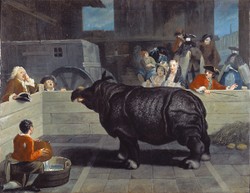
 

Clara visits Paris

Staatliches Museum Schwerin (State Museum Schwerin), Mecklenburg-Vorpommern state, northeastern Germany
Staatliches Museum Schwerin (State Museum Schwerin), Mecklenburg-Vorpommern state, northeastern Germany — Public Domain, via Wikimedia Commons

Sources Consulted


Carson, Mary Kay. 2007. Emi and the Rhino Scientist. With photographs by Tom Uhlman. Boston, MA: Houghton Mifflin Company’s Scientists in the Field series.

“Clara: A Brief Biography.” The J. Paul Getty Trust > News > Press > Oudry’s Painted Menagerie. Retrieved August 2015.

  • Available @ http://www.getty.edu/news/press/oudry/clara_biography_lh_final.pdf

Crossland, Pamela. 2006. “Clara’s Grand Tour: Travels with a Rhinoceros in Eighteenth-Century Europe.” Curled Up with a Good Book. Retrieved August 2015.

  • Available @ http://www.curledup.com/clarasgr.htm

Holmes, Mary Tavener. 2007. My Travels with Clara. Illustrated by Jon Cannell. Los Angeles, CA, U.S.A.: J. Paul Getty Museum, Los Angeles Getty Publications.

Lahiri, Oeendrila (Dr.). 2014. The Dutch Histories of Chinsurah. New Delhi, India: Aishwarya Tipnis Architects.

Available via Issuu, Inc. @ http://issuu.com/aishwaryatipnisarchitects/docs/english_storybook

Morton, Mary G., and Colin Bailey. 2007. Oudry's Painted Menagerie: Portraits of Exotic Animals in Eighteenth-Century Europe. Los Angeles CA: J. Paul Getty Museum.

Pollak, Lisa. 24 April 2005. “Clara, the Traveling Rhino, Belied Species’ ‘Brutal Beast’ Image.” The Baltimore Sun > Entertainment. Retrieved August 2015.

  • Available @ http://articles.baltimoresun.com/2005-04-24/entertainment/0504240275_1_ridley-van-der-meer-rhino

Rookmaaker, L.C. 1973. "Captive Rhinoceroses in Europe from 1500 until 1810." Bijdragen tot de Dierkunde, Vol. 43, No. 1 (1973): 39-63.

  • Available via UvA-DARE (Digital Academic Repository of the University of Amsterdam) @ http://dare.uva.nl/cgi/arno/show.cgi?fid=547904

Simpson, Samantha. 9 Jun 2007. “Clara the Rhino.” Monkey Fur: Samantha Simpson’s Art Blog. Retrieved August 2015.

  • Available @ http://monkeyfur.blogspot.com/2007/06/clara-rhino.html

Sullivan, Liam. 25 October 2007. “Book Review: Clara’s Grand Tour by Glynis Ridley.” Panorama of the Mountains: Liam Sullivan's Ideas and Reflections. Blog at WordPress.com. The Spring Loaded Theme. Retrieved August 2015.

  • Available @ https://othemts.wordpress.com/2007/10/25/book-review-claras-grand-tour-by-glynis-ridley/

Weinberger, Eliot. 2007. “The Rhinoceros.” Rhino Resource Center. Retrieved August 2015.

  • Available @ http://www.rhinoresourcecenter.com/pdf_files/120/1206206707.pdf

Wonfor, Sam. 3 August 2004. “On Horns of a Story.” SOS Rhino > News. Powered by Equitek Incorporated. Retrieved August 2015.

  • Available @ http://sosrhino.org/news/rhinonews080304.php 


Clara in Venice

Banca Intesa Collection, Vicenza, Veneto Region, northeastern Italy
Banca Intesa Collection, Vicenza, Veneto Region, northeastern Italy — Public Domain, via Wikimedia Commons
the end which is also the beginning
the end which is also the beginning — OpenClips, Public Domain, via Pixabay

My Travels With Clara Hardcover by Mary Tavener Holmes illustrations by Jon Cannell ~ Available now via Amazon

My Travels With Clara

Advertisement

Oudry's Painted Menagerie: Portraits of Exotic Animals in Eighteenth-Century Europe by Mary Morton and Colin Bailey ~ Available now via Amazon

Clara stories

Advertisement

14k Gold Rhinoceros Charm for Charm Bracelet by The Magic Zoo ~ Available now via Amazon

rhino-themed jewelry

Advertisement

Me and my purrfectly purrfect Maine coon kittycat, Augusta "Gusty" Sunshine

DerdriuMarriner, All Rights Reserved

Updated September 11, 2026

Comments

DerdriuMarriner7d ago

For those asking about the common, non-scientific name for Indian rhinoceros in the Greek language, such an arrangement appears as follows:

Ινδικός ρινόκερος.

DerdriuMarriner8d ago

For those asking about other English-language common names, such terminology acknowledges such alternate names as follows:

great Indian rhinoceros;
greater one-horned rhinoceros;
Indian rhino.

DerdriuMarriner9d ago

The below-articulated area also acknowledges the Romanization Chunchuṛā.

DerdriuMarriner13d ago

For those asking about the town Chinsurah, that place name arises from the Bengali language.

The afore-articulated area also acknowledges the Romanization Chuchara.

DerdriuMarrinerAug 13, 2015

Mira, Evidently there have been efforts at captive breeding, which just have not been successful other than those regarding the northern white rhinoceros in the Czech Republic. Of the black, Indian, Javan, northern and southern white, and Sumatran rhinoceros species, only the southern white species is a bit further away from endangerment and extinction.
My article on the northern white rhinoceros Nabiré's recent tragic death references the zoo's log of attempts, most of which succeeded.
It's a very charming book, whose succinct but enjoyable and informative text and wonderful art make Clara's story come to life.

MiraAug 13, 2015

I had no idea that rhinoceros were that rare. Why didn't zoologists try to breed them more in captivity?
Nice story about Clara, and great to have a book about her adventures!

DerdriuMarrinerAug 13, 2015

CruiseReady, Clara evidently had her sea legs and land wits about her since she impressed both of her owners and apparently every person she met in India and Europe.

CruiseReadyAug 13, 2015

What a cool book for a kid - or anyone -to love. The part about her living on a chip for eight months really set my imagination running!
DerdriuMarriner
DerdriuMarriner
536 articles
★ Editor's Choice
FollowMessage

Related articles

  • Music Book Review: Venetian Curiosities by Donna Leon, Baroque Era Title #2 With Vivaldi Concerti CD
  • Death of Nabiré: Only Four Known Living Northern White Rhinoceroses
  • Northern White African Rhinoceroses (Ceratotherium simum cottoni): Captive Relicts, Wild Extinctions
  • Death of Nola: Only Three Known Living Northern White Rhinoceroses