"Ananatara Golden Triangle Elephant Camp & Resort." Anantara Hotels, Resorts & Spas. Retrieved August 31, 2014.
- Available at: http://goldentriangle.anantara.com/
Angkasith, Pongsak. 26-28 February 2001. "Coffee Production Status and Potential of Organic Arabic Coffee in Thailand." Scribd. Retrieved August 31, 2014.
- Available at: http://www.scribd.com/doc/18619977/Coffee-Growing-in-Thailand-One-sheet
Associated Press. 16 May 1994. "Big Headaches for Brewers with Small Dreams." Los Angeles Times: Collections > Government Regulation > The Pacific. Retrieved August 31, 2014.
- Available at: http://articles.latimes.com/1994-05-16/business/fi-58367_1_local-beers
Associated Press. 7 December 2012. "Coffee from an Elephant's Dung Fills a $50 Cup." Fox News: Lifestyle > Food & Drink. FOX News Network, LLC. Retrieved August 31, 2014.
- Available at: http://www.foxnews.com/leisure/2012/12/07/gimmick-or-gastronomy-elephant-herd-in-thailand-leaving-its-mark-on-exotic/
Boelens, Bo; Watkins, Michael; and Grayson, Michael. 2009. The Eponym Dictionary of Mammals. Johns Hopkins University.
Brault, Len. 30 December 2009. "Coffee from Thailand." I Need Coffee. Retrieved August 31, 2014.
- Available at: http://ineedcoffee.com/coffee-from-thailand/
"Chiang Rai Guide." Anantara Hotels, Resorts & Spas. Retrieved August 31, 2014.
- Available at: http://goldentriangle.anantara.com/Chiang-Rai-Guide/
CNNgo Staff. 12 October 2012. "Would You Pay US$50 for a Cup of Elephant Dung Coffee?" CNNGo Travel: Asia Pacific ?> Thailand. Retrieved August 31, 2014.
- Available at: http://travel.cnn.com/bangkok/drink/why-worlds-most-expensive-coffee-comes-elephants-butt-426056
"Coffee: Beans Picked from Elephant Dung Make World's Priciest Brew." Vancouverdesi: December 10, 2012. Postmedia Network Inc.: Pacific Newspaper Group. Retrieved August 31, 2014.
- Available at: http://www.vancouverdesi.com/business/asia/coffee-beans-picked-from-elephant-dung-make-worlds-priciest-brew-gallery/395474/
"Coffee from Thailand." Coffee Forums: Coffee Addicts > Coffee Beans & Espresso Beans. Retrieved August 31, 2014.
- Available at: http://www.coffeeforums.com/forum/coffee-beans-espresso-beans/7510-coffee-thailand.html
"Coffee Production in Thailand." Jamala Foods. Retrieved August 31, 2014.
- Available at: http://www.jamalafoods.com/coffee-production-in-thailand/
"Craft Beer City Japan?" Japan Beer Times: August 9, 2012. Retrieved August 31, 2014.
- Available at: http://japanbeertimes.com/2012/08/craft-beer-city-japan/comment-page-1/
Craker, Lee. 16 February 2014. The Last Elephant: The Fight to Save the Elephants of Thailand. CreateSpace Independent Publishing.
"Duang Dee Hill Tribe Coffee Is Proudly Produced in Northern Thailand." Northern Thailand. Retrieved August 31, 2014.
- Available at: http://www.northernthailand.com/duangdeecoffee/
"Elephant Camp." Anantara Hotels, Resorts & Spas. Retrieved August 31, 2014.
- Available at: http://goldentriangle.anantara.com/elephantcamp.aspx
"Elephant Dung Coffee: Smooth, Rich, Expensive." ABC News: Now. Yahoo!-ABC News Network. Retrieved August 31, 2014.
- Available at: http://abcnews.go.com/Nightline/video/elephant-dung-coffee-smooth-rich-expensive-18734728
Foodbeast. 15 April 2013 (Updated 18 April 2013). "Elephant Dung Beer Sounds Grosser Than It Tastes." TheHuffingtonPost.com, Inc. Retrieved August 31, 2014.
- Available at: http://www.huffingtonpost.com/2013/04/15/elephant-dung-beer_n_3084996.html
"For Foreigners." Atsugi City Official Website. Retrieved August 31, 2014.
- Available at: http://www.city.atsugi.kanagawa.jp/foreigner/
FoxNews.com. 18 April 2013. "Elephant Dung Beer Sells Out Almost Immediately." FOX News Network, LLC: Lifestyle> Food & Drink > Beer. Retrieved August 31, 2014.
- Available at: http://beersensei.tenjou.net/?tag=sankt-gallen
Gecker, Jocelyn. 7 December 2012 (Updated 23 November 2013). "Elephant Dung Coffee: An Exotic Brew at $50 a Pop." Komo News. Seattle, WA: Sinclair Interactive Media, LLC. Retrieved August 31, 2014.
- Available at: http://www.komonews.com/news/offbeat/Elephant-dung-coffee-An-exotic-brew-at-50-a-pop--182539711.html
Gecker, Jocelyn. 8 January 2013. "Elephant-Dung Coffee Lures Intrepid Foodies to Thailand." USA Today. Retrieved August 31, 2014.
- Available at: http://www.usatoday.com/story/travel/destinations/2012/12/28/elephant-dung-coffee-intrepid-foodies-thailand/1797347/
Gecker, Jocelyn. 7 December 2012 (Updated February 6, 2013). "Elephant Dung Coffee Well-Received by Tasters." The Huffington Post. Retrieved August 31, 2014.
- Available at: http://www.huffingtonpost.com/2012/12/07/elephant-dung-coffee_n_2257628.html
"The Golden Triangle Asian Elephant Foundation." Helping Elephants. Retrieved August 31, 2014.
- Available at: http://www.helpingelephants.org/
"How to Serve and Experience Black Ivory Coffee." Black Ivory Coffee Company. Retrieved August 31, 2014.
- Available at: http://www.blackivorycoffee.com/#!how-to-serve-and-experience-/cqr1
"The Highlands Regions of Thailand." Route 66 Coffee Roasters. Retrieved August 31, 2014.
- Available at: http://route66coffee.co/the-highlands-regions-of-thailand
Jackson, Michael. 19 September 2000. "Beer Tops New Heights up Fuji." Beer Hunter. Real Beer Inc. Retrieved August 31, 2014.
- Available at: http://www.beerhunter.com/documents/19133-001373.html
Kay. 18 January 2013. "Something Dark and Bittersweet Is Brewing in Japan for Valentine's Day." RocketNews24. Retrieved August 31, 2014.
- Available at: http://en.rocketnews24.com/2013/01/18/something-dark-and-bittersweet-is-brewing-for-valentines-day/
Kay. 22 January 2013. "Something Dark and Bittersweet Is Brewing in Japan for Valentine's Day." Japan Today: Features > Food. Retrieved August 31, 2014.
- Available at: http://www.japantoday.com/category/food/view/something-dark-and-bittersweet-is-brewing-in-japan-for-valentines-day-chocolate-beer
Lee, May. 19 December 1995. "Japanese Drinkers Ready for New Brews." Cable News Network, Inc. Retrieved August 31, 2014.
- Available at: http://www.cnn.com/WORLD/9512/japan_microbrew/index.html
Lila, Muhammad. 14 March 2013. "Elephant Coffee, Smooth, Rich and Expensive." ABC News: Nightline. Retrieved August 31, 2014.
- Available at: http://abcnews.go.com/Business/elephant-dung-coffee-smooth-rich-expensive/story?id=18730668
Lister, Adrian. 2004. "African Elephant: Loxodonta africana." Pp. 178-179 in Grzimek's Animal Life Encyclopedia, Second Edition. Volume 15: Mammals IV, edited by Michael Hutchins, Devra G. Kleiman, Valerius Geist, and Melissa C. McDade. Farmington Hills, MI: Gale Group, Inc., division of Thomson Learning Inc.
Lister, Adrian. 2004. "Asian Elephant: Elephas maximus." P. 178 in Grzimek's Animal Life Encyclopedia, Second Edition. Volume 15: Mammals IV, edited by Michael Hutchins, Devra G. Kleiman, Valerius Geist, and Melissa C. McDade. Farmington Hills, MI: Gale Group, Inc., division of Thomson Learning Inc.
Luttinger, Nina; and Dicum, Gregory. 24 April 2006. The Coffee Book: Anatomy of an Industry from Crop to the Last Drop. New Press Bazaar Book.
Marcone, Massimo F. 2004. "Composition and Properties of Indonesian Palm Civet Coffee (Kopi Luwak) and Ethiopian Civet Coffee." Food Research International 37(9):901-912.
Marcone, Massimo F. March 2005. "Corrigendum to 'Composition and Properties of Indonesian Palm Civet Coffee (Kopi Luwak) and Ethiopian Civet Coffee'." Food Research International 38(2):233.
Master Blaster. 30 January 2013. "What's Better than Chocolate Beer? Chocolate Beer in a Chocolate Glass!" RocketNews24. Retrieved August 31, 2014.
- Available at: http://en.rocketnews24.com/2013/01/30/whats-better-than-chocolate-beer-chocolate-beer-in-a-chocolate-glass/
Master Blaster. 6 April 2013. "We Try Beer Made with Coffee from an Elephant's Butt!" RocketNews24. Retrieved August 31, 2014.
- Available at: http://en.rocketnews24.com/2013/04/06/we-try-beer-made-with-coffee-from-an-elephants-butt/
Mestanza, Jean-Pierre. 30 November 2012. "Phuket: Thai Hotel Brews Up Elephant Dung Coffee." The Phuket News. Retrieved August 31, 2014.
- Available at: http://www.thephuketnews.com/thai-hotel-brews-up-elephant-dung-coffee-35027.php
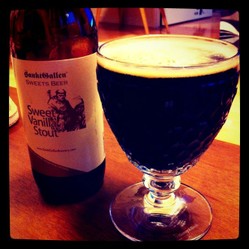
Mitchell, Aric. 18 April 2013. "Sankt Gallen Elephant Dung Beer." inStash. Retrieved August 31, 2014.
- Available at: http://www.instash.com/sankt-gallen-elephant-dung-beer
"Our Coffee." Mai Thai. Retrieved August 31, 2014.
- Available at: https://maithaicoffee.com/Our_Coffee.html
Pais, Allen J. "Elephant Dung Coffee Beans." EcoFriendly Coffee > Biodiversity. December 12, 2013. Michael Allen Smith. Web. ecofriendlycoffee.org
- Available at: http://ecofriendlycoffee.org/elephant-dung-coffee-beans/
petedrinks. 1 November 2013. "Sankt Gallen Yokohama XPA." Pete Drinks: Work Is the Curse of the Drinking Classes. Retrieved August 31, 2014.
- Available at: http://www.petedrinks.com/2013/11/sankt-gallen-yokohama-xpa/
Prendergast, Mark. 28 September 2010. Uncommon Grounds: The History of Coffee and How It Transformed Our World. New York, NY: Basic Books.
Rice, Robert; and Bedoya, Mauricio. September 2010. "The Ecological Benefits of Shade Grown Coffee: The Case for Going Bird Friendly." Smithsonian National Zoological Park: Smithsonian Migratory Bird Center. Retrieved August 31, 2014.
- Available at: http://nationalzoo.si.edu/scbi/migratorybirds/coffee/bird_friendly/ecological-benefits-of-shade-grown-coffee.cfm
Sanghvi, Vir. 15 October 2013. "Vir Sanghvi Tastes the World's Most Expensive Elephant Dung Coffee." NDTV Convergence Limited: Video > Freshly Brewed: Coffee for the Soul. Retrieved August 31, 2014.
- Available at: http://www.ndtv.com/video/special/vir-sanghvi-tastes-the-world-s-most-expensive-elephant-dung-coffee-972/294929
"Sankt Gallen Brewery." Beeradvocate: Places. Retrieved August 31, 2014.
- Available at: http://www.beeradvocate.com/beer/profile/7464/?view=beers&show=all
"Sankt Gallen Brewery." RateBeer LLC: Breweries > Japan. Retrieved August 31, 2014.
- Available at: http://www.ratebeer.com/brewers/sankt-gallen-brewery/7985/
Scoggins, Glenn. "Two Brewpub-operated Bars in Kanagawa Prefect." Brews News Issue #56: Bar Beat > Bar Sankt Gallen and Trattori Mokichi. Retrieved August 31, 2014.
- Available at: http://www.bento.com/brews56.html
Sullivan, Michael. 20 August 2014. "Coffee Flop: Elephants Make the Priciest Beans." Minnesota Public Radio (MPR) News. Retrieved August 31, 2014.
- Available at: http://www.mprnews.org/story/2014/08/21/coffee-elephant-dung?refid=0
Sullivan, Michael. 20 August 2014. "No. 1 Most Expensive Coffee Comes from Elephant's No. 2." NPR: The Salt What's on Your Plate. Retrieved August 31, 2014.
- Available at: http://www.npr.org/blogs/thesalt/2014/08/20/340154271/no-1-most-expensive-coffee-comes-from-elephants-no-2
Tepper, Rachel. 15 October 2012 (Updated 17 October 2012). "Elephant Dung Coffee: World's Most Expensive Brew Is Made with Pooped-out Beans." The Huffington Post. Retrieved August 31, 2014.
- Available at: http://www.huffingtonpost.com/2012/10/15/elephant-dung-coffee-black-ivory_n_1968096.html
"Thai Coffee, 'Oleang'." ImportFood. Retrieved August 31, 2014.
- Available at: http://importfood.com/thaiicecoffee.html
"Thailand Brewing Methods." Route 66 Coffee Roasters. Retrieved August 31, 2014.
- Available at: http://route66coffee.co/thailand-brewing-methods
"Thailand History in Coffee Cultivation." Route 66 Coffee Roasters. Retrieved August 31, 2014.
- Available at: http://route66coffee.co/thailand-history-in-coffee-cultivation
Titus, Dr. Anand; and Pereira, Geeta N. 1 October 2004. "Coffee Forest Symbiosis." EcoFriendly Coffee. Retrieved August 31, 2014.
- Available at: http://ecofriendlycoffee.org/coffee-forest-symbiosis/
Titus, Dr. Anand; and Pereira, Geeta N. 1 September 2007. "Coffee Forests: A Gateway to Wildlife." EcoFriendly Coffee. Retrieved August 31, 2014.
- Available at: http://ecofriendlycoffee.org/coffee-forests-a-gateway-to-wildlife/
Titus, Dr. Anand; and Pereira, Geeta N. 15 November 2010. "Coffee Forests and Green National Acconts." EcoFriendly Coffee. Retrieved August 31, 2014.
- Available at: http://ecofriendlycoffee.org/coffee-forests-and-green-national-accounts/
Titus, Dr. Anand; and Pereira, Geeta N. 9 September 2011. "Coffee Forests and Wildlife." EcoFriendly Coffee. Retrieved August 31, 2014.
- Available at: http://ecofriendlycoffee.org/coffee-forests-and-wildlife-credits/
Titus, Dr. Anand; and Pereira, Geeta N. 1 July 2007. "Coffee Hotspots: An Inventory of Biodiversity." EcoFriendly Coffee. Retrieved August 31, 2014.
- Available at: http://ecofriendlycoffee.org/coffee-hotspots-an-inventory-of-biodiversity/
Titus, Dr. Anand; and Pereira, Geeta N. 1 July 2008. "Human Elephant Conflict Inside Coffee Forests." EcoFriendly Coffee. Retrieved August 31, 2014.
- Available at: http://ecofriendlycoffee.org/human-elephant-conflict-inside-coffee-forests/
Torres, Ida. "Japanese Beer from Elephant-digested Coffee Beans Sells Out in 1 Day." The Japan Daily Press: Lifestyle & Travel. Retrieved August 31, 2014.
- Available at: http://japandailypress.com/japanese-beer-from-elephant-digested-coffee-beans-sells-out-in-1-day-1927306/
Travelingrant. 16 July 2014. "Irish Saints and Elephant Poo Beer: Sankt Gallen Brewing." Beer Sensei. Retrieved August 31, 2014.
- Available at: http://beersensei.tenjou.net/?tag=sankt-gallen
Ukers, William H. 1922. All About Coffee. New York, NY: The Tea and Coffee Trade Journal Company.
- Available via Project Gutenberg at: http://www.gutenberg.org/files/28500/28500-h/28500-h.htm
"Un, Kono Kuro." Sankt Gallen Brewery. Retrieved August 31, 2014.
- Available at: http://www.sanktgallenbrewery.com/index.php?p=&d=blog&c=&type=article&art_id=448
"What is a Stout Beer?" wiseGEEK. Retrieved August 31, 2014.
- Available at: http://www.wisegeek.org/what-is-a-stout-beer.htm
Wilson, Don E.; and Cole, F. Russell. 2000. Common Names of Mammals of the World. Washington, D.C.: Smithsonian Institution Press.
Wilson, Don E.; and Reeder, DeeAnn M. (editors). 2005. Mammal Species of the World: A Taxonomic and Geographic Reference (3rd ed), Johns Hopkins University Press.
Wrobel, Murray (Editor). 2007. Elsevier's Dictionary of Mammals: Latin English German French Italian. Oxford, U.K.: Elsevier B.V.
Young, Andy. 17 April 2013. "Elephant Dung Beer Sells Out in Minutes." The Drinks Business: International Edition. London, England: Union Press Ltd. Retrieved August 31, 2014.
- Available at: http://www.thedrinksbusiness.com/2013/04/elephant-dung-beer-sells-out-in-minutes/



Comments
DerdriuMarrinerJul 8, 2026
"(1) Sumatran Elephant (Elephas sumatranus): It resembles the Asian mainland elephant in the general shape of the skull; but the free part of the intermaxillary bones is much shorter and narrower; the nasal cavities are much less wide; the space between the eye orbits is narrower; the posterior part of the skull, on the contrary, is wider than in the mainland species.
By the shape of their crowns, the molars are closer to the Asian species than to the one peculiar to Africa; that is, their crowns offer the shape of wavy ribbons rather than diamonds: but these ribbons are the same width as those seen on the crowns of the teeth of the African Elephant; they are consequently less numerous than in the mainland Asian elephant. The dimensions of these ribbons, in the anteroposterior direction, compared to those taken in the transverse and lateral directions, are in a ratio of 3 or 4 to 1; whereas in the mainland elephant, they are as 4 or 6 to 1. The total length of six of these ribbons, in the new Sumatra species, as well as in the African one, is about 12 centimeters, whereas this length is only 8 to 10 centimeters in the mainland Asian species.
The other osteological forms are pretty much the same in the three species; but there is a difference in the number of bones making up the skeleton, as the attached comparative table proves."
DerdriuMarrinerJul 8, 2026
"(1) Elbphas Sokatràhus Nob. reMemble par la forme générale da crâne k l'Eléphant du continent de l'Asie; mais la partie libre des intermaxillaires est beaucoup plus 'courte et plus étroite ; les cafités nasales sont beaucoup moins larges ; l'espace entre les orbites des yeux est plus étroit ; la partie postérieure du crâne au contraire est plus large que dans l'espèce du continent.
Les machelières se rapprochent , par la forme de leur couronne ^ plutôt de l'espèce asiatique que de celle qui est propre à l'Afrique ; c'est-à-dire que leur couronne offre la forme de rubans ondoyés et non pas en losange: mais ces rubans sont de la largeur de ceux qu'on Toit à la couronne des dents de l'Eléphant d'Afrique; ils sont conséquemment moins nombreux que dans celui du continent de l'Asie. Les dimensions de ces rubans , dans la direction d'avant en arrière , comparées à celles prises dans la direction transversale et latérale, sont en raison de 3 ou 4 à 1 ; tandis que dans l'Eléphant du continent elles sont conmie 4 ou 6 à 1. La longueur totale de six de ces rubans , dans l'espèce nouvelle de Sumatra , ainsi que dans celle d'Afrique, est d'environ 12 centimètres , tandis que cette longueur n'est que de 8â 10 centimètres dans l'espèce du continent de l'Asie.
Les autres formes ostéologiques sont â peu près les mômes dans les trois espèces; mais il y a différence dans le nombre des os dont le squelette se compose, ainsi que le tableau comparatif ci-joint l'éprouve."
DerdriuMarrinerJul 8, 2026
DerdriuMarrinerJul 8, 2026
DerdriuMarrinerJul 7, 2026
"1. The Indian elephant (*Elephas indicus*). It has an elongated skull, a concave forehead, and molar teeth with crowns marked by undulating transverse bands. It appears to grow larger and be more docile than the African elephant. Its tusks grow more slowly and do not become as large. Its ears are much smaller. It is possible that the elephants of Africa's east coast belong to the same species."
DerdriuMarrinerJul 7, 2026
The last line on page 148 and the first six lines on page 149 detail the Cuvier description as follows:
"1. L’éléphant des Indes. (Elephas indicus.) Qui a le crâne alongé, le front concave, et les dents molaires marquées sur leur couronne de rubans transverses ondoyans. Il paroît qu'il devient plus grand et qu'il est plus docile que celui d'Afrique. Ses défenses poussent moins vite, et deviennent moins grosses. Ses oreilles sont beaucoup plus petites. Il se pourroit que les éléphans de la côte orientale d'Afrique fussent de la même espèce."
DerdriuMarrinerJul 7, 2026
We encounter the Cuvier explanation in his article Elephas indicus on pages 148-149 of Tableau elementaire de l'histoire naturelle des animaux ("Elementary table of the natural history of animals").
DerdriuMarrinerJul 6, 2026
The 10th edition of Systema Naturae ("A General System of Nature"), deemed as published Sun., Jan. 1, 1758, domiciles the afore-designated genus-specied-subspecied name.
DerdriuMarrinerJun 30, 2026
The scientific classification is Elephas maximus sumatranus, with the third name involving the Indonesian island Sumatra and the Latin suffix -ānus (Anglicized "of, pertaining to").
DerdriuMarrinerJun 27, 2026
The second subspecies goes by the English name Indian elephant.
That second subspecies inspires this wizzley even as the Indian elephant inhabits Thailand and even as Indian-elephant iterations and itineraries involve all mainland Asia.
DerdriuMarrinerJun 26, 2026
Such taxonomies designate first, genus; second, species; third, subspecies nomenclature.
The first subspecies is indicated as the nominate.
The Sri Lankan elephant, as Elephas maximus maximus, merits the monikker nominate subspecies even as the Asian elephant, Elephas maximus, musters three subspecies.
DerdriuMarrinerJun 25, 2026
The Latin word maximus translates into English as "biggest, largest" in size; "loudest, unencumbered" in amount, number, value; "eldest, oldest" in age; "highest, utmost" in degree; "chief, critical, importantest, leading" among others; "most distinguished, eminent, mighty, senior" in power or reputation; "outstanding" in activity or agency; "bravest, most confident, most generous" in mind and spirit.
That would work for elephantine achievements, actions and appearance, wouldn't it?
DerdriuMarrinerJun 24, 2026
The Greek word considers either the animal sentient called elephant or the ivory formation on such animals as elephants and walruses.
DerdriuMarrinerJun 5, 2026
Author Gabby Dawnay and illustrator Margaux Samson Abadie collaborated on Wild languages of Mother Nature for Wide Eyed Editions Tuesday, May 7, 2024. Their 48 natural-world communicators do not detail what thai elephants do.
How and what might thai elephants mention to one another about such mealtime memorables as bananas, coffee berries, sugarcane afore munching them and moisturizing them with water?