Wizzley
PopularLatestDiscussedEditor's Choice
AuthorsForum
Wizzley

A community of writers publishing stories worth your time — on the topics they know and love.

Explore

  • Popular
  • Latest
  • Discussed
  • Editor's Choice

Community

  • Top authors
  • New authors

Service

  • Help
  • Contact
  • Imprint
  • Terms of Use
  • Privacy

Check out our other international Webhaus communities!

Explore another site:English·Deutsch

© 2026 Webhaus LLC. All rights reserved.

Hobbies & CraftsGames, Crafts, CollectingEducationSchool and LearningFamilyKids and ParentingPlants & GardeningFlowers, Veggies et. al.Video GamesPC & Console Gaming
Article

Spinning Yarn on a Spinning Wheel

Now that you've got that spinning wheel, you have to learn how to use it. Here's a basic explanation of how to spin on a spinning wheel.

There are all sorts of spinning wheels. There are great wheels, also called walking wheels, flax wheels, Saxony wheels, charkha wheels and castle wheels to name a few. Walking, or great wheels do not have a treadle. They are operated completely by the hands. Charkha wheels too are spun with the hand. The treadle wheels made it possible for spinners to spin even more yarn than ever before. Here's some tips on starting to use your wheel.

Treadle Wheels

I will be describing how to spin on the most common wheels, the treadle wheels. There are several varieties of treadle wheels. The one most people picture when they think of spinning wheel is the Saxony or flax wheel. It is a horizontal wheel with the bobbin mechanism beside the wheel.

The castle or upright wheel has the mechanism above the wheel. It has the advantage of taking up less space and being easier to transport.

The Norwegian wheel is a cousin to the Saxony wheel with either 3 or 4 legs.

The modern wheels include the folding wheels which are generally built on the upright model.

Ragtimelil's Store on Zazzle

Lavender yarn business cardsLavender yarn business cards
Blue Yarn Business CardBlue Yarn Business Card
Missing Ewe Greeting CardMissing Ewe Greeting Card

Advertisement

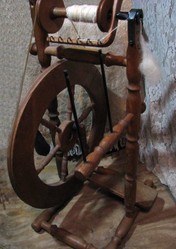
My Louet Wheel

Parts of the Wheel

Treadling

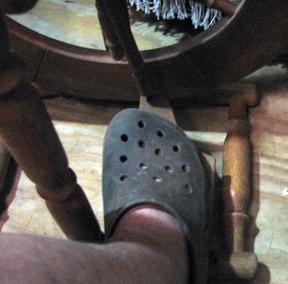
First, get used to the treadle. There are several types of treadles on spinning wheels. Some have double treadles, some only have one. On some wheels, my upright Louet wheel, for example, I can start, stop and change direction all with my foot because of the heel action on the treadle. That was not possible on my old Saxony wheel. I had to use one hand to start the flywheel moving in the right direction. I suspect most Saxony and flax wheels are like this.

Practice treadling without trying to spin. You need a nice slow even rhythm. If you go too slow, the wheel will stop or even reverse direction. If you go too fast, you’ll end up with a thick lumpy rope.

 Treadling

Getting Ready

Once you can keep a nice, even spin going, you can start spinning. One suggestion I’ve heard is to get two balls of commercially spun yarn and spin them together. I’ve never tried this, but it might make it easier to concentrate on the spinning first without having to draft and treadle at the same time.

leader yarn


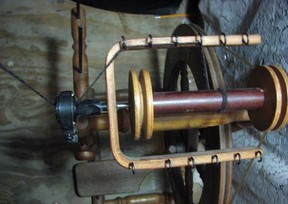
In any case, you first need a leader yarn. Take a length of yarn about a yard long and tie one end firmly around the bobbin. Hook it over the cup hooks and feed it through the orifice. On most wheels you might need a hook to pull the yarn through the orifice. You can bend a paper clip and use that if you don’t have an orifice hook.


Ready to spin

There are a couple of ways to join your wool to the leader yarn. The easiest for beginners is to roll a section of the wool until it makes a bit of yarn. Simply tie this to the leader. For more advanced spinners, fray both the end of the wool and the end of the yarn. Overlap them and fold. Hold carefully as you start to spin and allow that section to overspin slightly and feed in through the orifice as soon as possible so it won’t pull apart.


Starting to Spin

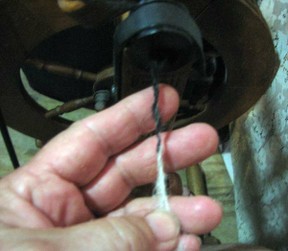
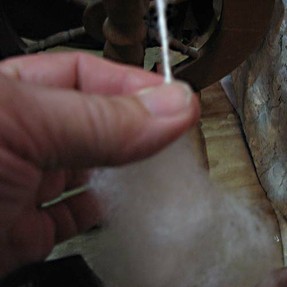
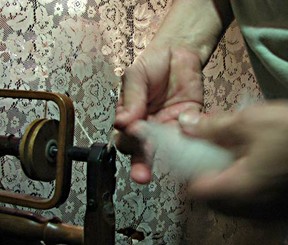
There are a couple of things to watch as you start to spin on a wheel, just as you do with a spindle. First, it’s most important to pinch the yarn between the twisted part and the wool ready to be twisted. Pinch with your dominant hand or which ever feels more natural and keep the twist from moving up the wool. With your other hand, you will gently pull, or draft, the wool evenly in an approximate triangular shape. When the yarn between the pinch and the wheel is twisted enough, slide your pinching fingers up the triangle and allow it to twist. Keep your fingers pinching in the new spot and draft with your other hand.

Pinching the yarn

drafting


My suggestion for beginners is to either treadle clockwise for a few beats, or, if you have a Saxony wheel, give the drive wheel a few spins by the spokes. Let it stop and then use both hands to draft and slide the pinch fingers. Then spin the wheel a few more times and repeat. Once the motions become automatic, you will be doing all at the same time. It’s really one of those things that’s easy to do once you get the feel of it..

Spinning Books

The Intentional Spinner w/DVD: A Holistic Approach to Making Yarn (Book & DVD)
Teach Yourself Visually Handspinning (Teach Yourself Visually Consumer)

Advertisement

What it Looks Like

SPINNING FIBER WITH GRACE

Updated September 20, 2012

Comments about spinning, dogs, the weather....

No comments yet.

Ragtimelil
Ragtimelil
166 articles
FollowMessage

Related articles

  • How to Ply Your Hand Spun Yarn
  • What is a Niddy Noddy and Why Would You Want to Make One?
  • Detailed Clover Pom Pom Maker Instructions
  • Runescape Fans! Make Yourself a Hat for Runefest