St. Nicholas Abbey grounds: repurposing an old sugar cane evaporating pan as large plant pot for garden décor
Saint Peter Parish, northeastern Barbados; Saturday, January 17, 2004, 05:00:25: bixentro, CC BY 2.0, via Flickr @ https://www.flickr.com/photos/bixentro/4632102888/
St. Nicholas Abbey: the old Boiling House complex comprising steam mill, syrup plant, and distillery
Peering above complex (right) is abandoned windmill, providing power for crushing cane before conversion ca. 1890 to steam power, with towering steam chimney (left).
Saint Peter Parish, northeastern Barbados: Charlie Dave, CC BY 2.0, via Flickr @ https://www.flickr.com/photos/charliedave/12483145585/
St Nicholas Abbey front elevation
Saint Peter Parish, northeastern Barbados: Pontificalibus, CC BY SA 3.0, via Wikimedia Commons @ https://commons.wikimedia.org/wiki/File:StNicholasAbbey.jpg
view of mid-17th century windmill that powered cane crushing at St. Nicholas Abbey until replacement by steam mill, ca. 1890
In addition to steam mill, plantation's Boiling House complex includes syrup plant as well as distillery, which was established by Sir John Gay Alleyne (1724-1801) after acquiring St. Nicholas via marriage in 1746.
Saint Peter Parish, northeastern Barbados: Charlie Dave, CC BY 2.0, via Flickr @ https://www.flickr.com/photos/charliedave/12483242333/
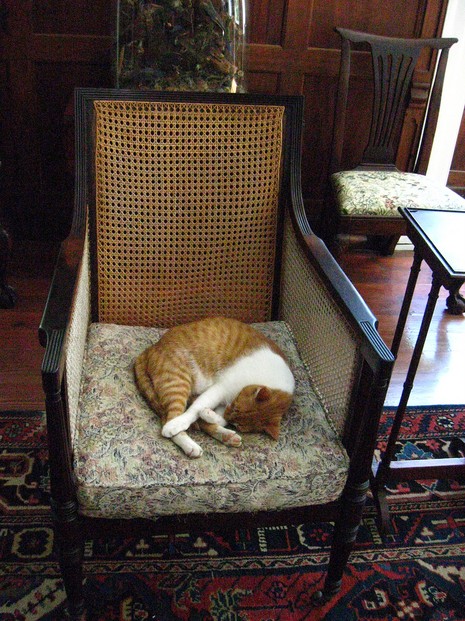
Included in tourists' complimentary feedback about St. Nicholas Abbey tours is appreciation of the Warren family's orange tabby, whose friendliness is encountered inside as well as on the Terrace Café.
Saint Peter Parish, northeastern Barbados; Friday, February 12, 2010, 09:12:14: rufus (rufusowliebat), CC BY 2.0, via Flickr @ https://www.flickr.com/photos/rufusowliebat/4361103655/
southeastern view of Barbados' Atlantic coast from Cherry Tree Hill: spectacular scenery at elevation of 850 feet (259 meters), with avenue of mahogany trees (Swietenia mahagoni) attributed to St. Nicholas owner Sir John Gay Alleyne (1724-1801)
As part of St. Nicholas Abbey, Cherry Tree Hill borders both Saint Peter Parish and its southeastern neighbor, Saint Andrew Parish.
Saint Andrew Parish, northeastern Barbados; Wednesday, May 8, 2013, 15:47:30: lns1122, CC BY 2.0, via Flickr @ https://www.flickr.com/photos/minijoegreen/8739373161/





Comments
DerdriuMarrinerAug 18, 2026
Kumburbjorg endures from Anglo-Saxon England even as it existed by A.D. 797 in Sweden.
The afore-indicated surname is inspired by the Anglo-Norse-Saxon word kumbur burg for "meadows fortified-settlements."
Old Norse originally united vǫllr bjǫrg, for "meadow fort/stronghold."
DerdriuMarrinerAug 17, 2026
The below-designated surname perhaps derives from the drawing together of "Cumbrians" and "stream, valley."
DerdriuMarrinerAug 15, 2026
DerdriuMarrinerAug 28, 2015
Perhaps some intrepid reporter will ask Benedict sometime if he knows why the Abbey is so-called despite having no known cloistered association ;-]!
MiraAug 22, 2015
The story about how Abbey came to be incorporated in the name of this house is plausible but not convincing. But not knowing much about this house and the topic, I don't have other hypotheses. I wish I did though. It's a curious thing.
DerdriuMarrinerAug 22, 2015
DerdriuMarrinerAug 22, 2015
St. Nicholas is authentically and beautifully furnished whereas Bacon's Castle remains sparsely so.
But all are beautiful in their own right.
The story that sounds most convincing to me is the Cumberbatch family (ancestors of Sherlock Holmes-interpreting actor Benedict ;-]!) suggestion of Sarah Cumberbatch honoring the family home in St. Nicholas Parish, Bristol, England and the place of her marriage, Bath Abbey, to Charles Cave (of super-successful banking fame).
MiraAug 22, 2015
blackspanielgalleryAug 21, 2015