
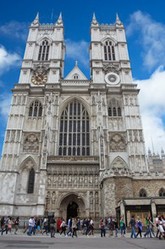
Westminster Abbey is situated just to the west of the Palace of Westminster (or, as it is more commonly called, the Houses of Parliament). The nearest underground station is Westminster - you can see the Abbey from most of the exits, it is across Parliament Square, and it is one of Central London’s most popular tourist attractions.
It is also, since 1066, the home of coronations for British monarchs – William the Conqueror was crowned here on Christmas Day in 1066. The Abbey is a Royal Peculiar, which means that, unlike most Anglican places of worship, it belongs directly to the monarch, rather than a diocese or province.
As long ago as the 10th century, around 960 AD, Benedictine monks were brought to a building on the site by the then Bishop of London, although the original building has gone. By 1065, Edward the Confessor had a new Abbey had been built on the site and consecrated, although only a little of this remains.
Henry III rebuilt the abbey in the Gothic style, in honour of Edward the Confessor (St Edward). Henry wanted to be buried near to his beloved Saint. Some of the Abbey was based on French design, the cathedrals at Reims, Amiens and Chartres being major influences, but the single aisle and long nave were very typically English. Similarly, the arches, with their elaborate mouldings, are very typically English. At almost 102 feet high, the Abbey has the highest Gothic vault in England. When Henry died in 1272, the Abbey was not complete, the Norman nave was not replaced until over a century later. Work on the western section of the nave continued for about 150 years.
It wasn’t until 1503 that Henry VII started work on the new Lady Chapel, to replace the one built in the thirteenth century. This new build is in a completely different style from the rest of the Abbey - built in the Perpendicular style. Why? We don’t know. There is even doubt about the identity of the architects.
In 1745, the West Towers were completed, in Portland Stone, with Purbeck marble used for the floors and walls. More building and restoration took place in the nineteenth century.
Like the nearby Catholic Westminster Cathedral, the Abbey also has a famous choir, made up of 30 boys from the Choir School, and the Lay Vicars - 12 professional adult singers. The choir sang at the wedding of Prince William to Kate Middleton in 2011. The choir tours overseas and participates in a number of broadcasts and recordings.
The organ at the Abbey was installed in 1937, although there has been an organ there since at least the fourteenth century. Organ recitals take place every Sunday, and there is a summer organ festival every year, which is attended by organists from across the world.
As a rule, the Abbey is open to the public from Monday to Saturday, but it is worth checking on 020 7222 5152 prior to visiting, to check that nothing will prevent your visit. The usual entry for adults is £18, although family tickets are available, and reductions for other concessions.
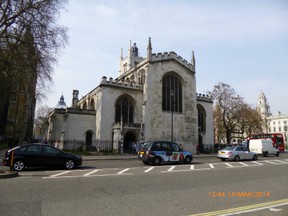
St Margaret of Antioch (St Margaret's) is close by. Details of when the church was originally built are not clear, however, by the end of the fifteenth century, the whole church was in need of repair and reconstruction - work started in 1482, and was finished in 1523. It is well worth a visit, even if you are not going into the Abbey itself. Like the Abbey, St Margaret’s is also a Royal Peculiar.
St Margaret’s is usually open Monday to Friday from 09:30 to 15:30, Saturdays from 09:30 to 13:30, and Sundays from 14:00 to 16:30, but check on 020 7654 4840 before visiting. Entrance to St Margaret’s is free.
The is a café at the Abbey, or there are restaurants and cafes within about ten-fifteen minutes walk, either along Victoria Street, or up near to Trafalgar Square, in The Strand.
Comments
TelestoMar 16, 2014
TolovajMar 16, 2014
TelestoMar 10, 2014
frankbeswickMar 10, 2014
TelestoMar 10, 2014
TelestoMar 10, 2014
frankbeswickMar 10, 2014
KathleenDuffyMar 10, 2014
TelestoMar 10, 2014
MiraMar 10, 2014