
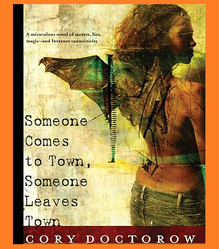

 Cory Doctorow's third novel begins in a Toronto setting about as ordinary as it gets. Alan has bought a property and he's enthusiastically doing it up.
The innards are gutted and every room is lovingly redecorated to perfection. This is a little more than slapping on some wallpaper.
He sands every floorboard down to the planks, then varnishes them again. He replaces every water pipe and electrical wire with new ones. In fact there's more than a touch of OCD in the way that Albert tidies his new living space.
This all serves to persuade the reader just how wonderfully ordinary Alfred is. He's middle aged, middle class, middle of the road Joe Bloggs. Except he isn't. He's not even entirely human. In addition to an unconventional family and a very flexible given name, he has wonderful powers of self-healing.
Nevertheless, he passes for human and does so with an utter desperation born of not wanting to be different. If there is a metaphor here, or some big underlying message, then it's in this very human desire not to be an outcast in society.
 I thought it was an analogy at first. Perhaps Alan got his propensity to have a spotless home from his mother, who was house-proud to the point of distance. She couldn't nurture her children, because she was too busy picking up after them. She did so much laundry that she might as well be a washing machine.
 There is a third story intertwined with the rest. This follows the progress of Alan and his punk friend Kurt, as they attempt to install free WiFi throughout the neighborhood. The venture is made even more interesting by the fact that all of their equipment is sourced from 'junk'.

Comments
JoHarringtonFeb 8, 2013
Darla Sue DollmanFeb 8, 2013
JoHarringtonFeb 7, 2013
HollieTFeb 7, 2013