
Wizzley
PopularLatestDiscussedEditor's Choice
AuthorsForum
Wizzley

A community of writers publishing stories worth your time — on the topics they know and love.

Explore

  • Popular
  • Latest
  • Discussed
  • Editor's Choice

Community

  • Top authors
  • New authors

Service

  • Help
  • Contact
  • Imprint
  • Terms of Use
  • Privacy

Check out our other international Webhaus communities!

Explore another site:English·Deutsch

© 2026 Webhaus LLC. All rights reserved.

RelationshipsLove and MarriageCulture & SocietyHistory, Religion, PoliticsEducationSchool and LearningFamilyKids and ParentingPersonal DevelopmentSelf Improvement, Learning
Article

Hubert Patey - an Indentured Servant

I just discovered that one of my ancestors was an indentured servant from England. I had to find out what an indentured servant really was.

Hubert Patey was born in Yorkshire, England in 1640. At about the age of seven, he became an indentured servant to the family of William Turner and came to Maryland with them in 1651 or 1652. Turner applied for a headright grant in 1654. A headright grant was land given to anyone immigrating to the colonies. More land was given if they paid for the passage of a laborer or indentured servant. "William Turner Demandeth three hunred acres of Land for Transporting himself, his wife , William, Edward and John Turner his sons, and Hebart Pitty (sic), his servant into this province since June 1652." In 1654 Hubert's term of indenture was up, but he wasn't just granted his freedom. .Turner wanted him to stay another year but Hubert declined. Herbert sued Turner for his freedom and called Turner's witnesses liars. They counter sued for libel.

Hubert

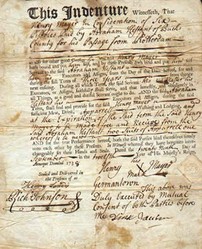
 We don't know how Hubert came to be an indentured servant but it was a common practice in the 17th century for even young children to be shipped to the colonies to work. Sometimes parents died. Sometimes they just couldn't afford to feed another mouth. Some were kidnapped. Whatever the reason, many were transported to the colonies as a source of labor. Their contracts were usually from four to seven years, enough to pay for their passage. Sometimes a father would sign legal documents with a ship captain. The captain would transport the youth and sell his contract to someone who needed laborers.

Sometimes young men and women were attracted by higher wages and opportunities that awaited them after their term of indenture was over.

The majority of white settlers came to the colonies as indentured servants, some say as many as 70-80%. The colonies were short of labor and England laborers were seeing low wages because of the surplus of workers. The population of England had doubled from 2.3 to 4.8 million in little more than a century between 1520 and 1630.  Rising prices and declining wages squeezed the poor and working class while sporadic crop failures led to misery and hunger. 

The Voyage

Many immigrants sold themselves as indentured servants to pay for their passage on a ship to the colonies. Most were young adults from Great Britain and Germany but there were children and families as well.  
The ships that transported indentured servants were overcrowded and the hold where the servants rode had such a low ceiling that the passengers could not stand up straight. There was one ladder leading to the deck but they were not allowed to go outside. The captains feared mutiny.
There were two buckets for toilets that were emptied once a day. They did not have enough food or water and what they did receive often was dirty and contaminated. Many died during the six to eight week voyage, and many of them young children. 
There's a dramatic account about the transporting and sale of indentured servants,HERE.
The Infortunate: The Voyage And Adventures Of William Moraley, An Indentured Servant
White Cargo: The Forgotten History of Britain's White Slaves in America

Advertisement

Being an indentured servant was very much like slavery, with the notable exception of freedom after the contract was up. The holder of the contract had all the rights of a slaveholder. He could punish the servant by whipping. He could add time to his indenture as punishment. He could sell, barter or gamble the contract away. As many as 40% of indentured servants did not survive until the end of their service. Female servants often were at the mercy of male masters. Women who became pregnant while in servitude often had years added to their service time. Many had such a hard life that they ran away or committed suicide. Those that were caught were punished and had more years added to their service. 


The Pettey ReunionHubert Patey won his court case and his freedom in 1654 and, as the record says, he" took off" for Norfolk County, Virginia where he worked as an overseer on an estate. He is the first Patey (or Pettey as it is now spelled) on record in Virginia. He went on to own his own property and to found what is considered the largest branch of Petteys in the United States. Some of the Petteys found their way to Texas and that's where my personal story begins.


Note:

There are also some interesting historical reinactors who have a great web site portraying the live of an indentured servant at Parsonjohn.org. The video clips are especially interesting.

Updated November 10, 2013

Historic Comments

RagtimelilNov 6, 2016

I had put a GEDCOM on FamilySearch but it has been so tampered with that it's beyond hope. I did put a tree on Ancestry(dot)com but don't remember how far back it went but you can always look at that.

Clara WatsonNov 6, 2016

Ha! Yes I've noticed!!! There are so many theories and debates it's not funny. I guess I should have stated my question a little more clearly. I had wondered if the "III" was a typo of some sort. Tempie Petty Was the daughter of William Walter Petty and Lillie Winters. William Walter was the son of Johnson Mannon Petty and Cynthia Peacock. Johnson Mannon was the son of John Petty and Betty (Betsy) Dawson. Going past these names it started getting tricky, and I'm not entirely positive I have it correct! I was just hoping to reach out to someone who might have any info. :)

RagtimelilNov 6, 2016

Hubert did have a son named Thomas Petty but he would not have been the third since he was the son of Hubert. Thomas also named a son Thomas. Years ago someone started the widely circulated history of the Pettey/Pettys with several Thomas's but that has been largely disproved. The Thomas in our line was in court several times charging that he did not get his inheritance from his father, Hubert.
I don't have a Temple Petty in my database but that doesn't mean everything. There are a LOT of Pettey/Pettys out there. I'm finding new ones all the time.

Clara WatsonNov 6, 2016

Would you happen to know if Hubert had a son named Tomas Petty III? I've been trying to track my family line back but it has been rather tricky. My Grandfather, William W. Hendrix's, mother was Tempie Petty, born in Texas.

RagtimelilJul 29, 2016

Well, howdy, cousin! I've recently found that one branch headed for Utah and another branch (my line) ended up in Texas.

S PettyJul 29, 2016

I did some searching and found that Hubert Patey is a direct great grandfather of mine. Very nice to then find your article.

RagtimelilOct 7, 2015

Not it my line, but it's possible.

R.PettyOct 7, 2015

Did Hubert have a grandson by the name of William, who married a Mildred Phelps?

RagtimelilMar 2, 2014

It's amazing what you discover tracing your family roots. I started to feel like they were real people, not just names and dates. I got to know some of them very well.

RoseMar 2, 2014

Wow what a story. Good for Hubert that he sued for freedom and won. Reading stories like this make me feel glad I live in the civilized 21st century!

RagtimelilJan 22, 2014

Yes, a lot did come that way. I did find a record (somewhere) that listed him as an orphan. He was pretty young to be a convict - :)

michael pettyJan 22, 2014

good article so now we have a idea that Hubert was already in service with the turners when he arrived so that pretty much removes the convict possibilities a lot of convicts were being sent over & land owners would buy their sentences

RagtimelilAug 5, 2013

Thank you. It was an education for me too!

cmoneyspinnerAug 5, 2013

This was certainly an educational article.

RagtimelilAug 4, 2013

Thanks Jo. I'll pop right over. lol My biggest question is if his 7 years was up in 1654 and he came over with the Turner family in 1651, that means he was indentured in England about 1647. What did they do until 1651? That's four years. Did they have indentured servants in England that didn't come to the colonies? I can't find anything about that.

JoHarringtonAug 4, 2013

Featherstone is very near Wakefield. You might find some information there, as it's a much bigger place.

RagtimelilAug 3, 2013

Thanks Thamisgth. It has taken us years to find Hubert. There was a mistake commonly believed that we went back to a Thomas Petit. That has been disproved. It sounded good though. There were sheriffs and doctors in that line. But it seems we were really descended from and indentured servant.

RagtimelilAug 3, 2013

Thanks Jo. Some sources say Featherstone. I have read some about the civil war.

ThamisgithAug 3, 2013

Fascinating story. You must have done quite a bit of research to uncover all that. Did it take long?

JoHarringtonAug 3, 2013

This is a fascinating story! 1640 was also the year that the Civil War kicked off in England, though not especially touching Yorkshire. Have you any idea where in Yorkshire Hubert came from?
Ragtimelil
Ragtimelil
166 articles
FollowMessage

Related articles

  • NextGen Genealogy: The DNA Connection by David R. Dowell
  • A Lesson Learned Too Late
  • Who Are My People?
  • Finding a Grave