Wizzley
PopularLatestDiscussedEditor's Choice
AuthorsForum
Wizzley

A community of writers publishing stories worth your time — on the topics they know and love.

Explore

  • Popular
  • Latest
  • Discussed
  • Editor's Choice

Community

  • Top authors
  • New authors

Service

  • Help
  • Contact
  • Imprint
  • Terms of Use
  • Privacy

Check out our other international Webhaus communities!

Explore another site:English·Deutsch

© 2026 Webhaus LLC. All rights reserved.

Food & RecipesCooks and CookingFamilyKids and ParentingHealthNutrition and WellnessCelebrationHolidays and OccasionsParty PlanningThrow A Great Party
Article

Old and Traditional Recipes of Lancashire, England

The traditional food eaten by people in the North West of England was shaped by poverty and an Irish influence from across the water.

When the Industrial Revolution forced country cottagers into the towns of North West England for work, they were obliged to set a basic meal cooking so they could eat when they got home. Irish workers escaping the famine and looking for work came in their thousands to the North West of England and brought their influence to local food. I have a huge respect for how people all over the world have done their best to feed themselves and their families with what was around them and survived against the odds with their own ingenuity. They used economical ingredients and nothing was wasted. With a world recession like we have had in recent years, maybe it is time to go back to the old traditional foods that kept people going centuries ago. I have chosen a few traditional foods from Lancashire, my birth location. The foods had to be very warming because of our climate in North West England. In a nutshell, warming, tasty foods developed out of poverty and climate.
Lancashire hotpot NIgel Haworth — Nigel Haworth
Butter Pie

Lancashire

 Butter Pie ( eaten mainly in North Lancashire )

 Pastry

225g/8oz Plain flour

50g/2oz Butter,

50g/2oz Lard,( Shortening )

Ice cold water

filling

3 Large potatoes 

1 Large onion

50g/2oz Butter

Method

1. Make the pastry blending the ingredients together, add the water and chill the pastry I the ridge for 20 minutes before using

2.  Peel the potatoes and onion, cut the potato into thick slices, Boil the potatoes for 8-10 minutes. Cook the onions,, in the butter until soft, .


3. Line a pie dish with pastry and put in the potatoes, onions and butter flakes, season with salt and white pepper and top off with the rolled remains of the pastry


 4. Bake at 180 degrees for about half an until golden, and serve immediately.


Lancashire Rag Pudding  (so called because it was eaten by raggedy people  in East Lancashire )


Ingredients


1lb mince beef

1 onion finely chopped

Beef stock

Dessert spoon cornflour

Seasoning to taste

Pastry

8 ozs self raising flour

4ozs  beef suet

Cold water

Leave to rest in the fridge for 1/2 hour


Method

1. Put the onion and  mince in a pan and  fry for a few minutes, add stock and seasoning . Cook for 1 hour slowly add the cornflour mixed with water then add to the meat to thicken slightly cook another 10 minutes.

2. Place the flour, suet and salt in a bowl bind it with enough water to form a dough, rest for half hour in the fridge.

3. Roll out the pastry and make a square pie full of minced (ground ) beef mixture. Top with pastry.
4. Bake for 30 minutes in the oven on 180C degrees  
......................................................................................................................................................
Lancashire Hot Pot  ( All Lancashire )
Lancashire hotpot is a dish made traditionally from lamb or mutton and onion, topped with sliced potatoes, left to bake in the oven on a very low heat in a heavy pot and so became a " hotpot "
1 lbs mutton or lamb chops
3 lbs potatoes in slices
1 onion
seasoning
water to cover the meat
optional ( 2 table spoons of pearl barley )
Brown the meat and onions and layer in a dish, add barley if using.Place slices of potatoes on top and pour over the seasoned water and leave it to cook for over 3 hours on a very low heat about 140C.
.........................................................................................................................................................
Eccles Cakes ( all over Lancashire )
1lb flaky/ puff pastry
1 oz butter
8 ozs currants
4 ozs sugar
spice to taste
Roll out the pastry
Melt butter and sugar in pan
add currants
Cut out circles in the pastry and put a spoonful of mixture in each one . Fold over to cover.
slash the top to let steam escape. Sprinkle top with sugar .
Glaze with beaten egg and cook for 15 to 20 mins on high , about 200C
................................................................................................................................................
Lancashire Favourites
Cheeses.
Lancashire Cheeses are my favourite cheeses. There are many local cheese farms making such individual cheeses as Parlick Fell, Inglewhites, Mrs Kirkham's. The larger cheesemakers include Garstang Blue , Lancashire Cheese in 3 types Creamy, tasty Crumbly. Lancashire Cheese even features in Robert Louis Stevenson's classic Treasure Island where Ben Gunn who has been marooned on an island has craved for a Leigh Toaster, the traditional name for Toasted Lancashire Cheese.
.....................................................................................................................................................
Bury Black Pudding
This is a type of blood sausage filled with oatmeal, barley, suet and meat. Bury in Lancashire is home to the best Black Pudding . In Lancashire it would be boiled.
.................................................................................................................................................
Egg dropped in cheese
And for the very poor in South Lancashire, because nothing could be wasted, when the bits of cheese had gone hard and unusable, they would be chopped and slightly melted in a little milk with an egg dropped in and poached in the cheese mixture. This Lancashire cheese mix would be eaten in a bowl.
..................................................................................................................................................

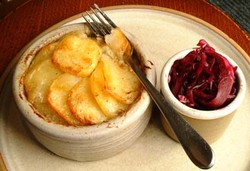


Eccles cakes

Lancashire Pan Hagerty

Pan Hagertys are from across the mountains in Northumberland but this is a Lancashire version .


  • Minced beef - suitable quantity for number of people you are feeding
  • Onions
  • Beef stock -
  • herbs of choice
  • Salt and pepper
  • White potatoes - peeled and finely sliced
  • crumbled Lancashire cheese

Heat he oven to 180C

Fry off the mince and onions in a pan, add the stock and simmer for 10 minutes

Slice the potatoes finely and layer on the bottom of an ovenproof dish , layer the beef mixture on top and finish with a layer of potatoes.

Crumble the cheese over the top

cover with foil and bake in the oven for 45 minutes.


Pan Hagerty

Chorley cakes

These little dried fruit pastries are traditionally eaten with a piece of Lancashire cheese to accompany them.


Chorley Cakes

4 oz self raising )wholemeal flour 
 4 oz self raising  flour
  5 oz butter
  1 oz light muscovado sugar 
finely grated rind of 1 small orange
finely grated rind of 1 lemon
1 tsp Mixed Spice 
4 oz  currants, 
1  beaten egg white
method
1. Lightly grease two baking sheets  

2. Put the flours into a bowl and rub in half of  the butter .

3. Add enough cold water to make a stiff dough.

4. Cream the remaining butter  with 1 oz sugar.

5. MIx in the grated citrus rinds and spice, then add the currants.

6. Divide the dough into 10 balls and roll each into a circle about 4 inches across.

7. Put a heaped teaspoon of the currant and spice filling in the centre of each circle.

8. Bring the edges together over the filling and seal them by pinching firmly together.

9. Turn the pastry rounds over and roll out to a round about 3 inches across.

10. Place on the baking sheets and score the top of each cake with a knife. Brush with egg white and sprinkle with some extra sugar.

11. Bake at 200°C / mark 6 for 20 minutes. Eat when cold .

Morecambe Bay Potted Shrimps

This is an 18th Century Lancashire recipe. Shrimps have been fished off the Lancashire coast for centuries.

Morecambe Bay Potted Shrimps

1 lb shelled shrimps

6 ozs butter

salt and pepper  to taste


Oven Gas 3 or Elec 325 F

Cut the shrimps in half

Melt the butter in a pan with seasoning

Put the shrimps in an ovenproof dish dish and cover with the butter mixture. Put a lid over the dish. Cook for 15 minutes.

Put the shrimps in warmed jars and pour butter over them.

Melt another 2 ozs of butter and pour over the shrimps to seal them.

Put a lid on and refrigerate.

Serve these with fingers of toast.  


Lancashire Foots

These are pastries which were popular with the field workers and miners. They are filled with savouries and were taken to work and eaten cold. They are always eaten in twos and are never called " Lancashire Feet " it is always Lancashire Foots.


Lancashire Foots

1lb shortcrust pastry

6 ozs Lancashire cheese

6 ozs cooked ham or bacon

1 onion finely chopped

seasoning of choice

egg/milk glaze


Pre heat the oven to 375F or Gas 5

Roll out the pastry and cut in to two equal pieces but leave one end of each piece unrolled out to be the heel of the foot

Mix the bacon, cheese and onion and divide equally between the two foots.

Turn the sides  of the pastry up and gather at the top.

Brush with egg or milk and bake for 25 mins until Foots are golden

Eat hot or cold.


Wet Nelly

Wet Nelly

Wet Nelly Recipe

Today I had a day out and saw this old Lancashire recipe for Wet Nelly. It is a moist tea bread and as with everything in old Lancashire was borne out of poverty and not wasting anything at all. Wet Nelly hails from Liverpool, the land of The Beatles. Wet Nelly is a moist, poor-man's version of Nelson Cake hence it is called Wet Nelly. It is made from leftover bread and pastry and soaked overnight to make it moist.


Wet Nelly

1 loaf of old bread cut into chunks

3 ozs of butter

5 ozs brown sugar

1.5 pints of milk

1lb dried fruit

3 eggs

cinnamon to taste


Soak the bread and fruit in warmed milk for at least 4 hours or overnight.

When soaked add the other ingredients and mix together.

Pour into a greased deep sided tin.

Bake Gas Mark 3 Elec 160C for 75 minutes until cooked.


Lancashire Harcake ( Soul-mas cake )

A Halloween treat

Here is a treat for welcoming the deceased souls, remembered at this time of year. Halloween. This was traditionally a ginger cake eaten on Hallowe'en. It is like a Parkin.


Harcake  ( Soul-mas cake )

2 ozs soft butter

1lb fine oatmeal

12 ozs golden syrup

1 oz ground ginger

1 large egg beaten

a little milk to bind

Bake on Elec 350F or Gas 4


Grease a tin 10 by 8 inches

Rub butter into oatmeal and add syrup and ginger. Mix well

Add the egg and then add just enough milk to make a smooth mixture and put it all in the tin .

Cover the top with paper and bake for 90 mins.

Store for 5 days before eating to allow time to mature.


Lob Scouse and Scouse butties

Lob Scouse

Lob Scouse came to Liverpool through Scandinavian sailors and the dish is known elsewhere in Old Europe as Lapskaus in Norway, Labskaus in North Germany, and Labskojs in Sweden.

Whilst there are national variations all use carrot, onion and potato, just like  Liverpudlian scouse Blind scouse has  no meat, but is still  scouse. It also has elements of the Irish Stew traditional and Liverpool is full of Irish people from over the water of course.

The word Scouse became used to refer to anyone from Liverpool. Scousers as they are called .


This is a traditional dish borne out of poverty and full of cheap, filling ingredients and what the poor of Liverpool had.  It can be made with diced lamb or diced beef and is a favourite in our household.    

Lob Scouse

Ingredients   

  • 2 onions large
  • 5 large potatoes cut into varying sizes large to medium
  • 1lb of  lamb or beef diced
  • water to cover
  • salt
  • 2 carrots cut into varying sizes large to medium

Method

Put the meat, salt  and onions in a large pan and cover with water . Cook for 1 and a 1/2 hours on low.

Add the potatoes and carrots and simmer for another one and half hours .

Enjoy.

Leftovers ; Scouse Butties

Leftover scouse was put between two slices of bread and eaten as a  SCOUSE BUTTY.

MALKIN PIE

The traditional dish of Lancashire witches

This dish was traditional amongst Lancashire witches

MALKIN PIE ( an extra dish )

This is an addition that I recently found since writing the above. It is believed to be the traditional dish of the Lancashire witches and eaten at the Malkin feasts although my own feelings are that they would have been too poor to afford this.

It is a layered pie with a shortcrust base infused with thyme .

Then layer 1 cooked ground mince lamb
layer 2 braised leek carrots and celery
layer 3 cooked diced beef and onions
layer 4 cooked diced bacon

Put a suet pastry crust on top. Bake on high for 20 minutes or until golden brown.

Everton Toffee Recipe

There are several versions of Everton toffee but this seems to be the one I preferred when sifting through recipes.

Everton football club in Liverpool was nicknamed " The Toffees " after this delight. A cook named Molly Bushell invented it and it was usually eaten around UK Bonfire Night on November 5th.

It is important to use a cooking thermometer for toffee making

Everton Toffee

1lb brown demerara sugar

1/2 pint of water

8 ozs unsalted butter

5 tbsps. golden syrup


  • Oil a square baking tine 8 inches by 10
  • Put sugar and water in to a pan on a low heat and dissolve
  • Stir in butter and sugar and cook until the mix is a golden brown colour
  • Check temp on a cooking thermometer
  • When it reaches 270 - 280 degrees F  pour it into a tin and leave to cool ,
  • During cooling mark it in to squares
  • Cut when cold or break into pieces


Blackburn Cracknells

savoury biscuits

Cracknells were known as far back as the 15th Century and are a thin flat biscuit which was eaten with cheese.

This is an easy recipe and could have several herb additions for flavour.

Blackburn is a town in North Lancashire.

Blackburn Cracknells  ( serve with cheeses )

1/2 lb plain all purpose flour

2 oz butter or lard ( shortening )

1/2 tsps. of cooking bicarb of soda powder

1/4 pint of warm milk

pinch of salt.

  • Rub the fat into the flour and bicarb powder.
  • Add salt and mix it all in.
  • Add the warm milk and stir it all together.
  • Roll the dough out thinly and cut into rounds.
  • bake Elec 325F or gas 3 for about 30 minutes

Pobs/ Pobbies and Lobs/ Lobbies

and Dip Butties

Last evening, a Lancashire friend asked me if I remembered these as a child. AND I DID.

These were known throughout Lancashire and were usually given to children to fill them up. They are poverty food and show how nothing could be wasted in the cold and poor areas of the North of England.

Pobs and Pobbies

When bread was about a day old and not stale but not as fresh as it was, it would be broken into chunks and put in a cup with warmed milk and sugar poured over it. My friend recalls having this for breakfast. This would be pobs or pobbies.

Lobs and lobbies

Similarly, if there were any meat juices off any meat that was eaten, chunks of bread would be placed in a cup and the meat juices were poured over. This would be lobs or lobbies.

I wouldn't expect anyone to want to eat these now, but this is basic Lancashire food and shows Lancashire's ingenuity in feeding its children.

If bread soaked in meat juices are eaten as a sandwich and not in a cup they are known as Dip Butties.  

Lancaster tart

This is a version of its cousin the Bakewell pudding from nearby Derbyshire in England I am making this for Easter Sunday

Lancaster Tart

Shortcrust pastry to line your dish 


1 jar of lemon curd
2 eggs
4 oz caster sugar
4 oz butter
4 oz ground almonds
 juice and zest of one lemon

Line a  pie dish with  pastry  and spread the lemon curd over the bottom.

Beat the butter and sugar together and stir in ground almonds . Beat  the eggs and pour the mixture over the lemon curd.

Bake 30 minutes or so at 180C, 350F or until cooked .Serve warm or cold.

April 2018 Addition ; Tosset Cakes

This recipe is from the Fylde coast in Lancashire and is considered to be linked to St Oswald. The Fylde area of Lancashire  in the not too distant past celebrated the Tosset Feast where they had a local fair and people ate Tosset cakes. This happened around August 5th each year.

Tosset Cakes

1lb plain/ all purpose flour

1lb of soft butter

6 ozs fine/ castor sugar

2 tsp crushed caraway seeds

1tsp crushed coriander seeds

  • Sieve the flour into a bowl and rub in the butter
  • Add the crushed seeds and mix well to form a dough
  • Leave the dough to cool then roll out and cut out rounds about 2 in across
  • Sprinkle with sugar and place on a greased baking sheet
  • Bake for 15 mins or until cooked on Gas 4  Elec 180C  350F 

Amblet of Cockles

dating from 1764

By request from my Big Bro. xx

Amblet of Cockles dates from at least 1764 and was in Elizabeth Moxon's cookbook.


Amblet of Cockles

Take 4 egg whites and 2 egg yolks,

a pint of cream,

2 ozs flour

grated nutmeg

4 ozs cockles

MIx them all together and brown them in a pan. Serve as a side dish.


Balderstone Cakes

Recipe from 1907

This " cake " is more of a pasty . It dates pre 1907 so ingredient quantities are not always listed..

Balderstone cakes

1lb sieved flour

8 ozs butter

4 ozs fine sugar

1 egg

milk to bind

Dried fruits pre soaked and mixed together.


Make the pastry with flour, butter, sugar and egg and roll out.

Cut into largish circles and place the dried fruit mix on half of the circle of pastry.

Fold the other half over the top and seal the edges together.

Bake in a hot oven until brown.

Heat warm or cold.

Manchester Tart

This was always one of my favourite puddings at school dinners .

There are several variations. I have chosen one. It is so easy and a huge favourite in Lancashire.

Manchester Tart 

ingredients 

One lined pastry case ( shortcrust pastry ) 

Jam of choice 

1/2 pint of thick custard / crème patisserie 

Optional bananas

Optional desiccated coconut 

Method 

  • Bake the pastry base blind ( Put greaseproof paper over the pastry base. Place some baking beans on it and bake for about 20 mins ) 
  • When cool, spread some jam of choice over the base. 
  • Optional : slice bananas over  the jam pour the thick custard / crem pat over the jam/ bananas and sprinkle with coconut.
  • Leave to set and eat cold. 

August 2026; Wigan. - A Pea Wet / A Smack Barm Pea Wet

A Wigan dish

Despite being only 30 miles away, today I found a recipe for a Lancashire food that I have never heard of. A pea wet !  Even in North West England, I have never heard of it. So, what exactly is a Pea Wet ? 

A  Smack Barm Pea Wet 

A SMACK is a deep-fried potato slice 

A BARM is a large, soft bread roll which uses the beer froth as yeast. 

A PEA WET is the liquid left over after cooking mushy peas or lightly pureed peas. 

So, a smack barm pea wet is, .... 

a bread roll with a filling of a deep-fried potato slice covered with the green gooey liquid left over from cooking mushy peas.

..........................

I think I will give this one a miss. 

This is very, very localised to one small town, Wigan, in Lancashire. Nothing is wasted up here in the North West. 

Updated August 9, 2026

Comments

VeronicaAug 11, 2026

I am astonished that you have Yorkshire tea over there.. I love it. Let me know what you think of it. It is my favourite, but may not be everyone's ..."cup of tea "!

DerdriuMarrinerAug 11, 2026

Thank you for your comment below in answer to my previous observation and question.

The vegetables peas and potatoes are among healthy foods that appeal to me even as this recipe attracts me as a curious, one-time attempt that never arises to the culinary, gastronomical heights of a Veronica recipe.

Yorkshire tea, as a drink associated with the Yorkshire area of my maternal-grandmother Winterbotham line and as a Veronica drink, graces my pantry this week!

Kroger stores have Assam- and Africa-tea leaved Yorkshire Tea as Taylors of Harrogate Yorkshire Black Tea and Taylors of Harrogate Yorkshire Gold Black Tea!

VeronicaAug 10, 2026

I only found the recipe this weekend and it does not appeal to me. . It sounds like you made it properly. But I will not be cooking it so i do not know .
I drink yorkshire Tea , which is black tea.

DerdriuMarrinerAug 10, 2026

Thank you for this localized smack-barm pea-wet recipe.

This past weekend I experimented by eating a smack-barm pea-wet.

But Kroger stores likeliest furnish their bakery patrons with bread rolls withOUT beer-froth yeast.

It might not be what typically means anything to me culinarily, gastronomically even as it made a hot, munchable matching acceptably -- despite temperatures at 90-plus/32.2-plus -- this one time my hot-tea snack drink.

I poured the "green gooey liquid" atop the bread roll and over the deep-fried potato slice between the lower- and the upper-roll slice.

Everything was hot in my version.

Would cool or heated or room-temperature or toasted bread work in the localized original invention?

DerdriuMarrinerAug 10, 2026

Thank you for your comment the second comment box down in answer to my previous observation and question.

The Kroger stores here carry under their Premium-Selection label, English-breakfast tea, whose ingredients configure black teas from Ceylon/Sri Lanka, India and Kenya. The afore-indicated ingredient list is what their information not on the box identifies even as the English-breakfast tea product label invokes only "black tea."

The Wikipedia article on English-breakfast tea lists as black-tea sources Assam, Ceylon and Kenya tea estates.

Might it matter in the appearance, scent, taste, texture which part of the Indian subcontinent musters the Indian estate-sourced black tea of the above-mentioned black-tea trio?

VeronicaAug 9, 2026

Today, I discovered a recipe from a Lancashire town only 30 miles away, Wigan. This is definitely not to my taste. Up above, I present from Wigan, " A Smack Barm Pea wet".

VeronicaApr 17, 2024

English breakfast tea and sparkling water for me.

DerdriuMarrinerMar 27, 2024

My Lenten recipes have been borrowed from your recipe pages.

This wizzley is the scrumptious source of lob-scouse, scouse-butty and wet-nelly servings.

This helpful, informative, practical, timely wizzley mentions them as the basic, simple fare of the British poor. So they offer themselves, to my way of thinking, as heads-down, humble, shuffling-feet Lenten fare -- albeit nice-looking, smelling and tasting.

Coffee with ginger-turmeric and senna tea bags tend to be my drinks.

Would hot tea and sparkling water be your drink preferences?

VeronicaMar 2, 2022

Derdriu,
That is great news. If deep-fried cod and vinegar fries is on a menu, I have to, just have to order it. I absolutely love it, esp with salt and vinegar on the fries.
Glad you liked it.

DerdriuMarrinerMar 2, 2022

Thank you so much for the traditional Lancashire way of doing cod!

Last year, I followed what you said and served the scrumptious result with vinegar-seasoned fries: such a crowd-pleaser!

Last night, as a special meal before, but consistent with, Lent, I followed the recipe again because this past weekend there was another cod mark-down that I couldn't resist. Crowd-pleaser again!

The vinegar touch is so delicious that it's what I also choose as my favorite variety now of my favorite Cape Cod chips.

VeronicaJul 31, 2021

I am so pleased it went well. It is a very old traditional recipe. We don t remove the crusts but restaurants do.
With regards to cod. The traditional Lancashire way would be to make a batter with flour, egg and milk, then dip the fish into it to coat it all over and immediately put it into a deep pan of very hot oil for about 6 minutes. Serve with French fries seasoned with vinegar . One piece of cod per person. This s the traditional way to eat cod ..... and it happens to be my absolute favourite. If it is on a restaurant menu, I HAVE to eat it! :)

DerdriuMarrinerJul 31, 2021

Veronica, The Morecambe Bay recipe appealed to one and all, and everyone appreciated the fingers of toast and the white sparkling wine.
But I wonder what your side of the pond does -- if anything -- with removed crusts (which I ate and served to those who like them as well)?
Also, would there be any old and traditional Lancashire recipes that I could use for my incredibly marked-down cod?

VeronicaFeb 20, 2021

So UK shrimps are tiny prawns

VeronicaFeb 20, 2021

Good evening Derdriu
How exciting . we call " shrimp " tiny little prawns . I don 't know what you call shrimp

"Fingers of toast " are what we make to serve with things like pates and pastes.
They Are VERY VERY elegant and provide a different texture to the normal crackers or wafers. Plus the toast can be warm which is a completely different experience having the paste with warm toast.
Toast slices of bread and cut off the crusts and then cut each slice into 6 or 8 rectangles . They can be served hot or cold.
I would serve these with a white sparkling wine.

DerdriuMarrinerFeb 20, 2021

Veronica, What are "fingers of toast"? There's a special this week on cod and shrimp (from this side of the pond, not Lancashire's ;-D) so I'm making up the Morecambe Bay potted shrimp recipe tomorrow late in the afternoon or early in the evening. What would be old and traditional to serve to drink and to eat before, during and after this main dish?

VeronicaOct 28, 2018

Autumn 2018
I have added the Lancashire favourite, Manchester Tart, to the list above. I loved this as a child.

VeronicaSep 29, 2018

Yes.I watched it too.marvellous … I was interested in the veg though .Lancashire mix of carrot and beetroot. I will try that.

Maybe he will read this page.

frankbeswickSep 28, 2018

28/9/2018. Tonight dancer John Partridge won Celebrity Masterchef [ on British television] by cooking traditional Lancashire recipes: starter,black pudding and scallops; main course, hotpot; dessert, egg custard tart. As far as I know, no-one has ever dared to present recipes from the unfashionable North West in a major cookery competition.John is a Lancashire lad through and through. Congratulations, John. You deserve your success! We North Western folk are with you.

VeronicaApr 29, 2018

Balderstone Cakes , Lancashire

I have found a 1907 recipe for Balderstone cakes . It is an unusual Lancashire recipe that I hadn't heard of before. I have added it to the page.

frankbeswickApr 16, 2018

As cockles were not easy to transport and keep fresh this recipe would have been for people who dwelt near the sea.

VeronicaApr 16, 2018

That is true but cockles were not the food of the wealthy in Lancashire so i would assume it was omitted. Cream was available on any farm.

frankbeswickApr 16, 2018

This cockle recipe contains cream and nutmeg, the latter being at one time very expensive, thugh it became cheaper as time went on. This was therefore to be seen as a recipe for someone with a bit of cash.

VeronicaApr 16, 2018

By request ... a traditional recipe for cooking that Lancashire delicacy COCKLES .

I have added it above.

VeronicaApr 15, 2018

April 2018 update
I have found an old recipe from Lancashire's Fylde coast for Tosset cakes and added it above.

frankbeswickApr 15, 2018

Foraged food might be blackberries, which are tasty even if you have sufficient supplies of staples, but limpets are not very nice to eat, though they are nourishing. I have used foraged blackberries, though I have never been sort of food, but I have never needed to eat limpets.

VeronicaApr 15, 2018

Anything that can be foraged is poverty food.

frankbeswickApr 14, 2018

Limpets are famine food!

VeronicaApr 14, 2018

TY . The only old recipe I can find for winkles and limpets is boiled , cooled and served in vinegar.

frankbeswickMar 30, 2018

The historic county town is Lancaster,, but the modern county is administered from Preston, which for non-British readers is at the centre of Lancashire, whereas Lancaster is in the north of the county, and Preston is the larger and more eonomically important of the two

VeronicaMar 30, 2018

What do you think the county town of Lancashire would be ? It's Lancaster and I was sent a traditional Lancaster Tart recipe by an online contact. It is akin to a Bakewell tart.

I have made it twice and it is really delicious. I love anything lemony and I have added the recipe above . I present Lancaster Tart .

frankbeswickMar 12, 2018

Cockles are cooked by boiling for five minutes.What may be of culinary interest is what accompanied them on the plate. Winkles were a popular food for the ordinary folk, so you might seek some recipes using them, though the commonest method was that they were cooked like cockles and served with vinegar. Winkles with vinegar was a very popular seaside snack at British holiday resorts.

frankbeswickMar 11, 2018

I did not say that they were wealthy, but that industralisation brought about some improvement over the wages paid on farms in many cases. It was a matter of poverty in the town or more serious poverty in the countryside.

VeronicaMar 11, 2018

Morecambe Bay has long been associated with shell fish and there must be some more Lancashire shell fish recipes out there

VeronicaMar 11, 2018

..... and most people were still impoverished. I don't know where you get the idea that Lancashire people were wealthy. The industrialists were but the workers certainly were not.

frankbeswickMar 11, 2018

A common resource that you have not mentioned is razor clams, which are quite abundant on the sandy beaches like the extended one at Southport, but there are no recipes for them other than fry them quickly. They are found on beaches in the west and south of England. I imagine therefore that they are abundant in Morecambe Bay, whose shrimps you have mentioned.What also of cockles, which were heavily fished in Morecambe Bay?

frankbeswickMar 11, 2018

Lancashire was an impoverished backwater until the Industrial Revolution.Then its people managed to earn some money; and the result is that Manchester, which is in South Lancashire, became England's second city on both economic and cultural grounds. But despite their new prosperity, the people of Lancashire were still careful with their money.

VeronicaMar 10, 2018

Despite the desperate poverty that Lancastrians lived in, they survived on next to nothing. I take my hat off to them .

Dip butty in a cup is best because you get extra meat juices on a spoon.

frankbeswickMar 10, 2018

Yes, Veronica, you have triggered a long-buried memory of having a dip butty in a cup, but I was not told that it was called a lob.

VeronicaMar 10, 2018

Frank, I have added a sentence about Dip Butties to the page.

This page continues to generate a host of visits.

Thank you to everyone or your support.

VeronicaMar 10, 2018

I used to have my dip butties in a cup and mum said they are Lobs . Dip butties are delicious.

frankbeswickMar 10, 2018

I just about remember pobs,as people spoke of bread in milk with sugar, though I never had them. But I am seven years older than you are. I note that it was the older people who tended to
mention this recipe.

Lobs! Well, I did not know of their being placed in a cup, but a variant form of them is the dip butty, in whch bread was dipped in meat juices. I love dip butties.

VeronicaMar 10, 2018

POBS AND LOBS

Last night a friend reminded me about Pobs and Lobs which were traditionally eaten in Lancashire. I have added it above.

I don't expect anyone to try to eat these but as social history aspect, it is fascinating that these have died out even since I was a child.

VeronicaSep 8, 2017

TY Frank,

I am seeking some rather old and unusual Lancashire recipes . This page generates so much traffic and visitors that I like to keep it updated.

The biscuits are like a very plain cracker and therefore accompany cheese very well.

frankbeswickSep 7, 2017

You are doing a good job in finding old recipes.

VeronicaSep 7, 2017

Blackburn Cracknells
I have found a very old recipe for a savoury biscuit known as Blackburn Cracknells. This is traditionally eaten with Lancashire cheese. They are very easy to make.

I have added it above.

frankbeswickSep 3, 2017

The original account of the witches' trial is still held at Chetham's Library, in Manchester, which is open to the public, though the documents are so precious that you have to be locked in while you are studying them. It is sited in a mediaeval building. I have never visited it, but my mother researched the trial account as part of her personal study for her history course. She came to the conclusion that the physical descriptions of the witches suggested that they might have had a deficiency disease due to inadequate diet. I don't know which one and mother''s study document is now lost.

VeronicaSep 3, 2017

The Lancashire witches should be a post in itself. The trials were during the reign of King James 1st when Scottish kings ruled England . He was OBSESSED with a fear of witchcraft and the entire nation went into an anti witchcraft frenzy during the early years of the Stuarts.

However, this could be an entire post in itself.

frankbeswickSep 2, 2017

The Lancashire Witches were scapegoats for social pressures. They probably cast charms, but what else could such landless, impoverished people do. As for Alice Nutter, the person who gave evidence against her bought her land after her execution. . Is any comment needed?

VeronicaSep 2, 2017

Regarding Soulmas cake.

This cake keeps vey well and is similar to Parkin which is often eaten around Bonfire Night in November.

VeronicaSep 2, 2017

Strange because here also we have had a drop in temperatures. I am sitting here in bed sox as I refuse to put the heating on until October.

Malkin Pie is linked to the famous Lancashire " witches ". They weren't really "witches" at all but desperately poor, starving and simple English people who begged and cursed people. Their trials were a farce. This pie was made and called Malkin Pie. I maintain that these sad women were too poor to afford these ingredients.

DerdriuMarrinerSep 2, 2017

Veronica, July and August stand this year as unseasonably in the high 90s. The drop in temperatures yesterday and today tell me that your hearty recipes are welcome, particularly the soul-mas for Hallowe'en. Were the Malkin witches bad or good?

VeronicaJul 30, 2017

KIMBESA
Yes it is basic food of the people and it helped them to survive very harsh conditions.

kimbesaJul 24, 2017

Very tasty sounding treats!

VeronicaMay 26, 2017

Everton Toffee
New Lancashire recipe

Well not a new one but another traditional Lancashire recipe, this time an 18th C recipe for Everton Toffee posted and updated above

VeronicaMay 23, 2017

Hello Json, what a lovely comment. TY.

It is interesting you say that because although it was basic food of the poor, it was comforting, nutritious and filling. I still cook some of these things and my 4 year old grandson loves traditional food like this.

json formatterMay 23, 2017

My mouth is watering....

VeronicaDec 21, 2016

I have added the Witches pie Malkin Pie to the list

VeronicaDec 13, 2016

Ty for this . Butties have been eaten in Lancashire for centuries.

frankbeswickDec 13, 2016

The word "butty" means a sandwich. It is not slang, but a genuine English word used by the ordinary people. But why do we call sandwiches after a place name? Well, the Earl of Sandwich would not leave the gambling table even to eat,so his servants brought him his meat between two slices of bread, and soon the word sandwiches came into English parlance. So the term sandwich was a form of upper class slang which became established in English. The idiotic story went about that the earl had invented sandwiches. Sheer poppycock. The ordinary folk had used them for many years.

VeronicaDec 13, 2016

Lob Scouse and Scouse Butties

The latest addition to the Traditional Lancashire food page. Liverpool (of The Beatles fame ) food at its poorest yet finest.

VeronicaOct 25, 2016

ty

frankbeswickOct 25, 2016

For the benefit of non-Catholics, All Hallows Day is the first of November, and it celebrates all the saints in heaven. All Soul's day is second of November and remembers those souls in Purgatory, the transitional state for those still not ready to be in heaven yet not doomed to Hell. On this day Catholics pray for those still in Purgatory. Why there was a specific Soul-mas cake I know not, for I have not heard of the custom before in any other place. I suppose that some meals and recipes just become traditional in a place.

VeronicaOct 25, 2016

That's very interesting especially as it is a Soul-mas cake for All Souls as opposed to a specific Halowe'en cake

frankbeswickOct 25, 2016

Recipes for traditional feast days are rooted in Catholicism, as Protestantism did not celebrate these days. Thus the recipes are definitely mediaeval in origin.

VeronicaOct 24, 2016

Especially for Halowe'en

I have found a traditional recipe which combines this time of year with Lancashire, the home of the so called Pendle witches.

Above I present Lancashire Harcake or Soul-mas cake as it is sometimes called. It is like a traditional English Parkin ( oatmeal cake)

VeronicaOct 5, 2016

This page gets so many viewers that I feel it is a privilege to find as many of Lancashire recipes when I can.

Thank you. My stick- thin husband ate a large slice of this today.

frankbeswickOct 5, 2016

Your research is commendable. You have unearthed a recipe that very few people, even those in Lancashire, have ever heard of. I know that I have never heard of it before.

VeronicaOct 5, 2016

Wet Nelly ( another recipe above )

I found this old Lancashire recipe today called Wet Nelly. It is a moist tea-bread borne out of poverty and a necessity to waste nothing.

Enjoy

VeronicaSep 10, 2016

Lancashire Foots

I have added a recipe for Lancashire Foots to the page above.

Thank to all for you continued support and interest in this page.

frankbeswickSep 1, 2016

We are in agreement on this matter.

VeronicaSep 1, 2016

Walking across Morecambe Bay should never be attempted without a trained guide. I wouldn't even go across Morecambe Bay with a guide.

frankbeswickSep 1, 2016

I would like to advise those considering going to Morecambe Bay that while it is a lovely place and the sandy beach near the shore is safe, if you stray out of the safety zone there are serious dangers such that the bay should only be traversed by experts with local knowledge. Follow the safety warnings. See my article on Wizzley, The Gathering Tide:a review. The cockle beds are now closed by law to allow for regeneration. Shrimping, as far as I know, continues.

VeronicaSep 1, 2016

You are quite right. I have looked through my old cook books and also my Lancashire recipes books and can't find specific recipes for razor clams or cockles that pertain to Lancashire specifically. I do keep looking though as this page attracts a lot of traffic.

frankbeswickAug 31, 2016

Morecambe Bay cockles are an old Lancashire tradition, but whether there were or are specific recipes for them is not clear to me. The basic treatment for cockles is boil for five minutes and discard the ones that don't open.

VeronicaAug 31, 2016

TY yes I am just finding old and traditional recipes not really new ones. The page statistics word stats show that people key word things such as traditional Lancashire food etc... so I want to keep it to that.

frankbeswickAug 31, 2016

Have you thought of recipes for Morecambe Bay cockles. They were very popular until over-fishing by gangs of poachers led to the cockle beds being shut.

VeronicaAug 30, 2016

yes most shell fish can be substituted in recipes

frankbeswickAug 29, 2016

Razor clams are much bigger than shrimps, but are caught in smaller numbers than shrimps are. I suggest that they might have been used along with mussels in shell fish dishes.

VeronicaAug 29, 2016

I will look out for razor clams recipes that pertain to Lancashire. Morecambe bay potted shrimps are a traditional food though.

frankbeswickAug 29, 2016

Morecambe Bay is great for shrimps, but I suspect that there are areas of the Lancashire coast near Southport or Formby where you an also catch lots of them. By the way, razor clams are found on beaches in western England, I saw plenty of evidence of their presence on Southport beach, so do you know of any recipes that use razor clams?

VeronicaAug 29, 2016

Thank you for the messages asking for more Lancashire recipes. I continue to look on your behalf. Today. I have found an 18th Century recipe for potted shrimps and have written it up above.

It is simple and nutritious and looks delicious.

TY for all the support for this page.

VeronicaMar 29, 2016

I think you would enjoy it . I's a very old, simple but tasty one.

frankbeswickMar 29, 2016

The name pan hagerty rings a bell. By mentioning it you have dragged up a long forgotten memory.

VeronicaMar 29, 2016

Lancashire Pan Hagerty

Thanks to those we have messaged asking for more Lancashire traditional foods. This one above is a simple to make one and very nutritious. Lancashire Pan Hagerty.

frankbeswickFeb 18, 2016

Lancashire hotpot was traditionally made with scrag end of lamb, which I think is a dialect term for the neck chops, which were cheap. Sheep meat has always been cheap in England compared to beef, as England is a land with a history of sheep farming. Scrag end was one of the cheaper cuts of this cheaper meat. Don't listen to any nonsense about the roast beef of old England, only the rich ate it. The poor ate sheep and pig when they could get it.

The use of barley in hotpot is linked to the fact that wheat does not grow well in Northern England, and in fact it is mainly confined to southern regions,particularly drier ones, whereas barley is our local cereal, as it grows well in our region. Oats will grow in Lancashire, but barley is the main cereal.

VeronicaFeb 18, 2016

I occasionally work at a museum in East Lancs and I think I heard the expression there.

VeronicaFeb 18, 2016

I don't eat offal but I know it was a dish for the poor at the time.

frankbeswickFeb 18, 2016

Heart takes some time to cook, so I infer that ox heart would have cooked long in the oven besides the fire.

frankbeswickFeb 18, 2016

Your spelling is quite likely to be right, though I suspect that there is no standard form of what is a dialect word.

VeronicaFeb 18, 2016

This is very interesting information thank you. I have never had heart. I have heard of a ham hock called a pestle or shank but like yourself am unsure of the spelling. I think that Ham Pestle is a SE Lancs expression.

frankbeswickFeb 18, 2016

Swede would have been useful as it is a cold-hardy root crop that is harvested in Autumn [Fall] into early winter, when other crops were scarcer. People would have got the swedes from Lancashire farms, but to grow this crop in bulk Lancashire farmers would have had to lime their soils, as the organic soils of Lancashire are not rich in the lime that swede, a member of the brassica family needs. This lime would have come from the Pennine Hills nearby. But Lancashire was great for market gardens at one time.My father remembered eating lettuce from Ashton Moss, a large area of drained swamp then used for market gardens and small farms, now sadly a shopping centre. There still are a large vegetable farms on Chat Moss. So vegetables were readily available, and many folk used to grow a few in pots in the back yard.

I think it worth saying as well that bones were used to thicken broth,as newly stripped of flesh they contain juices and soluble substances that add nourishment to the broth. Many people ate offal:liver,kidney, brains, pancreas, tripe. I can recall my mother cooking ox heart, which done properly is quite delicious. Pigs trotters were popular across Northern England.

Northern English dialect sometimes referred to a ham joint as a pessul [I have heard the word but don't rely on my spelling it, as I have never seen it in writing, so people used to have access to joints sometimes. In our old home in central Manchester, where I dwelt until five years old, we had a range fore with a hob on one side and an oven on the other, where mother used to cook joints from the heat of the coal fire. We had a cooker as well.

Crumpets were sometimes in Lancashire parlance known as pikelets, a term derived from Welsh, which is still used for finger shaped crumpets.

VeronicaFeb 18, 2016

For those who have messaged asking for more traditional Lancashire recipes on occasion, I have added one more today. Thank you for your interest and support.

VeronicaJan 5, 2016

Thank you. I think that local recipes are the food of the people, developed out of their need and will to survive terrible conditions and therefore should be recorded as a tribute to them.

sandyspiderJan 4, 2016

Thanks for the recipes. Looks so good.

VeronicaDec 26, 2015

Thank you . I shall add Lancashire recipes on occasion as I can.

Mashed carrots and swede

This is a dish which started out with an Irish influence in the North West of England and is still as popular today as ever. I have given this to overseas guests at my house and they always enjoy it.

500gr of carrots
50gr of swede
Butter,
salt and pepper
seasoning of your choice

Cut the vegetables into pieces
Boil them in salted water for about 25 minutes until soft
Then mash them together with a knob of butter, salt, pepper and seasoning of your choice.
If it is a bit dry add some orange juice
Put in the oven for 5 or 10 minutes to heat through.

Enjoy hot with meat or fish.

informatica training in chennaDec 25, 2015

The northwest region of England has a long tradition in speciality dishes and local delicacies. Many are as popular as they ever were and some, rather sadly, have been gradually forgotten. We appreciate that this is not an exhaustive list, but would welcome any suggestions on additions - please name and describe the dish that you suggest and tell us something about it that will be informative to other readers.

frankbeswickDec 24, 2015

Some of the large estates sold off rabbits killed by gamekeepers, which is where the butchers obtained them. Our family did not eat rabbit,but retained the tradition of eating goose at festive time. Pork also had a place in the culinary agenda.

VeronicaDec 24, 2015

Ha, yes much of it is substantial and tasty.

For Christmas dinner the Lancashire poor would have had a rabbit. The better off would have had beef .

I never had rabbit for Christmas dinner but some older members of my family did.

Have a lovely, peaceful Christmas.

MBCDec 24, 2015

All I can say is YUM!

frankbeswickSep 18, 2015

You are correct about acorn bread, but it is not sufficient to powder it down, as you must blanch the acorns first for a few hours to ready them, and then they are powdered. I do not know how well acorn flour rises when yeast is added. However, a single oak tree can produce a mass of acorns, food for pigs and people.

The poor would have foraged by roadsides for herbs such as Fat Hen and Good King Henry, which are prolific. I have noted that Good King Henry seems the more common of the two in Lancashire. Dock and sorrel can be eaten, as can dandelions [but not the stem.] Nettles could be boiled and eaten, and ground elder can be foraged in many places. B

VeronicaSep 18, 2015

One of the main foods of Tudor poor in Lancashire was acorn bread, Powdered down acorns mixed with water and cooked over the fire.

The poverty in Britain was unimaginable.

frankbeswickSep 18, 2015

Northern English peasants kept pigs if they could, but a cow, if they had a bit of land, would have been kept for milk. Its male calves could be eaten as veal, but this would have been an extra. Those who kept herds of sheep might have had access to lamb sometimes, but mutton would have been more common, as they ate old sheep past their lambing time. These probably had to be well boiled. Rabbit was off the menu, as it was kept on rich men's lands and poaching was illegal. This sounds a bit grim, but some country folk were not averse to eaten surplus kittens.

A genuine poor person's diet in the North would have included barley and oats, not wheat, leeks, onions, carrots, cabbage and kale, beans and peas. Foraged berries and fruits would have been extras. During Autumn many ordinary folk used to forage for hazel nuts in woodlands, where they sometimes would send a pig to forage on fallen acorns and beech nuts for free.

So any dish that involves meats that were expensive was not an ordinary person's dish.

VeronicaSep 17, 2015

I agree. These dishes are invented and then passed off as the food of the poor. Look beyond the supposed dishes and decide what would have been realistic for them to eat.

frankbeswickSep 17, 2015

You are probably right about the Lancashire witches being too poor to afford malkin pie, While lamb might have been an occasional luxury for these inadequate people, beef would have been well beyond ordinary folk. I detest the myth that roast beef used to be Englishmen's food. Leeks, carrots and onions were staples for them.

VeronicaSep 17, 2015

MALKIN PIE ( an extra dish )

This is an addition that I recently found since writing the above. It is believed to be the traditional dish of the Lancashire witches and eaten at the Malkin feasts although my own feelings are that they wold have been too poor to afford this.

it is a layered pie with a shortcrust base infused with thyme .

Then layer 1 cooked ground mince lamb
layer 2 braised leek carrots and celery
layer 3 cooked diced beef and onions
layer 4 cooked diced bacon

a suet crust on top . bake on high for 20 minutes or until golden brown

VeronicaSep 10, 2015

Lancashire is my favourite cheese and there is a Cheese Trail and Walk around Lancashire villages in the Trough of Bowland. I would like to do that one day.

frankbeswickSep 10, 2015

There are three varieties of Lancashire cheese. Young Lancashire; mature, tasty Lancashire; and crumbly Lancashire. The first two can be made by traditional methods, but the third and the youngest variety of the trio is made by modern cheese making methods.

Veronica speaks of the climate of North West England, where Lancashire is situated. Its problem is that it is damp. Rains are not always the most intense, but they come often, and Manchester, in South Lancashire, has always had a reputation as a rainy city. We don't get the worst frosts, but the weather is not really warm for long periods. The result is that when combined with the air pollution that used to occur, the conditions were somewhat unhealthy and chest diseases abounded.

VeronicaSep 9, 2015

Today, I was out and saw a snack meal on a menu for a toasted sandwich containing Lancashire cheese and strawberries. I did not choose it but my son did and surprisingly said it was delicious. So there you go toasted Lancashire cheese and strawberry sandwich.

VeronicaSep 2, 2015

In answer to a question, next to the picture of the Lancashire Hotpot is a great northern delicacy . Lancashire Hotpot is usually served with red cabbage or pickled beetroot. The best pickled beetroot recipe any where on the web is on Chef Miles Collins website.

Red cabbage though takes about an hour to cook very slowly and close to the end of cooking time, we add sliced apple and onion. Lancashire Red Cabbage, wow. It is also pictured next to the Butter Pie.

VeronicaAug 31, 2015

Yes I mentioned Mutton in my list at the start. Nowadays , hogget or tegg are more popular being older than lamb and younger than mutton. Mutton itself is very expensive now as it is mainly organic.

My husband and sons are great fans of mutton but I tend to get hogget for them. It is more easily available.

My Caribbean pupils have tended to eat mutton or goat.

frankbeswickAug 31, 2015

One important element in Lancashire dishes was mutton. Hot pot used mutton chops as part of the recipe. Mutton was an important part of my childhood diet, though few people eat it now. It has been replaced by lamb, though the Caribbeans in Britain still make use of it in their cuisine, so I am told.

VeronicaAug 31, 2015

Thank you it was surprisingly good. Potatoes, onions and seasoning with flecks of butter here and there.

We have three wonderful butchers in our village, small, independent businesses. Their meat is so much better quality than the superstore meat. I think it is better to eat less meat but better quality from a good butcher. So eating meat free meals such as butter pies is a good idea on non meat days. Some people add grated cheese over the potato and onion mixture in the Butter Pie. That is more Mid Lancashire though.

candy47Aug 31, 2015

Butter pie sounds wonderful. I'll make that today. I'd like to make the eccles cakes too but I'll have to use raisins (no currants on hand).

VeronicaAug 29, 2015

Thank you Katie.

This is a North Lancashire recipe and I only encountered it about 3 years ago because it is so localised. ( I was born in South Lancashire but live in Cheshire. ) When I heard the name butter pie I imagined it was full of butter so was pleased to find that it is just potato, onion and some butter for moisture. I have this evening posted some Irish traditional recipes

katiem2Aug 29, 2015

Interesting and oh so traditional, the pie is something I have got to try, the ingredients, potatoes, are curious, a must try for sure. Thanks for the traditional recipes from England.

VeronicaAug 28, 2015

Fortunately, ... Haggis wasn't a traditional Lancashire dish. There are many more dishes from old Lancashire. I merely listed a few here.

frankbeswickAug 27, 2015

I agree. I have tried to eat tripe and failed. But I love haggis , which is traditionally a stuffed sheep's stomach. My wife sometimes buys me haggis as a present.

VeronicaAug 27, 2015

I would be surprised if anyone ate tripe these days although I know the Lancashire folk ate it in times gone by. The sight of it puts me off.

frankbeswickAug 24, 2015

Yes, tripe is the only meat that I don't eat. When mentioning tripe I was doing so for historical and etymological reasons, not making a culinary recommendation.

VeronicaAug 24, 2015

Frank ; TRIPE

Tripe is revolting. I can't even look at it. The Lancashire Poor had little option but to eat it .

I don't have to, luckily.

VeronicaAug 20, 2015

Writer's Artist. I agree. I have been to Paris and eaten in fancy restaurants but in France, the best food is found in the villages, freshly cooked, basic food of the people. Yummy indeed.

frankbeswickAug 20, 2015

An interesting point about the term humble pie. It refers to a recipe for a pie made out of umbles, deer tripe, which was eaten by the poor,Tripe is an animal's intestine.

WriterArtistAug 20, 2015

The humble pie of the poor could be so delicious. Actually, I find the roadside food more delicious and filling than a five star restaurant for obvious reasons. You don't really need exotic ingredients to churn out yummy recipes, simple and fresh local food is best.

frankbeswickAug 18, 2015

There were not specific dates, and I know that conditions in 1955 were better, but I cited the rabbits' hanging in the butcher's as evidence of what people ate. Note that I called him a traditional butcher and made clear that he was at the end of a tradition. However, the urban poor of the nineteenth century shared in the Victorian belief in self-reliance, at least some did, and they took up allotments when offered and sometimes grew what they could in boxes or frames in the yards. Obviously this was not done by everyone, such as those in back to back accommodation. But there was in Lancashire a strong belief in self-improvement, which took different forms.

VeronicaAug 18, 2015

Frank, What dates for Manchester urban poor are you talking about ? !The conditions of the Manchester urban poor had vastly improved in your inner city childhood from the Victorian era. It's a vast time scale.

frankbeswickAug 18, 2015

The vegetable component of Northern, urban diet often came with bread baked from wheat, and from potatoes. A large market for cheap potatoes grew up in the nineteenth century. It was this market that gave us the Irish potato famine, as the variety grown in Ireland, the lumper, which was sold to the English poor, was very prone to potato blight. No one grows this variety any longer. There might at times be turnips available, as the farmers sometimes sold off surplus turnips.

Many urban poor had back yards where they might rig up a bed for vegetables. They would feed them on manure dropped by horses, which were still widely used before the modern age. Some urban poor kept chickens in their yards, and Manchester was the only city to actively refuse to ban urban chicken keeping. Some urban poor kept allotments. Some kept window boxes for herbs, and at times those who could get to the country on Saturdays and Sundays used to forage for blackberries when they could.

Churches and abbeys did have vegetable gardens, but the Catholic church was smashed by Henry the Eighth, and what was put in its place was less good for the poor than the kind hearted Catholic church was. And yet our British history books used to tell us that the Reformation was good for Britain. Absolutely untrue. The poor suffered from it, but they were written out of official history.

I do like rabbit, Veronica, but it lacks calories and is not very nutritious.

VeronicaAug 18, 2015

Yes Angela's Ashes is a good depiction of Limerick, Ireland where my Gran's family were from and shows life in the 1930's and 1940's I believe when things were slightly better than in Victorian Times. The mill towns and cities in Victorian Lancashire and Yorkshire, England were worse and so food had to be filling and cheap as seen above. Veg was seen as a luxury unfortunately.

MiraAug 18, 2015

I just googled it and remembered I saw a very poignant movie about these slums. The living conditions were, indeed, appalling! I'm trying to remember the name of an actress in the movie...
P.S. It's Emily Watson and the movie is Angela's Ashes. It was about poverty in Ireland, actually. Very, very good movie.

VeronicaAug 18, 2015

IT is difficult to put across just how appalling conditions were for the poor and working classes in the North of England. I suggest people " Google Image Victorian Manchester Slums " to get an indication of living conditions. The poverty was indescribable.

My ancestors left Ireland in search of a better life in Manchester. And this is what they came to!

MiraAug 18, 2015

This is all fascinating to me, because I know that churches/abbeys had always had gardens, and used many veggies and herbs. So maybe it was just the churches. Very interesting.

VeronicaAug 18, 2015

Great comment. Fantastic . Yes indeed they are. You highlight a major problem with the health and the diet of the North of England poor in past times. An Irish ancestor was dead by the age of 39 of Consumption and her little children cast into a Manchester workhouse like "Oliver".

But these are the traditional old recipes. Vegetables were not readily available in Lancashire inner cities and there were not seen as a priority. Potatoes, parsnips were available but there were no gardens, no way of keeping food fresh. The place was plagued with rats and mice. The benefits of vegetables weren't as well known then.

MiraAug 18, 2015

This was very interesting to me but I'm surprised there aren't very many vegetables. Veggies are cheaper than beef, aren't they?

VeronicaAug 18, 2015

Rabbit of course was the traditional North of England Christmas dinner meat. The middle classes would have had beef and the upper classes Turkey, although Turkey is now generally available to all and is the main Christmas meat. We have Gammon and Chicken at Christmas.

Rabbit is one of the few foods that I dislike intensely.

frankbeswickAug 18, 2015

A food ingredient available to ordinary people would have been parsnips, which are sweet and therefore provide calories. These were often eaten roasted or as part of stews. They were often used in place of carrots.

Ordinary folk often ate rabbit. I lived until I was five in. inner Manchester, and near us was a traditional butcher, whose shop used to have rabbits hanging up awaiting sale. But when we moved the butchers seemed more modern, and they had no rabbit. Maybe our butcher was an old person clinging to old ways/

VeronicaAug 18, 2015

That is the Irish Influence of course. If It were an Irish stew the difference would be that the potatoes are not sliced but are in different sizes throughout the lamb stew. The small potatoes "dissolve" down to make a lovely thick texture to the dish. Lancashire hot pot has the potatoes sliced on top of the meat and onions.

I can leave it in the oven on very low and come home to a hot cooked meal in our North of England winters, which ... :) ... can be quite severe some years. Our lowest temperature in recent winters was -25C So you can imagine that in past centuries with no heating the poor had to have warming food. My ancestors of course brought their Irish food ideas with them.

My husband is from the south of England and had never had potatoes added to stews before. Now he loves Irish/ North of England food.

blackspanielgalleryAug 18, 2015

I like just about anything that requires potatoes. Looks like an interesting dish.
Veronica
Veronica
130 articles
FollowMessage

Related articles

  • Lancashire ;- The Pendle Witches
  • Speke Hall, Liverpool
  • Czech Republic Comfort Food: Chestnut Cake With Chocolate Whipped Cream Frosting
  • Authentic Chinese Food vs. Americanized Chinese Food