Wizzley
PopularLatestDiscussedEditor's Choice
AuthorsForum
Wizzley

A community of writers publishing stories worth your time — on the topics they know and love.

Explore

  • Popular
  • Latest
  • Discussed
  • Editor's Choice

Community

  • Top authors
  • New authors

Service

  • Help
  • Contact
  • Imprint
  • Terms of Use
  • Privacy

Check out our other international Webhaus communities!

Explore another site:English·Deutsch

© 2026 Webhaus LLC. All rights reserved.

Culture & SocietyHistory, Religion, PoliticsBeauty & FashionClothes, Hair, BodyCelebrationHolidays and OccasionsTravelVacations and ExcursionsWeddingsEverything but the groom
Article

Why is the Cockpit of an Airplane Called a 'Cockpit'?

What does flying a plane have to do with fighting cockerels? How did the word cockpit come to be used in aviation?

The English language is a curious beast. A cocktail of influences and a fluidity with the passing centuries has made it rich and interesting, but it's also downright weird at times. For example, what does a cockpit (an arena in which cockfights are held), have to do with a cockpit (the flight deck of a plane or spacecraft)? How did the word morph so drastically, or is there a link between the two definitions?
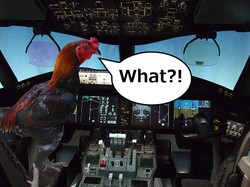
Cockerel in a Cockpit

From Cockfights to Dogfights

The winding history of the word 'cockpit'

Cockpits originally meant exactly that: cockpitsThe word cockpit was first used in the latter part of the sixteenth century, and was, as mentioned above, used to mean exactly what it suggests it means: a pit in which fighting cockerels did what fighting cockerels do for the entertainment of bloodthirsty spectators.

However, it didn't take long for the meaning to be transformed. It was quickly taken on to mean any locale were battles took place.

And, in around 1599, Shakespeare (being a great one for creating and transforming the meaning of words), was even using it to refer to his theater, "Can this cockpit hold the vasty fields of France?" Henry V, Prologue.

So far, it's making sense. Cockpit = fighting, so that's fair enough. And the Globe Theatre was a pit-like structure, so that's not such a stretch, either.

But how did we go from there to planes?

'Cockpit' in The Eighteenth Century

Well, the route went via boat.

In the early eighteenth century, cockpit began to be used to refer to the lower deck in the aft of man-of-war craft; the part of the ship where wounded men were taken. Presumably, the word was borrowed for this purpose because that section of the ship was, to put it mildly, grisly. With lots of blood, death and a confined space, it wasn't dissimilar to the original meaning of cockpit.

From the dumping ground for the wounded, 'cockpit' took another slight shift. This time, being used to mean the well (or pit), of a ship, where the steering controls were housed. Because it was below decks, it too resembled the pits used for cockfights.

Moving Up in the World

Cockpit came to be a naval termHowever, it was via this usage that the definition became far less literal.

No longer was 'cockpit' simply associated with spaces that could be likened to a cockpit.

Now, it was being used to mean the place from which a vessel is steered.

It's not difficult then to see why the word made the leap from water to air in the first half of the twentieth century. And, indeed, to cars in around 1930.

So, there you have it: from cockerels, to aircraft...with a 200-year layover on boats. 

For More on the Origins of Words

Why Do We Say It?: The Stories Behind the Words, Expressions and Cliches We Use

$8.89 $9.95

Word Origins And How We Know Them: Etymology for Everyone

$9.99

Dictionary of Word Origins: The Histories of More Than 8,000 English-Language Words

$10.39

Advertisement

Updated May 13, 2014

Comments

TelestoAug 23, 2014

Ah so now I know! I love things like this, thank you.

WiseFoolJun 5, 2014

Thanks, Brandon. It certainly did go on quite the journey! Glad you enjoyed reading about it.

lobobrandonJun 5, 2014

First the battle arena, then it went sailing across the seven seas. After all that hard work one would expect it to be in a high spot lol... Nice read. Had no clue that's how it began.

WiseFoolJun 1, 2014

Thanks, Nate and Jo. Always great to hear that others find these geeky things interesting, too!

NateB11May 26, 2014

That is fascinating and I love learning about the roots of words and phrases.

JoHarringtonMay 24, 2014

I love stuff like this! And that's one I didn't know. Thanks for sharing!

WiseFoolMay 14, 2014

Thanks, Dustytoes glad you found it interesting. And thanks so much cmoneyspinner, the tweet's much appreciated!

cmoneyspinnerMay 14, 2014

Tweeted for #WizzleyWednesday. It's my way. Happy Hump Day!

dustytoesMay 14, 2014

This is not something I've ever even wondered about, but now I know. Love your image too.

WiseFoolMay 13, 2014

: ) It's a pleasure!

GuestMay 13, 2014

My fact for the day. Thank you.

WiseFoolMay 13, 2014

Thank you, Mira. It's a fascinating thing language! The current definition of some words seems to have absolutely no connection with their original, and I'm always intrigued to track that change back.

MiraMay 13, 2014

Interesting :) I often wonder about words and phrases like that myself, too.
WiseFool
WiseFool
73 articles
★ Editor's Choice
FollowMessage

Related articles

  • Words We Should Use More Often in the United States
  • The Color Blue: What Does It Mean And Symbolize?
  • Supercalifragilisticexpialidocious Meaning
  • English Phrases and Their Origins